Polish Club – Thursday Morning 18th September 2025.
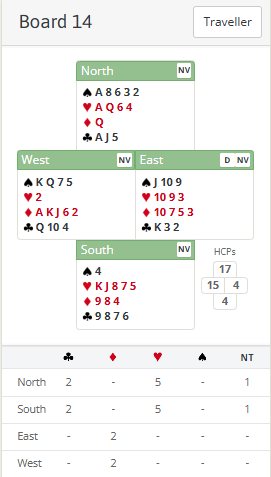
For some reason it looks like different boards were played at the two venues last Thursday. So I have picked a hand here from the Polish Club session. Apologies to those in the City session. Hopefully this was a one-off.
When you hold 54 in the majors and shortage in the opened minor it’s often a dilemma whether to overcall your 5 card suit or start with a takeout double. Board 14 was an example last week – and it made quite a difference to the contract reached!
The auction is likely to start with 2 passes to West who will open 1♦. North clearly wants to bid but what? He has a diamond shortage and support for the other 3 suits which suggests double. On the other hand he has a 5 card major which suggests 1♠. What to do?
As so often there isn’t a perfect answer – either approach could work well on any particular hand.
On this particular hand double is likely to work better. South will respond 1♥ which North should raise – showing a better than minimum takeout double. Now South could consider having another go – it’s important to understand that when he responded 1♥ he could have had a 4333 zero point hand – he is basically forced to bid (he can hardly leave 1♦x in). So in THAT context, his hand is actually quite good – 4 points when he might have had 0, 5 hearts when he might have had 4, a singleton spade and no values in the opponent’s suit. It’s still dubious to move but it would be right to do so on this hand since North South can make 4♥!
The other action from North would be a 1♠ overcall. Here that could work out disastrously because it’s very likely to become the final contract! Clearly neither East nor South can bid over it so it will come back to West. Even though he holds 15 points he should definitely pass it out. See advanced section for why.
These days though, I think more experts would overcall 1♠ than double on the North hand. Why? Let’s consider the plusses and minuses of each approach.
Double has the advantage of being more flexible – it effectively shows 3 suits which increases the chance of finding a fit in one of them. But it means a 5-3 spade fit will almost certainly be lost – partner is extremely unlikely to ever bid a 3 card spade suit in response to a takeout double when he will be sure you only have 4. Double also takes up no space in the auction which may make things easier for the opponents to bid to their contract.
1♠ will ensure a 5-3 spade fit is not lost and it also takes up some more space in the auction which may make it harder for the opponents to bid. But it appears more unilateral as it only shows 1 suit (and not a particularly good one here either) and hides the hearts which could be your side’s contract (and on this hand that is the case!).
So you might think double is better? Not really. Double will work better if North only has one chance to bid. But that’s not necessarily going to be the case. North may well get an opportunity to bid again. Especially as auctions these days are a lot more competitive. Whenever the auction comes back to him at the 2♦ level for example, he can make a takeout double and now he has described his hand almost perfectly – 5 spades, 4 hearts and takeout of diamonds.
Another way of thinking about it is that the downsides of double can’t be recovered from (how will you ever convince South you actually have 5 spades not 4?) But the downsides of 1♠ frequently CAN be recovered from because the auction won’t often end there (sadly on this hand it does(!) but that doesn’t invalidate the point). So overall 1♠ would be what I’d do (and yes I’d probably get a bad score on this board!)
This has mainly been about the bidding but just a few words on the play. 1♠ by North will not be pleasant. East will no doubt start with diamonds so declarer is immediately forced to ruff. Down to 5 trumps he’s not really in a position to try and draw trumps so the best he can probably do is scramble some more ruffs in his own hand. He is likely to end up with ♠A, ♥A, ♣A and 2 (or maybe 3 if the defence slip up) ruffs in his hand – but that’s all.
A heart contract (likely played by South who will have responded to North’s double) is much better. Again after 2 diamonds, declarer can play on cross-ruff lines (ruff spades in his hand, diamonds in dummy) to make 10 tricks. In fact he can make 11. See advanced section for the details.
Key points to note
It tends to be better to overcall a 5 card major if you have one rather than start with double – even with 54 in the majors. There’s almost no way of finding a 5-3 fit if you don’t overcall.
Having overcalled, you can often then show the rest of your hand on the next round with a takeout double.
Always keep in mind what you COULD have had for your bidding to date. For example when you respond to a takeout double you are forced to bid so you could have absolutely nothing. Hence even a 5 point hand with a 5 card suit is massively better than that – and might be enough to move further if partner invites.
Think about what partner didn’t do in the auction as well as what he did do!
More advanced
Even though West has 15 points I said he should pass out 1♠ in the auction 1♦ 1♠ P P. For two main reasons:
- Where is his side going? He has length in spades which the opponents have bid.
- Where are the hearts? Remember partner passed over 1♠. Surely if partner had 4 hearts and even 5+ points he would have doubled to show hearts? So partner either has a very weak hand with hearts or he has a few values but does not have hearts. Since you only have 1 heart yourself that means in the latter case you know the opponents have a heart fit which they haven’t found. So don’t give them the chance! What partner did NOT do in the auction can often be just as important as what he DID do!
So how do North South play hearts the best way? Besides the cross ruff I mentioned the key is actually the club suit. Look closely at the spot cards. South can run one of his cards and effectively finesse against West’s ♣10. Running the ♣9 would force East’s ♣K and now there’s a finesse of the ♣AJ. If West covers with ♣10, the ♣J loses to the ♣K but on the next round the ♣8 can be run. Declarer can basically then score 2 clubs, ♠A and 8 trumps via cross ruffing. On the hand here even making 10 tricks in 3♥ scored very well since several pairs played in 1♠, and several only made 8 or 9 tricks in hearts.
Julian Foster (many times NSW representative) ♣♦♥♠