Polish Club – Thursday Morning 25th September 2025.
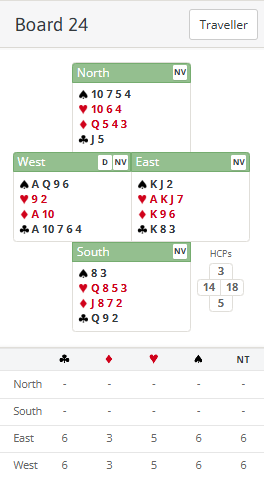
Sadly the hands were still different between the two venues last Thursday so not everyone will have played this board.
Board 24 at Ashfield was where East West could make slam although only one pair bid it. But it’s a good hand to consider the bidding and then the best line to make 12 tricks – whether or not you are actually in slam.
West will most likely open 1♣ (a few people might consider upgrading the 14 points with a 5 card suit to treat it as a strong 1NT opening but that’s not really necessary since you don’t have a rebid problem). East responds 1♥ and West has a simple 1♠ rebid – although he again might choose to rebid 1NT to show the balanced nature of his hand. East of course has a strong hand and knows as soon as West opens that he will be forcing to at least game and possibly slam depending on how things progress.
After 1♣-1♥-1♠ East should continue with 2♦ – artificial fourth suit (which is almost always played as game forcing in Australia). I would bid 2NT now as West as I have a diamond stopper and a relatively balanced hand (the ♦A10 holding is also appealing for no-trumps – see advanced section for why). At this point East still doesn’t really know how strong West is but he could perhaps jump to 4NT. That should NOT be blackwood. No suit has been agreed. It should simply be an invite to slam in no-trumps. Although it’s close, West would probably decline the invite (yes he’s certainly a lot better than the 11 point hand he might have had – but he only has an average opening bid, certainly not any obvious extra values; nor does he have anything in the suit his partner has bid).
Another option for East over 2NT could be 3♣ to set clubs as trumps (remember 2♦ established a game force so there’s no need to jump the bidding). If he is playing a method where West’s 1♠ rebid shows shape then he knows West will almost always have at least 5 clubs (see advanced section for why). At that point the pair might continue cue bidding to show their various controls and perhaps reach 6♣ or 6NT.
Should West have chosen to show his hand as balanced (either initially or at his 1st rebid), he will have defined his point range more accurately. If he shows 11-14, then East probably won’t look for slam as the maximum the pairs could have is 32 points and you normally need at least 33 for slam in no-trumps with two balanced hands. If of course West upgrades to treat his hand as 15-17, then East will now almost force to slam as he’s now looking at 33-35 combined points. It just shows that a marginal decision by one partner can have a dramatic impact on the other!
On this hand I wouldn’t crime missing slam. It’s the club fit and West’s 5 card suit which helps matters.
Let’s switch to the play and defence.
What about the play in 6NT if you did get there? Or indeed the play in no-trumps regardless since you still want to make as many tricks as possible. The first step as usual is to count your top tricks. 4 spades, 2 hearts, 2 diamonds and 2 clubs is 10. So you need 2 more. Where could they come from? A heart finesse is possible – but that would only be 1 more. That should tell you to look to the club suit. And it’s very hopeful. Whenever clubs split 3-2 (68% of the time) you will be able to lose a club trick and then set up the 2 long clubs in the West hand to ultimately make 4 club tricks. Some of the time clubs split 4-1 you will still be able to score 4 tricks. The fact the club suit is likely to provide the 2 extra tricks you need should tell you that you do NOT need to take the heart finesse – certainly not immediately (see advanced section for more advanced plays if clubs don’t behave).
That’s from declarer’s point of view. What about the defence? 4th highest from an honour is traditional against no-trumps but that’s with the aim of later setting up long cards in the suit. It would be very unlikely for that to happen in 6NT, your side just won’t get on lead enough times. So a key principle when defending against 6NT is it’s usually right to lead passively (i.e. from a bad suit, rather than underleading an honour). A suit slam is very different and there you normally want to lead much more aggressively. Why? See advanced section.
It looks like quite a few pairs played the hand by East and South led the ♥3. I wouldn’t consider this against 6NT. Here the heart runs to declarer’s ♥J which immediately gives 11 tricks. I would lead ♠8. Similarly from North I wouldn’t consider leading ♦3, I’d probably lead a heart through dummy’s suit (better then leading a black suit round to declarer’s known length there).
Key points to note
After 3 suits have been bid, a bid of the 4th suit is artificial and establishes a game force. There’s no need to jump the bidding after that.
Two balanced hands tend to need about 33 points to make 6NT (or, as here, slightly fewer points but a 5 card suit).
A bid of 4NT as an immediate raise of a no-trump bid where no suit has been agreed should NOT be blackwood – it’s just an invite towards slam (usually 6NT).
Always count your tricks as declarer and identify the best place to look for the extra tricks you need. If one suit will provide all the tricks you need, then taking a finesse in another suit may be pointless.
Tend to lead passively against 6NT but aggressively against 6 of a suit.
More advanced
The diamond holding of ♦A10 is very appealing to bid no-trumps on (far more appealing than ♦Ax would be). The reason is that you only need ♦Jxx opposite to have two stoppers when you are declarer. The defence will need to expend the ♦K or ♦Q to knock out the ♦A but now you are left with ♦10 opposite ♦Jx which is worth a 2nd stopper. Conversely if the lead is coming through your hand then you probably won’t have two stoppers – RHO can win an honour on the 1st round and then duck to the now bare ♦A. Hence it’s better to have the ♦A10 holding as declarer. It’s beneficial on this hand too for a slightly different reason – imagine the opening lead came round to West. East would have to play the ♦J or ♦Q at trick 1. Now if the honours are split, declarer can finesse North for the other honour and make 3 diamond tricks. But the same is not true if the first lead came from South as there will be no finesse position later.
I’ve talked before about playing a method where a no-trump rebid shows a balanced hand and a suit rebid denies one. Here, even if West could bid 1♠ he might decide to rebid 1NT (allowing for East to use checkback to look for a spade fit). That method means the 1♠ rebid guarantees an UNBALANCED hand. It’s that negative inference which can be so useful to partner. It means West either has 5+ clubs and 4+ spades or a 4441 shape. The only time therefore that West does NOT have 5 clubs would be is if he was exactly 4144 shape (and had opened 1♣ not 1♦). If West could rebid 1♠ on any balanced hand, then he could be all sorts of other balanced shapes too – so the odds would be much higher that he’d only have 4 clubs.
How should you play the club suit? If they split 3-2 it doesn’t matter what you do. If they are 4-1, you can still score 4 tricks if North has a singleton honour (cash ♣K to drop that honour and then finesse ♣10). So starting with ♣K is appealing. Although starting with ♣A is just as good if South has a singleton honour – now lead towards the remaining ♣K8 and North holding ♣J9x would have to expend one of his top clubs to stop the ♣8 scoring. Now the other can be knocked out and declarer’s ♣7 becomes the top one left!
What about if clubs don’t behave at all – e.g. if one defender has ♣QJxx? When you get the bad news on the 2nd round of clubs, you should duck. The only hope left then is some form of squeeze, hoping the defender with the remaining clubs also has heart length. When you cash your diamond and spade tricks, perhaps that defender cannot hang onto his club winner and his heart length? Then with the aid of a heart finesse you might score the 4th heart as well. Not that likely but it’s an extra chance that’s only relevant if clubs have misbehaved to start with.
So why lead passively against 6NT but not against 6 of a suit? Mainly because in no-trumps declarer can’t ruff a suit good, he is going to have to rely on brute force to set his tricks up. So you generally just don’t want to give anything away. When there’s a trump suit there’s more chance that your tricks will run away if you don’t set them up quickly – because declarer can use his trumps to ruff a long suit and turn the long cards in it into winners on which he can later discard his losers. Exceptions where you might still go passive in a trump slam are if you know you have a nasty surprise for declarer (i.e. a bad break in a key suit) – or if the pair have had a slow invitational auction where it sounds like they have dragged themselves to slam and will have a lot of work to do.
Julian Foster (many times NSW representative) ♣♦♥♠