City and Canada Bay – Thursday Morning 19th June 2025.
Last week, the City session was playing a GNOT qualifier (scored by imps) and the CBC session was playing regular pairs (scored by matchpoints). Because the two forms of scoring are so different it can lead to taking different actions.
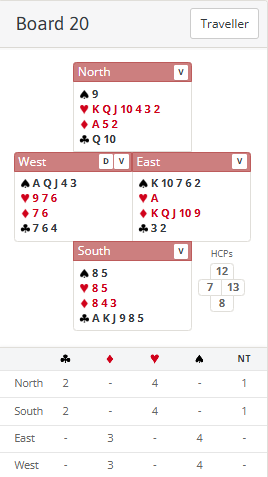
Board 20 last week was a competitive deal with both sides able to make a high level contract. As is often the case it gave rise to some big scores in both directions!
The normal start to the auction will be Pass 1♥. Then East might choose a simple 1♠ overcall or he might bid 2♥ (a “Michaels” cue bid showing 55 in spades and a minor). Which he chooses will depend on what his side may have agreed about the strength they show when they bid Michaels (see advanced section for more).
South can’t really bid over either of those (2♣ would normally be showing a stronger hand than the 8 points he has). West, having discovered his partner has 5 spades, knows his side has a 10 card fit. So he should immediately jump to 4♠ (he is going to want to do that over 4♥ anyway so he should do so immediately to force North South to guess at a high level what to do next).
4♠ could well end the auction – even though North has a strong shapely hand, it’s asking a lot for him to unilaterally bid 5♥. Likewise South can’t really bid on either.
The play in 4♠ isn’t very interesting. If South is on lead he will surely cash 2 clubs and the defence will later score ♦A. If North is on lead he will surely lead ♥K. Declarer will win, draw trumps and knock out the ♦A. North at that point will surely play clubs as the only suit left where the defence can take any tricks – particularly as East will be dummy so the winning diamonds will all be visible as will the fact that another heart will be ruffed. In either case the result should be 620 to East West.
On this hand, however, North South do in fact have a good sacrifice available in 5♥ which a few tables did play in (if West doesn’t jump the bidding straight away it’s possible North will be able to bid again and this might help North South realise it’s worthwhile to bid on). Also once or twice North South were allowed to play 4♥. Deep Finesse says that 5♥ should go one off. However, when it was played it generally made (usually doubled!) or went 2 off.
The defence will usually take 2 diamonds, 1 heart and 1 spade against a heart contract but they need to be careful. If they don’t set their diamonds up before their ♥A is knocked out, it’s too late. That’s presumably how some pairs allowed 11 tricks to make. Say they start with two rounds of spades – that’s fatal because declarer ruffs, knocks out ♥A, wins ♦A, draws trumps and discards all his diamond losers on dummy’s long clubs.
If East leads ♦K to start with, all should be well. If he starts with a spade to West’s ♠A, West needs to immediately switch to a diamond but this should be clear to do. Not sure why? See advanced section.
Deep Finesse, however, says North South can in fact make 10 tricks in hearts. How? By taking advantage of a small extra chance. After a diamond lead (or a spade lead and diamond switch), the answer is to not play a trump but instead play on clubs. On the layout on this particular hand both defenders follow to 2 clubs, then West follows to a 3rd round, declarer discards a loser (spade or diamond) and East is only able to ruff with his singleton ♥A that would have scored a trick anyway! Note this only works because the hand with 2 clubs also happens to have precisely singleton ♥A. It’s not that likely but it is a small extra chance to avoid a loser. Should declarer try this? Perhaps – even if East does have a small trump instead, the fact declarer discards a loser means he is effectively just swapping a trick (East scores a low trump instead of one of his diamonds). But this is where the difference between imps and matchpoints comes in. Should declarer try this line? At imps I would say the answer is possibly, at matchpoints I would say the answer is definitely no. Why? See advanced section for more discussion.
Key points to note
When you have a 5-5 shape it’s important to bid but it’s worth discussing what strength you are showing in your partnership. There are different styles around and that influences what partner might do.
If you know of a 10 card fit, it’s very often right to immediately jump to the 4 level (especially if it’s 4♠). The quicker you bid, the harder you make it for your opponents.
Long suits can be used to discard losers. When one is visible in dummy it’s important for the defence to attack other side suits to try and grab what tricks they can there before declarer can discard losers.
Sometimes you may spot a small extra chance that you can play for. It may work every so often – but you need to check if it’s too risky. The form of scoring can change that answer as well.
More advanced
There are two schools of thought when it comes to making bids like Michaels cue bids (and the unusual 2NT overall). One says the shape is more important to get across and you should bid it with any suitably shaped hand regardless of strength. The other says you also need to know about values so you should only bid it with a weak or a strong hand but not an intermediate one (the logic being a weak hand may pave the way for your side to make a good sacrifice over their contract, a strong hand may lead to your own contract and possibly slam, but an intermediate hand will often contain defence, not be enough to make your own game, so it may be better to defend).
Personally I subscribe to the 2nd camp. It makes it much easier to know how to respond if you know partner is weak or strong but not intermediate. The downside, however, is you might miss a big fit in one of the suits. That’s because with an intermediate hand instead of bidding Michaels you start by overcalling one suit with the hope you can then bid the other suit later. If, however, the opponents start jumping around then the auction may come back at too high a level to safely do that. As usual there is no perfect answer – each method will work well on some hands, and badly on others! The most important thing is that you and your partner are on the same wavelength.
I said that defending hearts after a spade lead, that West should immediately switch to a diamond. Why? Count the spades. In the auction West will have heard his partner show 5 spades (either by an overcall or via Michaels). He can see 2 in dummy and has 5 himself. That’s 12. Hence declarer can only have 1 and will ruff a 2nd spade. Looking at all those good clubs in dummy, the only hope for the defence is diamonds so West should have a diamond on the table almost instantly after winning ♠A!
So in 5♥ after ♦K lead why might it be worth declarer trying clubs when playing imps but not when playing matchpoints? It all comes down to how the scoring works and what you have to lose. At imps the size of the score matters. At matchpoints, the size isn’t always so important – it’s the number of pairs you beat that matters. On the hand here playing clubs works well – declarer escapes for -200 in 5♥ when the opponents had 620 available in 4♠. Also, if East could ruff with a small trump, declarer is just back to the -500 he was going to score anyway.
The key is the risk involved in playing on clubs first. It works here because clubs are 3-2. But what if they are 4-1 and a defender ruffs the 2nd round with a low trump? Now the defence will score that ruff, 2 diamonds, 1 spade and ♥A. That’s now 3 off and -800. At imps that’s bad but it’s not a calamity – it will lose 5 imps against the likely alternative score of -620 in 4♠. But at matchpoints it’s an absolute disaster because it pushes your score below all the pairs scoring -620. What’s more whether you score -200 or -500 isn’t likely to make that much difference – both will score very well against -620. The amount of the difference is irrelevant – it’s how many pairs are scoring -200, -500, -620 and -800 that matters.
So at matchpoints you are risking a complete bottom almost 32% of the time (the odds of clubs being 4-1 or 5-0) which is a big risk to take especially when -500 will still be a good score. You should just win ♦A, knock out ♥A, and accept -500 knowing it will beat anyone who allowed the opponents to play in 4♠ making.
At imps the equation is different. The amount of the difference does matter. Suppose the alternative is -620. Occasionally playing clubs will get out for -200 (when clubs are 3-2 and there is a singleton ♥A) and gain 9 imps, most of the time it will go -500 (when clubs are 3-2 but there is not a singleton ♥A) and gain 3 imps, but sometimes it will go -800 (when clubs are 4-1) and lose 5 imps. You might take the view the relatively small loss of 5 imps is worth the risk of the additional imp gains. The key point is the loss when your line doesn’t work is much smaller at imps than it is at matchpoints. They are very different games and require a very different mindset!
Julian Foster (many times NSW representative) ♣♦♥♠