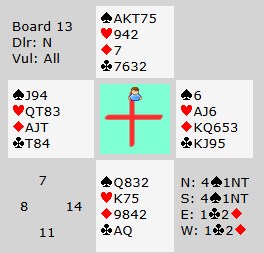
This hand is taken from the Wollstonecraft matchpoint pairs congress played on 16th November 2025.
A forcing defence (forcing declarer to ruff so they run out of trumps) can be extremely effective but sometimes there are things declarer can do to limit the damage. On this hand that would have made quite a big difference to the score.
The auction began with Pass 1♦ Pass 1♥. North now overcalled 1♠ which, as a passed hand, is perfectly reasonable. It indicates a good lead for partner, might allow his side to compete in spades, and doesn’t run the risk of partner going overboard as he knows you are already a passed hand. At this point East doubled – this was a support double showing 3 hearts (see advanced section for more discussion). South bid 2♠ and West bid 3♦ which became the final contract. See advanced section for why West can work out East must have at least 5 diamonds and why there’s a case for South to have done more.
The natural start by the defence was two rounds of spades. It’s often a good idea as a defender if you hold long trumps to try your own long suit in the hope of forcing declarer to trump and lose control. Declarer ruffed at trick 2 and now tried ♦AJ (if diamonds are 3-2 she will be able to set up 3 hearts to go with 5 diamonds for at least 8 tricks and maybe eventually score a club for 9). Things took a turn for the worse when North showed out. Now after the heart finesse lost South continued the forcing defence and played a 3rd spade. At this point he has 2 trumps left and so does declarer. After declarer ruffed she was down to 1 trump in each hand. This meant she had lost control of the trump suit. She played off the hearts but South could ruff the 4th round and exit his last trump which took both of declarer’s out. At this point she could only play a club which meant South scored 2 clubs but, crucially, the defence also had the remaining spades because declarer had no trumps left. That resulted in 2 off (declarer scored 5 trumps and 2 hearts) and a score of -200.
Could declarer have done better? Yes. Although she can’t make the contract, what she could have done is deliberately not ruffed the 3rd spade but discarded a club from hand instead. Notice what a difference this makes:
a) If the defence continue another spade, now she can take the ruff in dummy and discard a loser from hand (thus scoring 6 trumps instead of 5). More importantly this preserves the 2 trumps in her hand which will still then be able to draw South’s remaining ones.
b) If they do play a 4th spade it also means North has no entry to his 5th spade so there may now be time to set up a club trick.
The defence are unlikely to give a ruff and discard in practice. So they will probably exit something else – most likely a trump. But that means declarer can draw trumps and at least score all her heart tricks. There still isn’t time to get a club trick (she has to use all her remaining trumps to draw South’s) but the difference is South can’t ruff the 4th heart so declarer will score 5 trumps and 3 hearts. That’s still 1 off in 3♦ but that would have been -100 and a much better score. The difference between -100 and -200 when playing matchpoint pairs can be enormous – see advanced session for more discussion on why.
This technique can sometimes be used to save yourself from a forcing defence – leave a trump in dummy and don’t ruff in hand until dummy can take the force instead. Even if it means you go off, it’s often still better than losing trump control and letting the defence cash their long suit.
Key points to note
In defence if you have trump length it’s often good to lead a long suit in the hope of forcing declarer to ruff.
Losing trump control is usually very bad – look for ways to avoid it, even if it means going off (you may well be limiting the damage). One way is to not ruff but wait until dummy is also out of the suit.
Listen to the auction – you can often identify partner must be short in a suit which means your hands will fit well.
At matchpoint pairs -200 always scores very badly on a partscore hand. The difference between -100 and -200 may well be enormous.
When playing pairs try and work out how the opponents might have gone in their contract. Even if you go off, if you concede less than that it is likely to be good.
More advanced
East’s support double is quite a common method these days. It applies by opener in competition after a 1M response with some intervention (up to 2M) in between. Double shows 3 card support which means another useful inference is a direct raise of the major then shows at least 4 card support. It can be very useful for responder to know exactly how many of his suit opener has – both to compete in a partscore or find a 5-3 fit to bid game. But like every convention there are hands where it isn’t so good – usually when responder only had a 4 card suit to start with and a weak hand. He can’t leave the double in so has to do something and the choices may be unpalatable! On this hand he can safely bid diamonds but suppose he was 3424 shape – now it’s not so nice and the pair might well end up in a nasty 4-3 heart fit.
In the auction given you might think West’s 3♦ was risky as couldn’t East have only had 4 diamonds? However, stop and consider it more closely. Assuming North South have at least 8 spades for their bidding then his own 3 spades mean partner can’t have more then 2. She has also shown exactly 3 hearts which leaves 8 cards in the minors. But if she was 4-4 in the minors she would have opened 1♣ not 1♦. Therefore she must have at least 5 diamonds.
South should probably have done more than just bid 2♠ – although he only has 11 points his hand is looking very good when partner overcalls with a known 9 card spade fit and the ♣AQ likely to be sitting well. When the 3♦ bid comes back to him, things have improved even more! Now the opponents have surely got at least 8 diamonds which means partner can have at most 1. Hence he knows his side has little wasted in diamonds and his losers there can be ruffed in partner’s hand. Therefore a spade contract will play very well (as it does – in fact they can make game!)
Why would -100 have been so much better than -200? Because matchpoint pairs scoring is very different to imps in two key respects:
- You score points based purely on how many pairs you beat – but not by how much you beat them. If you score +620 and everyone else scores +140 you get a top. But if you score +170 and everyone else scores +140 you still get the same top! That means there is not the same benefit to bidding a pushy game.
- Every board is worth the same. Very different to imps where slam hands can be worth a huge amount and partscore hands very little. That means what happens on partscore hands can be much more important at pairs (and a difference in score of just 10 points can be worth a huge amount).
What does that mean for this hand? Assuming you have not missed bidding an obvious game when you play in a partscore and make it you will score between 90 and 140 depending on the contract. Scoring 1 or 2 overtricks might take that to 150 or 170. If you play a contract and go off you lose 50 per undertrick when not vulnerable and 100 per undertrick when vulnerable. But notice that the highest partscore I mentioned was 170. That means if you go -200 it’s worse than any partscore the opponents could made. It’s therefore almost always a very bad score and why you need to be much more careful competing when vulnerable. Contrast that with scoring -100. That can be very good if the opponents could make a contract worth more than that.
On this hand, when declarer discovered diamonds had broken 4-1 and the heart finesse lost she can work out how North South would have gone in a spade contract. They will have at least 5 spade tricks, ♥K, only 1 diamond loser and at least 1, possibly 2 club tricks. They would surely have been able to score an absolute minimum of 110 and quite likely 140 or 170. All of those scores fall between 100 and 200 – hence if she can escape for -100 in 3♦ she will likely do very well. This is an example of the difference in thinking between pairs and imps – sometimes at pairs it’s perfectly OK to NOT try and make your contract! You are just trying to concede something less than their contract would have been worth. Suppose everyone else scored +140 with the North South cards. Playing imp pairs going -100 in 3♦ means a gain of 1 imp, going -200 means a loss of 2. So just 3 imps at stake. But in matchpoint pairs it’s the difference between a complete top and a complete bottom!
Julian Foster (many times NSW representative) ♣♦♥♠