30th October 2025
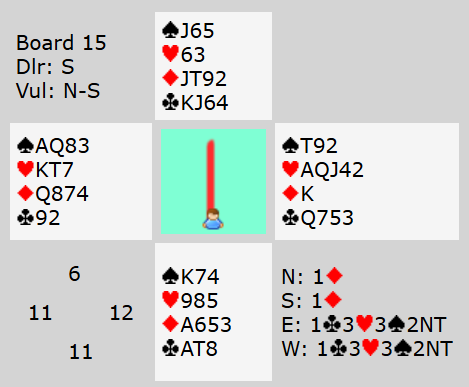
This week’s hand is taken from a congress I recently played in New Zealand which became an instructive defensive problem. I was fortunate my opponent got it wrong at the time but he had enough information to get it right!
It’s quite common to start off with a plan (either as a declarer or defender). But when information comes to light which tells you that plan can’t work, it’s necessary to change tack. Sometimes it’s already too late but often it isn’t. This hand was an example of the latter.
First the bidding. South passed (these days some might open – see later for how that might have changed things). I was West and opened 1NT (we play a weak 11-14 1NT). We proceeded to bid uncontested 2♦-2♥-3♣-4♥. 2♦ was a transfer to hearts. 3♣ was game forcing with clubs. This is quite an aggressive action by East with only 12 points opposite a weak no-trump and no guarantee the ♦K is worth anything (her alternative option would have been 2NT invitational). But the event was Swiss pairs (imp scoring) so you want to push towards bidding games since there’s more to gain.
As West my jump to 4♥ was showing a minimum following something called the principle of fast arrival – see advanced section for more details. 4♥ became the final contract.
North led ♦J which was sensible – top of a sequence is one of the best leads in bridge combining safety with the potential to set up tricks. South won ♦K with ♦A and switched to a spade. This was also perfectly sensible. It looks like the defence may need some spade tricks to have any chance of beating the contract. What’s more it may well be necessary to cash them now (see advanced section for why).
Now let’s switch to my (declarer’s) perspective. The contract doesn’t look great at this stage. I have 5 trumps, ♠A and ♦Q but that’s all. Where can I get 3 more tricks from? The only hope is spades and at least 1 club ruff in my own hand (ruffs in the short trump hand do create extra tricks). But you also have to look at losers. I’ve already lost ♦A and have two immediate club losers. So I can’t afford to lose a spade. Which means I either need to hope South has underled ♠KJ or that he’s underled ♠K and finesse the ♠Q. I chose the latter and the ♠Q held. That got me up to 8 tricks. Now I played a club preparing to try and set up my club ruffs. I played low to the ♣7 (North might have won ♣K in case I was leading away from ♣A but she didn’t do so). South won and at this point played a 2nd spade still trying to set up a trick there. This was a mistake – at this point he needed to switch to a trump. Can you see how he can tell he should do that? See advanced section for the answer.
What happened at the table was I won ♠A, cashed ♦Q discarding dummy’s spade and played a 2nd club. Now it doesn’t matter what the defence do. They actually played another diamond which I ruffed in dummy and took a club ruff in hand with ♥10. I played a spade to ruff in dummy (see advanced section for why) and ended by ruffing dummy’s 4th club with my ♥K. That just left 3 top trumps in dummy to make 10 tricks. This was worth a lot of imps since most pairs hadn’t bid to 4♥ and some had only made 9 tricks.
Finally it’s worth considering what might have happened if South had opened the bidding. Say he opened 1♦. I can’t bid over that and North will either raise diamonds or perhaps bid 1NT. East might now overcall hearts but she might not – her ♦K now looks useless and she has a lot of losers. Even if she does overcall my hand might invite but there’s no guarantee we’ll reach game. South opening first makes things much harder for East West. This is frequently the case.
Key points to note
Getting into the auction first tends to give your side an advantage. It’s harder to bid accurately when you start as the overcalling side.
The opening lead or play to the 1st trick frequently tells you where cards in that suit are (here the lead of ♦J placed ♦Q with declarer).
When defending you need to always think how you might beat the contract. Sometimes when your first plan fails it’s necessary to reconsider. Frequently it’s still not too late.
Defenders may need to count declarer’s shape, or his points, or his tricks (sometimes all 3!) The point range is quite narrowly defined when he’s opened or rebid no-trumps so this can help identify partner’s point range too.
More advanced
The principle of fast arrival is frequently used when a pair is already in a game force. It basically means the quicker you bid to the final contract, the weaker the hand you are showing because it takes up more bidding space. Stronger hands bid lower to leave more room to explore slam. Another common example often occurs after 1 of a major and a 2NT game forcing raise. Many pairs play that the weakest thing opener can do is just jump straight to 4 of the major. On this hand had West been stronger I could have bid 3♥ over 3♣. This allows more room to explore towards 6♥ if East had had a really strong hand (obviously not the case here(!) but quite possible since 3♣ was basically unlimited).
Why was South’s 2nd spade a mistake? For the same reason his 1st spade was sensible! Assuming the pair are playing normal overleads then his partner’s ♦J denies ♦Q. So I am known to hold that card and it’s going to provide a discard in dummy – surely going to be a spade. Hence they need to try and cash any spades they can immediately.
He should also consider the points. Whenever declarer has opened or rebid NT they have usually shown a fairly narrow point range. So as a defender you should always add that range to what you can see in dummy and your own hand. Then subtract from 40 and that tells you partner’s point range. Here I have shown 11-14 initially and then my 4♥ showed a minimum so I probably have 11-12. 23 are visible to South in his own hand and dummy. That leaves North with 5-6, 1 of which is known to be ♦J. So it’s possible North could have ♠AJx or ♠AJxx. If that’s the case it’s critical to take the spades now before the discard on ♦Q is taken.
That was fine logic at trick 2 but once my ♠Q held the trick and I had led a club South should have reconsidered. His first (perfectly reasonable) plan to take spade tricks has failed. He now knows I have ♠AQ and ♦Q so he can predict what’s going to happen after a 2nd spade. I’m going to win ♠A and discard dummy’s spade loser on ♦Q (there was no rush for me to do so immediately while I still held ♠A). So the defence cannot win a spade trick. He needs to try a plan B!
What he needed to do at that point was also count declarer’s tricks. 2 spades, 5 hearts (even if I don’t hold ♥K he knows the finesse will work) and 1 diamond. That’s 8 so I need 2 more. They can only come from clubs or ruffs in the short trump hand. That’s South’s clue. I have just lost a club trick to the ♣7 so it doesn’t look like I am trying to win many club tricks by force! (I didn’t want to play ♣Q though since one defender might have had ♣AKx and then I’d only need one club ruff to set up the ♣Q). So he should try to stop me taking ruffs by playing a trump and then when in with the 2nd club the defence need to lead a 2nd trump. That works because it limits me to only 1 club ruff in my hand and 9 tricks in total. I’ll end up losing the 4th round of clubs. (You might think I can ruff a spade to set my 4th spade up. Yes I can but I can’t both ruff a club in my hand AND cash that 4th spade since after ruffing a club I can’t draw trumps ending in my hand and I have no other entries there. If instead I draw 3 rounds of trumps ending in hand to cash that spade it’s still only my 9th trick as now I can’t ruff any clubs.)
After my 1st club ruff I chose to play a spade to get back to dummy. Why? Because I knew South still held ♠K and hence I couldn’t be overruffed. When North followed with ♠J it was safe to ruff low in dummy and my contract was now 100%.
Julian Foster (many times NSW representative) ♣♦♥♠