9th November 2025
Two weeks ago I described a disaster hand from the Spring Nationals. So to level the score a bit(!) this week I’ll focus on a hand I got right since it involved some “table reading”.
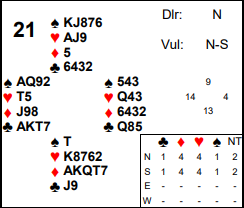
The auction was 1♥ (X) 2♥ (P) 4♥.
North knows there is a heart fit already but, without the double, may well start with 1♠ in the hope of finding an even better fit there.
The double from West, however, will usually have spades so that reduces the likelihood of North South having a spade fit (and even if they do they may not want to play in it!) Hence North preferred 2♥.
Even though South only holds 13 points, his shape makes it worth trying game. After all North could hold ♥AQx and nothing else and there would be huge chances for 10 tricks (5 in each red suit). The high card points are barely relevant – the shape is far more important (as usual!).
West led ♣AK and a 3rd round which I ruffed. Partner is close to having the ♥AQx you were hoping for – but not quite! Nevertheless there are still good chances. The contract has 1 spade and 2 club losers so it depends on making 10 red suit tricks. This in turn requires finding the ♥Q.
In isolation the normal way to play hearts would be to finesse the ♥J and play West for ♥Qx or ♥Qxx. But is that likely here? He has made a takeout double of 1♥ so ♥Qxx is certainly unlikely. It’s also likely that you will need to trump a diamond in dummy to set the suit up (as it happens on this hand ♦Jxx comes down but you don’t know that).
When you think a finesse will fail, you can sometimes look for an alternative. Here there is one – West holding ♥10x (see advanced section for more on this). So I played a heart to the ♥A, then ♦A and a diamond ruff with ♥9. Now was the moment of truth. I played ♥J and ran it. Pleasingly West did follow with ♥10 (of course had he won ♥Q I would have gone off in an apparently cold game and looked like an idiot!) Now I could ruff a club back to hand (confident West couldn’t overruff me even if he had only started with 3 clubs), draw East’s ♥Q and try to cash my diamonds. Because they had broken 4-3, they were all now winners. A satisfying +620.
Note it was essential that I held ♥8 to play this way. I was using the ♥9 in dummy to take a diamond ruff. If East had had ♥Q8 left she could have covered ♥J to promote her ♥8 into a trick.
This hand was also written up by another player in the Spring Nationals bulletin based on similar play by several declarers at other tables. One variation described there was declarer tried leading a spade up first. See advanced section for why he did that and the extra information he gained. Plus the different reason why I also took that line.
Key points to note
Always remember the bidding when playing a hand.
If you think a finesse is almost certain to fail, consider if you have other options. Frequently you do!
Think about possible layouts that will allow you to succeed. Then try to decide which is the most likely – this is often a combination of the raw distribution mathematical odds and the bidding or play to date.
Sometimes the speed with which opponents act can indicate if they have a clear cut or a difficult choice.
Conversely try to bid and play smoothly yourself to make it harder for your opponents to read you (use the time others are thinking to predict what might happen and decide in advance what you’ll do in each case).
More advanced
Why might declarer play this way? Partly because of the initial double, but there are other reasons.
I mentioned some declarers lead a spade initially. Why? It gave the extra chance of West ducking (now declarer could win ♠K and then he could afford a heart loser). It also confirmed ♠A (and quite possibly ♠AQ were with West). One such declarer then inferred that had West held AQxx Qx Jxx AKxx he might have chosen to overcall 1NT instead of doubling. Hence he was more likely not to hold ♥Q.
I didn’t lead a spade up but I did decide West probably held ♠A anyway for his original double. In my case, however, I used something else. At our table West had doubled 1♥ almost immediately. That suggested to me that he had a clear cut double. Obviously you take inferences like that at your own risk but I wondered if he might have been slightly more reticent to double with ♥Qx. We’ll never know what West would have done in that case of course!
Of course that’s a dangerous inference to take but the speed with which opponents act can be a pointer to “table reading”. If they pause they will have a reason – trying to think what their problem might be can be very illuminating. Bear in mind though – it’s not acceptable to deliberately pause at bridge to make it look like you have a problem when you don’t – it’s not poker!
Another thing to be very careful about is this. The speed with which your PARTNER does something is definitely not authorised information to you and should not be used. All the information you are entitled to know are the bids partner makes and the cards partner plays – not the manner, or speed with which they do either.
Of course there is another side to this. You should try and make your own bids and players smoothly. Easier said than done of course but doing so not only makes you a much tougher opponent (i.e. harder to read) it also makes you a better partner as playing or bidding slowly can give your partner unauthorised information. Get into the habit of using the time when others are thinking to predict what they are thinking about, what plays they may be about to do and plan what you will do in each case.
Finally, the heart position from this hand or similar layouts can give rise to what’s known as a “Backwards finesse”. This is technique that can sometimes be used when the regular finesse is known to be failing. Suppose on this hand that the bidding had indicated (most likely from the points) that East had to hold ♥Q. In that case the regular finesse cannot win and playing this way or (better) running ♥J immediately from dummy is the best option. Effectively you force East to cover ♥J (otherwise you run it). Now you finesse against West’s ♥10 instead. Another reason you might play that way is that, at that point in time, you couldn’t afford to lose a trick to East (he might be able to switch to something dangerous through your hand) but you could afford to lose to West.
Julian Foster (many times NSW representative) ♣♦♥♠