City and Polish Club – Thursday Morning 7th August 2025.
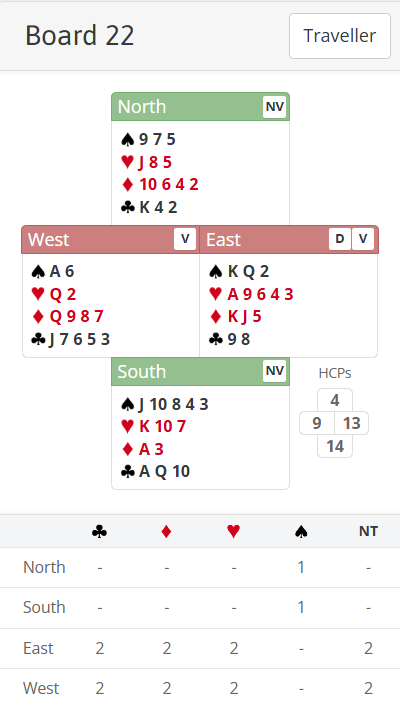
Board 22 last week was another partscore hand where it’s worth both sides competing. East will normally start with 1♥ and South should overcall 1♠. Yes the suit isn’t great quality but it’s at the 1 level, South has plenty of values and the chance to get the spade suit into the bidding and potentially find a fit is too good to miss. That outweighs the risk that his side ends up defending and partner leads ♠K from ♠Kx or something.
What about West now? Quite a few tables seem to have played 1NT by West. If South didn’t overcall that’s certainly what I’d bid but after a 1♠ overcall I would prefer double. That’s an opportunity to show both minors with one bid (West isn’t strong enough to bid 2♣ which would normally show at least 10 points). Also Ax isn’t a great spade holding to be showing as a stopper. If your side is going to play no-trumps it’s likely to be better with partner as declarer (see advanced section for more).
After a double if North passes East will most likely rebid 1NT and that should make easily. Start by winning the likely spade lead in East and leading a low heart towards the ♥Qx. South can win and play a 2nd spade to ♠A but now declarer can cash ♥Q and play a diamond to force an entry back to his hand. That will lead to (at least) 3 spades, 4 hearts and 1 diamond. The best the defence can do is take ♥K, ♦A and 3 clubs. That’s of course quite fortunate because both hearts and clubs are 3-3.
But should North pass? No – I would raise to 2♠ (over both a double or a pass from West). For several reasons:
⁃ It might make!
⁃ The favourable vulnerability. Even if it doesn’t make there’s a good chance the opponents can make something and -50 or -100 will score better than that.
⁃ It will make life much harder for East West if they do have stronger hands (remember West’s double doesn’t have to be weak – it could be based on something like 3244 shape and a strong hand; also East could have up to 19 or 20 points). That’s why the spade suit is so powerful as it takes the whole level of bidding away from the opponents.
On this hand 2♠ from North may well be enough to win the auction. Neither East nor West can really bid over it. Note it’s generally better to raise to 2♠ immediately rather than wait for East to rebid and then later raise to 2♠. That way West finds out a lot more about the hand by hearing East’s initial rebid. The immediate raise takes the space away.
What about the defence to 2♠ from South? It can be beaten – the defence have 3 top trumps and they can score 2 hearts and 1 diamond. But in practice West is likely to lead ♥Q (which is a perfectly reasonable thing to do – it just happens to be unfortunate on this deal). That reduces the defence’s heart tricks to 1. Quite a few tables saw North South score +110 as a result.
East may well think ♥Q is a singleton, win ♥A and play another hoping to give partner a ruff. Instead on this layout declarer wins and play a spade. As it happens that scrambles the defence regardless of where they win the 1st spade trick. West can win ♠A but can’t now get East in. Or East can win ♠Q but that leaves West with singleton ♠A which there’s no point ruffing a heart with as it will score a trick anyway.
After the unfortunate start of ♥Q, all is not lost though. It is still possible for the defence to beat 2♠ but it’s much harder for them.
As is so often the case the key to the hand occurs at trick 1. East needs to NOT win ♥A and instead must duck! Then West needs to win ♠A on the 1st round. Now he can cross to partner’s ♥A and receive a heart ruff with his ♠6. That effectively gets back the trick lost on the opening lead and means the defence score 4 trumps, 1 heart and 1 diamond.
Retaining communication between the defenders’ hands is a very common theme. It’s seen most often in no-trumps but in a suit contract after a doubleton lead it can frequently also be right for partner to duck the Ace to preserve communication and enable him to give a ruff on the 3rd round.
Can the defenders find this on this hand? Not easy. There are some small clues for East that it could be right to duck at trick 1. But there are certainly layouts where that will be wrong. It’s largely a guess for him. See advanced section for more thoughts.
What’s more, even if East does find that duck, declarer can still make it harder for him to continue with the right defence. Think about what he might try and see advanced section for more.
Key points to note
When you have the spade suit it’s worth being aggressive both when overcalling and when raising partner’s overcall (especially when not vulnerable). It takes up a whole level of bidding space and can make life hard for the opponents. Raising immediately is much better than passing first and then raising – that lets the opponents exchange information at a lower level.
Be wary about bidding no-trumps with stoppers like Ax or Axx. Frequently it’s better played from the other side where Qx or Qxx will guarantee a 2nd stopper if the lead is coming round to them.
When a doubleton is led against a suit contract it’s often right for the other defender holding the Ace to duck to preserve communications and perhaps set up a ruff on the 3rd round (but be aware that could backfire if partner has in fact led a singleton!).
Try to act smoothly as defenders. The speed with which you play a card is unauthorised information for partner. It can be delicate if you think for ages and then duck as it’s letting partner know (unethically) that you had an alternative play available.
As declarer always remember the defenders can’t see your hand. Leading towards it even when you don’t need to might mislead them about your holding and trick them into a mistake.
More advanced
I mentioned it’s often better for holdings like Ax not to be declarer in no-trumps. Imagine here that East held something like Qxx. With the lead coming round to that he is guaranteed 2 stoppers. With the lead coming through it he is not. It’s the same with a holding of Axx opposite Qx. So it’s often attractive not to bid NT with Ax/Axx (unless you only need 1 stopper and can run enough tricks for your contract immediately). For the same reason it’s often attractive to bid NT with Qx/Qxx holdings.
Can East realistically duck ♥Q at trick 1? It’s hard. After all from his perspective West might have a singleton heart and he could also have ♦A. That means East could win, give partner a ruff, get back in with ♦K and give him a 2nd ruff. That way the defence would score ♥A, 2 heart ruffs, ♦AK, and ♠KQ will be good for a 6th trick. But there are some possible clues that ducking may be right. Firstly he knows partner can have at most 2 spades (South overcalled, North has 3 and East has 3 himself). So if West did also have a singleton heart he would be 2155 or 2164 shape. East might reason that with either of those distributions West might have had another go over 2♠? Secondly, in general doubletons are simply more common than singletons. Neither of those are especially strong reasons here though – the argument West might have another go would be stronger if he was not vulnerable.
Let’s assume East did find the duck. Even then it still may not be clear to West what is going on (from his perspective East may have opened a bad suit and declarer has ♥AKx and he may not play a 2nd heart even if he does win ♠A). So East needs to make sure he signals clearly with an encouraging card at trick 1.
What East should try NOT to do is take ages and then duck. That’s now making it clear to his partner he has the ace but in an unethical way (the tempo with which partner plays his cards is not authorised information). It’s not easy here, especially for less experienced players who may not have seen the position much before, but East should try and think this through as soon as he sees the ♥Q lead and dummy. That way when declarer plays from dummy he can have made his decision, act smoothly and not give any unauthorised information away. Incidentally that’s another reason why declarer should not immediately play from dummy either – he should take some time himself to think about the hand (which is usually what he should do for his own benefit anyway!). There are players who, when they put dummy down and it has a singleton in the suit led, play it immediately to be “helpful”. That’s absolutely NOT what they should do! It’s up to declarer to call for the card when he’s ready.
Anyway back to this hand. If ♥Q is ducked, declarer may well now see what’s likely to happen. Can he do anything? Not genuinely but what about crossing to dummy’s ♣K and leading the 1st round of spades from dummy? He knows his spades are bad but East doesn’t! It might look to East as if declarer has ♠AJxxx sitting over him and he may try inserting ♠Q. That would be fatal here as it leaves West with singleton ♠A so he can no longer get an effective ruff. Of course East shouldn’t fall for that – it cannot gain him to insert an honour (indeed he would look very stupid if West had singleton ♠A or ♠J). But defenders are not perfect and it costs declarer nothing to try! He doesn’t need the ♣K entry for anything else on this hand. There are many many occasions where declarer can make life hard for the defence purely because they can’t see the hidden hand.
Julian Foster (many times NSW representative) ♣♦♥♠