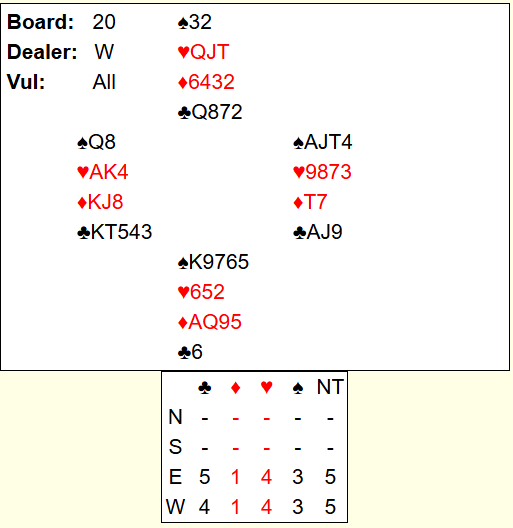
This hand is taken from a recent matchpoint pairs congress in New Zealand.
Penalties at low levels are often some of the most satisfying but you don’t often see large penalties at the 1 level.
Let’s first consider the bidding. As I mentioned last week, system has a big bearing on results. For many pairs in Australia West will open a strong 1NT (15-17) and East West will have a simple stayman auction 1NT- 2♣ – 2♦ – 3NT.
For those playing a weak NT (more common in New Zealand), it’s more likely to start 1♣ – 1♥ – 1NT with the rebid showing 15-17. After that it again depends on methods but East can enquire about spades to check for a fit there and when there isn’t one they will also end in 3NT.
The auction may influence the lead. The strong no-trump auction hasn’t revealed that dummy has hearts so ♥Q is a potentially attractive lead. The weak no-trump auction has shown hearts are in dummy so a passive diamond may be more appealing. In either case, declarer is likely to make at least 10 tricks.
The weak NT system at our table had another variant though. After 1♣ – 1♥ South overcalled 1♠. This is pretty reasonable – it might easily lead to a contract his way. Today, however, it didn’t work in a pretty unlucky way! It initially gave me as West a problem. My intended 1NT rebid (15-17) was no longer so appealing without a spade stop. So instead I decided to double (many pairs these days play that as support showing 3 hearts but we just play it as takeout). But partner (East) then made a decision to pass 1♠x!
This turned out to work extremely well on the hand. What to lead though? Remember when you pass the opponents’ doubled contract at the 1 level you are basically saying you expect to make more tricks than them – so you usually want to be aiming to draw trumps. Hence you should normally lead trumps – ♠Q in this case.
I, however, started with ♥A. Partner has responded 1♥ so she has at least as many hearts as spades and she won’t be passing without at least 4 good spades. So I initially thought we might want to play hearts to force declarer’s long trump out. However, the sight of ♥QJ10 in dummy put paid to that. So I then switched to ♠Q.
♠Q ran to declarer’s ♠K who then led a 2nd heart to my ♥K. I continued trumps which partner won ♠10 and played a 3rd round on which I had to discard. The question is whether I want her to lead a club or a diamond through. I can’t discard a diamond but I could either encourage or discourage in clubs. I decided to encourage clubs (my logic being if declarer had ♣Ax, she might duck a club switch so I could win ♣K and have a safe club exit – whereas after a diamond through I might be endplayed). However, partner had also signalled clubs (can you see how? See advanced section for more). Partner actually played through ♦10 which went ♦Q ♦K. Now again there’s a decision. If partner has ♦9 it’s safe to exit a diamond. If not, I need to avoid touching diamonds. But in fact I switched to a club for two reasons. One was her earlier signal but there was also a 2nd reason. Can you see what it was? See advanced section for more.
The club went to partner’s ♣J who drew a 4th trump and continued a low club which declarer ruffed. She crossed to ♥Q in dummy (to which we both had to follow). That was her 3rd trick. She now led a diamond and had to decide whether to finesse the ♦10 or not. At the table she finessed losing to my ♦J. Declarer had no trumps left at this point so I could now play a club to partner’s last 2 cards (♣A and the 13th heart). This meant 4 off and -1100. But declarer’s choice to finesse in diamonds was absolutely the right thing to do – see advanced section for why.
Key points to note
When defending at a low level it is nearly always right to lead trumps. You are basically saying you want to play in that suit so it’s the same principle that declarer normally wants to draw trumps.
When defending after showing count in a suit the small spot cards can be used to give suit preference signals.
Always consider what partner has shown up with in the play so far – and see if that makes sense compared to their bidding.
At pairs the difference between a penalty less than their game and greater than their game will be huge. But the difference beyond that may well be nothing.
More advanced
How did partner signal clubs when she hadn’t made any discards? By what she did in hearts. She played the ♥8 at trick 1 (discouraging in case I had led ♥A from ♥Ax which is quite possible as it was her suit – remember we were not playing support doubles so my X did not necessarily show 3 hearts). When declarer played a heart back to my ♥K, she played the ♥3. This was her lowest heart and was a suit preference signal (it didn’t matter how many she had and the honours in hearts were all known). So this said she preferred clubs to diamonds. Very commonly the small seemingly irrelevant pips can be used by advanced defenders to show suit preference. Suppose you hold 432 in a suit. You play the 4 on the first round to show count (assuming playing reverse count – the 2 if playing natural count). But on the 2nd round you could play the 3 or the 2. So the order you play those can be used to send a signal. A sharp eyed defender should notice and interpret the signal.
The other reason I knew she had something in clubs was simply the points. She has shown up with ♠AJ10x and nothing in hearts. Declarer thought for a while before playing ♦Q so was likely to have ♦AQ (and partner’s ♦10 switch is not suggesting anything in the suit either). But there’s no way she would pass 1♠x with so little. She must therefore have points elsewhere too – and they can only be in clubs – i.e. ♣A, and maybe ♣J.
Why was declarer’s choice to finesse in diamonds at the end correct? Because she was playing matchpoint pairs. Had she made 4 tricks (the most likely outcome had she played ♦A) she would have scored -800. But most pairs our way will be scoring around 600 for 3NT. So that will be a terrible score. Her only chance of matchpoints was to make 5 tricks and go -500. On the hand -800 would have been a compete bottom anyway so the extra 300 cost nothing – but she gave herself the chance to get a good score of -500. Notice how different the thinking is between pairs and imps. At imps each trick does make a big difference so you might well take -800 and accept a loss of 5 imps because you don’t want to risk -1100 and a likely loss of 11 imps. On the other hand -500 would be a gain of 3. So it’s a tricky decision. But at pairs the key trick is just the one that changes the penalty from less than the value of opponents’ game to more than it. The difference in matchpoints between -800 and -1100 was nothing; and the difference between -500 and -200 would also have been (both beating the -600 most pairs will get).
Julian Foster (many times NSW representative) ♣♦♥♠