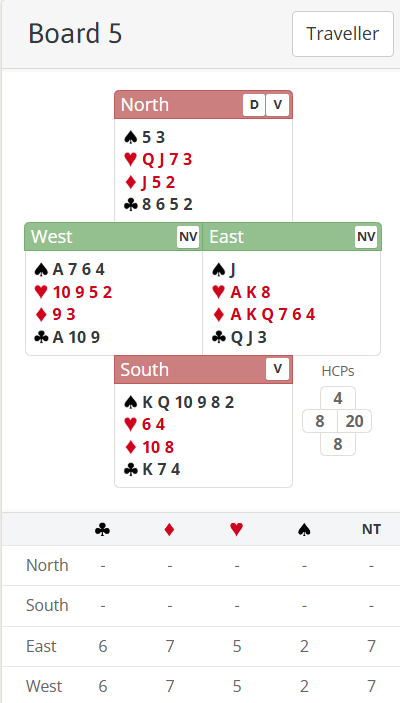
This is another hand from the Sydney Bridge Club Christmas party which caught my eye because a large proportion of the East West field played in 3♦ despite holding a combined 28 points. Let’s see what might have gone wrong.
North will pass and East will most likely start with 1♦. Yes the hand has 20 points and potentially a lot of tricks but it’s still not quite a game force which is what many pairs now play a 2♣ opening as. See advanced section for more about the reasons for that.
South is likely to overcall either 1♠ or 2♠. North is already a passed hand so he knows it’s the opponents’ hand but the unfavourable vulnerability and the relatively balanced nature of the hand means I’d prefer 1♠. If things sit badly, 2♠ could end up going for a penalty of at least 500 which is more than the value of the opponent’s game. In theory 1♠ could as well – but it’s far less likely in practice.
After a 1♠ overcall, West will most likely double (a negative/takeout double to shows 4 hearts). North will pass. Now what should East do? I suspect at this point quite a few Easts bid 3♦ but the big problem with this is it’s not forcing. It’s effectively the same as if the bidding had gone (uncontested) 1♦ – 1♥ – 3♦ which is usually showing about 15-18 and 6 diamonds. Here East is much too strong to do that. West can (and will) pass it and the pair have arrived in 3♦ holding a combined 28 points.
After a 2♠ overcall, West will probably pass and it will come back to East. Again I suspect some bid 3♦. But again the hand is too strong for that.
So what’s the solution? After 1♦ 1♠ X P, East should be forcing to game. Partner has voluntarily made a bid after the 1♠ overcall so he must have some values. Even a minimum response should be enough for game opposite his 20 points. East can’t immediately raise hearts as he only has 3, nor can he bid no-trumps without a spade stop, and we’ve already said he’s too strong to jump to 3♦. So what’s left? The answer is a cue bid of the opponents’ suit – i.e. 2♠. That is clearly forcing and asks partner to describe his hand further – most commonly to show if he has a spade stop. Here West can comfortably bid 2NT and East can raise to 3NT. Had West had 5 hearts and no spade stop, he could have repeated those and now East could raise to 4♥.
Things are a bit harder after 1♦ 2♠ P P back to East because now he doesn’t know West has anything (he could easily have anything up to about 9 points and just not be able to bid over 2♠). Therefore East definitely needs to bid again. This time he should re-open with a double (a 3♦ reopening would typically show a hand weaker in high card points and probably with 7+ diamonds). Double is primarily allowing for the possibility that West does in fact have spades and wants to penalise South. Secondly it’s takeout (West could still have 5+ hearts) so it’s another way to ask partner to describe his hand further. Here West will take the double as takeout and bid 3♥. Once again East can cue 3♠ to find out more. Yes he is effectively now forcing to game opposite what could be nothing. But it’s the practical thing to do since he has basically 8 tricks in his own hand. That’s the impact of the 2♠ overcall taking more bidding space away.
There is another possible rebid that East could make on these types of hands – see advanced section for more.
This article is more about the bidding but what about the play? 13 tricks are in fact available with the aid of the club finesse and the double heart finesse (i.e. playing North for both ♥Q and ♥J). But of course that’s knowing the lie of the cards! In reality 10 or 11 tricks are more likely. After a spade lead, declarer will surely duck at least one round to try and exhaust North of spades. After a 2♠ overcall only needs to duck once since he knows South will have at least 6. After a 1♠ overcall and the ♠5 lead, he might duck the 2nd round as well (North could have been leading MUD from something like ♠853). Then he takes the club finesse safely into that hand. Although it works on the hand, it’s highly unlikely that anyone will take the double finesse in hearts (unless perhaps they had not received a spade lead). As it happened even making 10 tricks in 3NT was a good score because so many pairs were playing in 3♦.
Key points to note
It’s quite possible to open 20 point hands at the 1 level – and it’s often better than taking up more space by opening 2♣ (or 2♦).
After a 1 level opening bid a jump rebid of the same suit usually shows about 15-18 and a 6+ card suit. Therefore you can’t also make this bid on a similar hand with 19-20+ points because partner will pass with 5 or 6 points and you’ll miss a game.
When you have opened a big hand at the 1 level, you may well need to find a forcing bid later in the auction. Cue bids of the opponents’ suit can be used to do this.
More advanced
There are different styles of strong opening. These days, however, it’s becoming more common to open more and more hands at the 1 level and reserve a 2♣ opening only for really strong game forcing hands.
Two main reasons for that:
- 2♣ takes up so much more bidding space that it makes it much harder to find your best contract. This is especially the case with 2 suited hands where you want to show both your suits at a reasonably low level to explore a fit there. Imagine for example that you have a strong 4261 hand. If you start with 2♣ and partner bids 2♦ you have to start bidding your longest suit at the 3♦ level. If partner doesn’t bid 3♥ then you will struggle to show your spade suit at all. It tends in practice to be far better to start with 1♦.
- These days there is so much more competitive bidding that the chance of the auction being passed out at the 1 level is far lower than it used to be.
There is, of course, a downside to making 2♣ an unconditional game force. It means you will end up in game with sometimes only 23-24 points opposite absolutely nothing. But, in practice, this is rare (and occasionally it makes anyway!). It’s a small price to pay for the ability to bid many other hands more accurately.
Sometimes with a hand like East’s that’s too good for a simple suit jump rebid, a rebid of 3NT can be used to show a big hand with a running suit. In a contested auction, however, it would show a stopper in the opponents’ suit (so here it might be suitable for East after, say, 1♦ 1♥ X P).
If anything the hand is more of a problem if the opponents don’t bid at all. What should East rebid after an uncontested start of 1♦ P 1♥? Once again it’s too strong for 3♦ so East has to find something else. I have seen methods where a 2NT rebid is used as an artificial bid to show a strong hand like this (with 3 card support and a strong 6 card minor). I have also seen a 3NT rebid used to show this sort of hand. A third option (if you play a new suit as forcing) is to invent a 2♣ rebid just to find out more from partner. More established partnerships should discuss these kinds of hands to work out what their preference is to handle them.
Julian Foster (many times NSW representative) ♣♦♥♠