City and Polish Club – Thursday Morning 17th July 2025.
Last week was the first week that the Thursday duplicate moved to the Polish Club. I hope everyone playing there enjoyed it.
For the benefit of any new readers who many not have seen this column before – the same boards from this session are played in the City at the same time. I look across both sets of results and pick a hand each week to write up – usually with a broad theme. The main column looks at the likely auction and play, sometimes also mentioning the results actually obtained in the 2 sessions. I then summarise some key points it’s worth remembering. To finish is a more advanced section which typically discusses some additional points, different bidding methods that can be used in the sort of auction likely to happen on the hand, or analyses some trickier aspects of declarer play or defence.
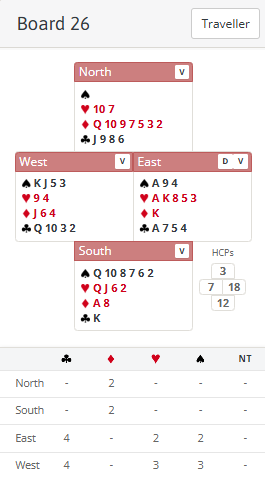
Board 26 was a hand that most people who declared would no doubt rather forget! Almost no-one made a contract and there were some ugly results with contracts from both sides going several off vulnerable. Yet this arose with no-one doing anything particularly bad!
The auction should usually start 1♥ 1♠ 1NT. South has a normal 1♠ overcall (he can’t see his partner has a void spade!) West’s most descriptive bid after that start to the auction is definitely 1NT. This should usually be semi-constructive. It shows a hand with a spade stopper, no primary heart fit and about 7-10 points (with more you can bid at the 2 level or jump to 2NT). Note it’s not the same as responding 1NT to a 1♥ opening bid. For that you might well have less and of course you won’t necessarily have a spade stop. After the overcall, however, you can pass with a weak hand (there isn’t the need to stretch to respond because opener will get another bid if he has a really big hand). So when you bid 1NT you are making a constructive move.
North can’t really bid at this point because 2♦ would usually be forcing and he’s too weak, despite his shape. His is the sort of hand that is described well by passing and then bidding later (if possible). So it’s likely to be back to East and, with 18 points opposite a constructive 1NT bid, it would be perfectly reasonable for him to bid 3NT.
On the hand 3NT will fare very badly though! Even if he wanted to, North can’t lead his partner’s suit so will surely lead a diamond. South should of course win and return a diamond and declarer’s perfectly reasonable 3NT contract goes 3 down when the defenders cash 7 diamonds! Yet neither East nor West really did anything silly – sometimes even perfectly reasonable actions just don’t work! That’s the nature of bridge. It’s important to try not to get too upset when this happens – all that does is make you play worse on the next few boards. Easier said than done though!
Things were equally bad for South if he tried more than 1♠. Several Souths played in 2♠. Perhaps he jumped over 1♥ and neither East nor West then bid again? Or perhaps East took things slower with a 2♣ rebid and South voluntarily then came in again with 2♠? He certainly shouldn’t do that. There are some warning signs – see advanced section for more details. 2♠ went 3 down several times after a heart lead since West can get ruffs and declarer will probably score just ♦A and 4 trumps. In fact perfect defence can hold declarer to 4 tricks – see advanced section for how they do that.
Deep Finesse shows that North South can only make 2♦ and East West’s best contract is actually in clubs – although it’s unlikely that either will bid the suit.
Key points to note
Sometimes you can take perfectly reasonable actions but end up with a silly result – that’s the nature of bridge and it’s important not to get upset when that happens!
A 1NT bid after your partner has opened and the opponents have made a 1 level overcall should be constructive (about 7-10 with no primary fit and a stopper in their suit).
If you hold length in the suit opened on your right, be wary about bidding too much. It’s fine to overcall once but if the suit isn’t raised on your left then coming in again can be dangerous as it may well be a misfit hand.
More advanced
I said there were some warning signs for South. The main one is length in his right hand opponent’s suit. Not only does that represent possible tricks in defence but it also reduces the chance of the opponents having a fit. When hands are misfitting you generally want to be defending not declaring! So, while it’s perfectly normal to overcall 1♠, a jump to 2♠ might be risky on this hand (as indeed it proves). Voluntarily bidding spades a 2nd time is also very dangerous for a few reasons:
- once hearts have not been raised you know the opponents don’t have a primary fit so your length in the suit means the chances are left hand opponent will be short and can ruff your hearts away.
- once you hear West bid 1NT over your 1♠, you know there’s a spade stopper there and he will frequently have 4 spades sitting over you.
- when partner doesn’t raise spades, it increases the chances he is short.
How should East West defend spades optimally? After a heart lead, East can switch to his singleton ♦K. Declarer will win and surely play a trump. West wins, gives East a diamond ruff, receives a heart ruff, crosses back to East’s ♣A and receives a 2nd heart ruff. At this point both defenders have one top trump left (they both followed to the 1 round declarer played, West has received 2 heart ruffs, East 1 diamond ruff). So now West plays another diamond which East can ruff with ♠A – freeing up West’s own top trump for a trick as well! All in all, the defence score 1 trump from the round declarer played, 5 more via ruffs, plus ♥AK and ♣A. 9 tricks in all and a very sorry score of -400 for South!
Julian Foster (many times NSW representative) ♣♦♥♠