City and Polish Club – Thursday Morning 4th September 2025.
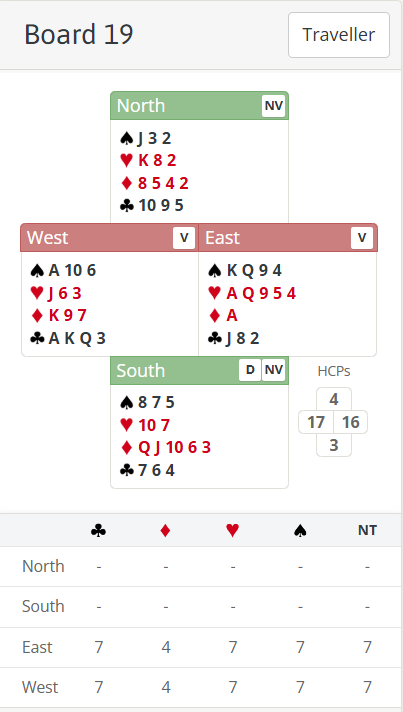
Board 19 last week had a slam available for East West which really should be quite easy to bid. Let’s have a closer look.
After a pass from South, West has a normal strong 1NT opening. At this point East should immediately be thinking about slam. He has 16 points and partner has shown 15-17 so that’s a combined 31-33. His first job, however, is to see if they have a fit in either of his majors.
The normal start would be to bid 2♦ transfer to hearts and then bid spades. That shows at least 5 hearts and at least 4 spades. (See advanced section for another idea).
What should West do? He will complete the initial transfer to 2♥ (although he has 3 card support and a maximum for his 1NT, the trumps aren’t great and his shape is 4333 so he’s not really worth a super-accept).
East should continue 2♠. Although some pairs play this particular sequence as invitational in my view it’s far better to have the agreement that any sequence where you transfer to one suit and then bid a new suit is GAME FORCING. The reason some pairs treat it differently is because the sequence 1NT-2♦-2♥-2♠ is the only such sequence where the 2nd suit is at the 2 level. In all other such sequences the 2nd suit will be at the 3 level. But it’s generally better to be consistent and treat them all as game forcing.
Back therefore to West and he can now bid 3♥ to agree hearts. Note 3♥ not 4♥. The 2♠ bid established a game force so there is no need to jump. Indeed 3♥ should show a STRONGER hand than 4♥ would at this point – it’s known as the principle of fast arrival. See advanced section for more details.
Once East knows West has a non-minimum 1NT hand he can almost force to slam. One (blunt) approach is just to use blackwood. He will find out partner has 2 key cards so the pair is missing 1. He might therefore settle for 6♥ and that would indeed score quite well. But there’s another consideration when playing matchpoint pairs – 6NT instead of 6♥ because it scores 10 points more! What card in the West hand would East need to know about to be comfortable bidding 6NT instead of 6♥ though? See advanced section for the answer.
I said Blackwood is a blunt instrument. It tends to be useful if all you want to know is partner’s key cards. Here that’s not really the case – you would like to also know what other honours partner has. For that cue bidding tends to be better. See advanced section for more on how you might cue bid.
What about the play? North will most likely lead a club or diamond against either 6♥ or 6NT. The key of course is playing the heart suit. As it happens, spades play for 4 tricks on this hand so you have 10 tricks in the other suits and only need 2 hearts to make slam. The first move will definitely be to finesse the ♥Q. Once ♥Q holds, you then have to decide how to continue the heart suit. Two questions to consider here (see advanced section for the answers):
- How should you finesse the ♥Q? Run ♥J or low to the ♥Q?
- Does your play differ if you are playing teams or pairs? If so, how?
Key points to note
Once partner opens 1NT you have a good idea of the combined point range of your hands – which should immediately tell you if you are in the partscore, game or slam zone.
It is best to play any transfer and new suit sequence over 1NT as game forcing.
The principle of fast arrival applies when you are in a game forcing sequence. Jumping to game then becomes a WEAKER action (because it’s leaving less room to explore slam).
When you have plenty of values and double stoppers in all suits, 6NT may be an option instead of 6 major – at imps it makes no difference, at matchpoint pairs it can be vital to score the extra 10 points!
More advanced
Although transferring to hearts and then bidding spades is easy on this hand there is another bidding method that can be used which you may come across called “Smolen”. With that method hands holding 54 in the majors start with simple Stayman. Over a major suit response they obviously already have a fit, over a 2♦ response they follow up with 3 of their 4 card major which conventionally shows 4 of that major and 5 of the other (you bid the shorter suit to increase the chance that the stronger 1NT opener plays the hand). So here East would start with stayman and then bid 3♠. Smolen still enables all major suit fits to be found but it then frees up sequences like 1NT-2♦-2♥-2♠ and 1NT-2♥-2♠-3♥ to show 5-5 type hands. One downside, however, is it can use up more space.
Space is what the principle of fast arrival is all about. It is something that is commonly used amongst experienced players. It basically applies when a game force has already been established. In that situation a jump immediately to game is the WEAKEST action a player can make. It’s trying to shut the auction down quickly and is leaving no room for exploring better things. A similar example occurs after 1M – 2NT game forcing raise. If opener jumps to 4M he is showing a complete minimum opening that’s not interested in going further (of course if responder has a huge hand he can still go on himself). Conversely of course if you do NOT jump to game you are showing a stronger hand because you are leaving more room to explore for slam – usually with cue bidding.
After the sequence 1NT-2♦-2♥-2♠-3♥ West has agreed hearts and shown a non-minimum (because he didn’t bid 4♥). How the auction continues now might depend on cue bidding methods. If you only cue 1st round controls East would bid 4♦. West should now realise his black suit controls are critical and cue 4♠. East might now take over with blackwood. But a method that would work better on this hand is to cue 1st or 2nd round controls. East could then cue 3♠ and the auction should then continue 4♣-4♦-4♠. Once again East might well blackwood now but this time he knows partner has club and spade controls so he is better placed to reach a grand slam should he find West have all the missing key cards.
In deciding whether to bid 6NT, East would want to know about the ♦K in West’s hand. East knows a key card is missing so it will be necessary to knock out a black suit ace, or at least take a trump finesse – i.e. he may need to lose the lead. Hence 6NT could be a disaster on a diamond lead because it immediately knocks out ♦A and the defence may be able to cash ♦K when declarer does lose the lead. If West is known to hold ♦K, then there are likely to be double stoppers in all the side suits which makes 6NT safe to play.
Finally, the answers to the two questions posed above are:
- You should play low to ♥Q. Suppose North had singleton ♥K. Leading low will cause it to pop up so you can now score ♥A, ♥Q and ♥J separately. Had you led ♥J and the first round went ♥J,K,A you would now lose 2 tricks to South’s ♥108xx. Leading low toward honours applies generally when playing a suit – the only time you would lead the honour is if you had enough lower intermediate cards or if you were desperately short of entries back to the West hand.
- This is a bit of a catch question! It frequently should make a difference but on this hand it actually doesn’t matter. Something that you should consider at imps is a “safety play” which would be to cash ♥A on the first round. You can afford one heart loser but not two. So you are trying to cater for South holding singleton ♥K – the concern being if you finesse into that, you might lose 2 tricks later on. But here you are OK because of the presence of the ♥9. Imagine the ♥Q did lose to a singleton ♥K. On the next round you would play ♥J and find that out – and you can now finesse against North’s remaining ♥108. If East did NOT hold ♥9 then the safety play would be the right play at imps. At pairs, however, it’s only going to be a good idea if you think very few pairs have bid slam. If most have (which they should here because you hold a combined 33 points) then you simply want to maximise your tricks. So you want to try to make all 13 tricks if you can. After the initial heart finesse wins, there are two ways of not losing any heart tricks – either cash ♥A (playing North for ♥Kx) or run ♥J (playing South for ♥10x so you pin his ♥10). There’s basically nothing to go on to decide that here – it’s just a guess!
Julian Foster (many times NSW representative) ♣♦♥♠