City and Canada Bay – Thursday Morning 22nd May 2025.
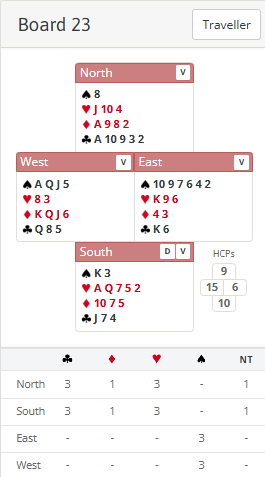
After a 1NT opening and a transfer response, the opener may have a good fit and there are ways they can announce that by not simply completing the requested transfer. But exactly why they do that, what they bid and what particular bids might show is often subject to agreements. Board 23 last week was an example.
The normal start to the auction will be Pass, 1NT, Pass, 2♥ (transfer to spades). After that a number of things could happen.
East’s intention at the time he bids 2♥ will be to pass a 2♠ transfer completion. He is obviously better than he could have been with two Kings and a 6th spade. But he still only has 6 points opposite 15-17 and no shortage. It looks like that auction did happen at a few tables.
After East’s 2♥ South might double to indicate he holds hearts. There is some risk to that action and some pairs might choose to play it differently – see advanced section for more. Regardless of that, the focus is really on West. His normal response would be to complete the transfer and bid 2♠ (then his partner can describe his hand further). But here West has prime 4 card support for his partner’s spade suit so he knows the pair have at least a 9 card fit. He can show this by bidding something other than 2♠ (in Australia we tend to refer to an action like that being a “super-accept” – in England where I learned my bridge we called it a “transfer break” – but it’s the same thing).
There are 2 main reasons to do a super-accept:
- To give partner the chance to bid game if he has a marginal hand that now improves when it learns about a fit. This is the major benefit of super-accepts.
- To immediately take the bidding to the 3 level (knowing there’s a 9 card fit) to make it harder for the opponents to compete.
In both cases it takes the bidding higher than a simple transfer completion would – that’s why it’s important to only do this with a good fit (remember partner could be doing a transfer with a 5332 zero count hand!) So super-accepts nearly always should have 4 card support. Bear in mind of course there are downsides – if East did have the 5332 zero count hand he’ll curse his partner for super-accepting as now the pair will have to play 3♠ instead of 2♠! As ever there are pluses and minuses to every bidding method.
Having decided to make a super-accept, the next question is what to actually bid? The simplest is to jump to 3 of the suit – so 3♠ here instead of 2♠. But there are various other options available and they can be used to show more specific types of hand – see advanced section for more.
Another thing to consider is what values a super-accept shows. Traditionally it shows a maximum for the 1NT as well as 4 card support for the transfer suit. But an alternative view (which is more aligned with the 2nd of the 2 reasons above) says a jump to 3 of the suit should show a MINIMUM with 4 card support (the idea being to get quickly to the 3 level to shut out the opponents who are more likely to have some values if opener is minimum) and with a maximum you make another bid. See advanced section for more on this too.
Let’s briefly consider what might happen if West does not super-accept but just bids 2♠. Now if South had doubled 2♥ North would have quite an easy 3♥ bid. If South had passed but it proceeded 2♠ P P back to him, now he might consider coming back in with a double (not ideal being 2533 but not ridiculous). That would allow North South to find a 3 level contract. It might also allow them to reach game if either were a bit stronger. That’s the scenario where jumping to 3♠ with a minimum can gain a lot.
On this hand a 3♠ bid from West will probably end the auction. Neither North nor South can bid at the 4 level. As discussed earlier, East is certainly better than he might be but even after hearing a super-accept he’s still only looking at a maximum of 23 points between the hands although he does know there’s a 10 card fit. So it’s dubious to try 4♠ – especially playing matchpoint pairs where there’s less to gain by bidding a tight game.
Lastly the play. There shouldn’t be much to that on this hand. As long as the defence don’t panic and wait for North to put a heart through when he gains the lead with one of the minor aces they should score 2 hearts and their minor suit aces. That’s 4 tricks and declarer makes the remaining 9. But it’s worth noting that game is effectively just on the heart finesse. Swap the two red aces between North and South and now 4♠ would make with a combined 21 points. Such is the power of a 10 card fit.
Key points to note
After a transfer response to 1NT, opener can “super-accept” by doing more than just completing the transfer – this usually shows 4 card support for the transfer suit.
Super accepts can help a pair reach a game they might not otherwise bid, or make it harder for opponents to compete.
There are various schemes available for what particular bids mean but sometimes they can give more information away than is actually worthwhile.
One purpose of transfers is to get the stronger hand to be declarer – so it’s worth playing “re-transfers” if opener doesn’t bid the transfer suit.
More advanced
I said South might double 2♥. It’s worth more experienced pairs discussing how to defend against transfers. A double usually shows the suit bid (hearts here) although it has some risk on this hand because East is unlimited at the time he starts the transfer. If North has almost nothing then South could be in big trouble wading in. But in practice that’s rare and it’s worth it to indicate a heart lead (remembering that after a transfer sequence the 1NT bidder is nearly always declarer so partner will end up on lead). Some pairs do play a different method where they play double to be takeout of the shown suit (spades) instead. Personally I don’t really see the point of that – if you have a takeout double of spades you can pass 2♥ and then if the 2♠ transfer completion comes back round to you, NOW you can make that takeout double (which is also safer as you now know East’s hand is weak because he passed 2♠). You only lose out if West does jump to 3♠ which comes back to you and you don’t have enough to double that.
So what other bids might West make? 2NT is a possibility – we’ll come back to that. What about suit bids? I have seen pairs play methods where a suit bid shows a potential source of tricks in that suit (so 3♦ on this hand). I have also seen those bids played as showing shortness (so 3♥ here – bear in mind “shortness” in the context of a 1NT opening means a low doubleton). Both those methods are intended to help partner judge how well the hands fit in order to decide whether to bid game or not.
But the big downside of some of those specific agreements are they give a lot of information away about the hand that is likely to end up as declarer and would otherwise be hidden. That makes the defender’s lives much easier. My own experience is it’s not worth it for the few times it comes up.
What my regular partner and I do is play a jump to 3 of the major shows a minimum with 4 card support. We play 2NT as a non-minimum usually with 4 card support (occasionally 3 card support if we really like our hand). And that’s all. We don’t use other suit bids at all. However, it’s worth noting that we play a weak NT opening so jumping to the 3 level with a minimum there has more to gain as it’s relatively more likely it will be the opponents’ hand than it is with a strong NT opening.
Bidding something other than 3 of the major also leads onto another concept. One of the points of transfers is to get the stronger hand to be declarer so the defence have to lead round into it. But if West doesn’t actually complete the transfer that might not happen. Therefore, many pairs play a method where, after one of those other bids, East has the option (if room) to “re-transfer” – i.e. make the bid just below 3 of the relevant major. Here he’d bid 3♥ to force West to bid 3♠. East would then pass 3♠ with a really bad hand, or bid on with a better hand (but West will be declarer).
Julian Foster (many times NSW representative) ♣♦♥♠