City and Canada Bay – Thursday Morning 12th June 2025.
You frequently hear the term “it’s a bidders game” in bridge. Very often that’s true. You tend to gain more by bidding more – not only do you reach makeable contracts but you may be allowed to make some unmakeable ones because defence is the hardest thing at bridge.
Nevertheless there are some times when keeping your mouth shut is right too!
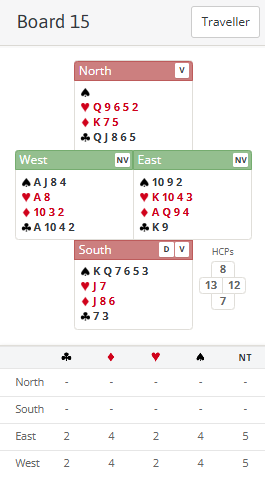
Board 15 last week saw a lot of people open 2♠ as South (or perhaps a 2♦ multi). At several tables they played in 2♠ going several off vulnerable. Some actually scored quite well because they went -300 when the opponents could make 3NT for 430. But that doesn’t make it a good bid(!) – they were lucky not to be doubled or go even more off!
There are several reasons why I wouldn’t open this South hand with a weak two:
1. It has no shortage – which means a lot of losers.
2. The texture of the spade suit is poor – i.e. poor intermediate cards after the ♠KQ.
3. It has two Jacks which aren’t really worth 1 point.
4. t is vulnerable against not. That means you are going off in 100’s so even -200 will be worse than any part-score the opponents can make and if you get doubled just 2 off is -500 which is worse than any game the opponents can make (in fact on this hand it’s possible to go -500 undoubled – i.e. 5 off vulnerable!)
Pre-empts can of course be very effective but remember one major point of a pre-empt is to make it hard to bid accurately over. So you tend to want to do them when it’s the opponents’ hand. How likely that is varies depending on which seat you are in – i.e. on who has already passed. Vulnerability also matters because if you do go off you want it to cost less than the contract the opponents could have made. So going off in 50’s instead of 100’s makes a big difference! Similarly when doubled the penalties are less when not vulnerable so you can afford to go more off if they are making game the other way.
That means it’s well worth varying your pre-empts based on position in hand as well as vulnerability. See advanced section for more on the difference of being in the 4 seats. It’s also very important to agree your style with your partner – how aggressive will you be, can it be a 5 card suit, etc. If you open 2♠ with both ♠Qxxxx and ♠KQJxxx then it’s very hard for partner to be able to bid accurately when he does have a good hand.
Here if East did decide to make a double of 2♠ for takeout (not ideal as he is short in clubs but not ridiculous and protecting against partner holding exactly the sort of hand he does have!) then West could (and definitely should!) pass to convert it to penalties. That will lead to an absolute minimum of -800 and if the defence is perfect declarer could be held to just 3 tricks for -1400!!
So how is the play and defence to 2♠ likely to go? As West I would lead a diamond. Mainly just through a process of elimination. Silly to lead a trump round to declarer and I have aces in both the other suits I don’t want to lead. I wouldn’t lead ♥A even though it was a popular choice. That’s because I have length in trumps so I am going to score trump tricks anyway and don’t really want ruffs. Also, so often leading an Ace into thin air costs a trick (on this hand it’s OK but overall it’s wrong far more often than it’s right).
After two diamonds East will probably be nervous about underleading either of his Kings so should probably just exit his 3rd diamond. Poor old declarer will be in dummy and unable to start on trumps so will have to play hearts or clubs which will help the defence see how those suits lie (I’d lead a heart to the Jack but West can win and return the suit). Whatever declarer does just leads to more losers though! He’s likely to lose 2 tricks in each side suit and at least 3 trumps which is 4 off.
Note Deep Finesse says East West can actually make 4♠ – i.e. 10 tricks! That would mean declarer making only 3 tricks and going 5 off vulnerable for -500! Can you work out the perfect defence to do that? See advanced section for the answer.
When East West did reach 3NT, they normally made 10 tricks. Declarer has ♥AK, ♣AK and 3 diamonds (the finesse wins and the suit breaks 3-3 so the 4th diamond in the East hand becomes a trick). Once declarer runs ♠10 from dummy through South, he will be able to score 3 spade tricks there as well which brings the total to 10. It is possible to make 11 though – see advanced section for how.
Key points to note
Weak twos are a very effective weapon but some hands are too much! Be wary of hands with lots of losers, poor suits and at adverse vulnerability where it’s all too easy to go for a large penalty (even if not doubled!)
Vary your style of pre-empts based on both vulnerability and seat (1st seat can be quite aggressive, 2nd seat should be sound, 3rd seat almost anything goes(!), 4th seat shouldn’t even be a pre-empt as there’s no-one left to cause a problem to!)
When on lead, try and avoid leading aces into thin air – it costs more often than not.
When defending against weak twos, try to cash your side suit tricks first and then take a ruff in one defender’s hand (if declarer has also run out of the suit, he can’t now just discard a loser in another suit).
More advanced
I talked about the style of weak twos varying by seat and vulnerability. The vulnerability is obvious because of the risk of a greater penalty. The variation due to which seat you are in is more subtle and revolves around whether you are more likely to make things hard for your own side or the opposition when you pre-empt. Here’s a guide:
- 1st seat – if you have a weak hand then it’s now 2 to 1 that it’s the opponents’ hand (all the other high cards have 2 chances to be in the opponents’ hands and only 1 chance to be in partner’s). So it’s reasonable to be quite aggressive when pre-empting.
- 2nd seat – now your right hand opponent has passed, it’s 50-50 out of the other two hands who has the most values. So you are just as likely to pre-empt your partner. Hence you should be more conservative and keep your pre-empts to a fairly well defined range so partner has more chance to bid accurately.
- 3rd seat – this time it’s a sure thing that your left hand opponent must have a good hand as both your partner and right hand opponent have already passed. So now you can be very aggressive and wide-ranging when pre-empting as the chances of your side having game on are remote. Almost anything goes!
- 4th seat – different again. There is no-one left to pre-empt now. So you only want to open if there’s a decent chance of making a plus score (you can pass the hand out to score zero). Hence it’s common to play 4th seat 2 level openings as stronger hands than pre-empts – typically about 12-15.
With the huge variation in the situation around the table (and with the vulnerability) it’s important to discuss and agree your partnership’s style. No point opening on a 2 count and a 5 card suit if partner is going to think you have an 8 count and a 6 card suit and start inviting on a 16 count!
The perfect defence to 2♠ isn’t easy but after two diamonds I suspect they need to cash ♥AK and ♣AK ending in West then lead a 3rd club which East ruffs with ♠10. Declarer can’t discard anything useful (that’s why you need to cash ♥AK first otherwise he could just discard a heart loser). So he will probably have to overruff. When West next gets in he can lead his 4th club which East can ruff with ♠9. Ultimately declarer can be held to just 2 trumps and 1 diamond! Another possibility might be to cash the side suits and then have East lead another heart. If declarer ruffs, West can discard his 3rd diamond.
When playing 3NT, declarer will need to lose a spade trick while setting up his 3 tricks there – and also a diamond trick to set up the 13th diamond in East. But having done that if he cashes all his spade and diamond tricks, North is going to be in trouble! He has the length in both hearts and clubs. Imagine a 5 card end position of something like ♥A8 ♣A104 opposite ♥K104 ♣K9. North will also have to come down to 5 cards which means he is unable to keep 3 cards in both suits. So if declarer can read North’s discards correctly, then either the ♣4 or ♥4 will become a trick as well.
Julian Foster (many times NSW representative) ♣♦♥♠