A splinter is a bid showing shortage in one suit while agreeing another. It is a very descriptive bid and often helps evaluate whether two hands fit together well or not.
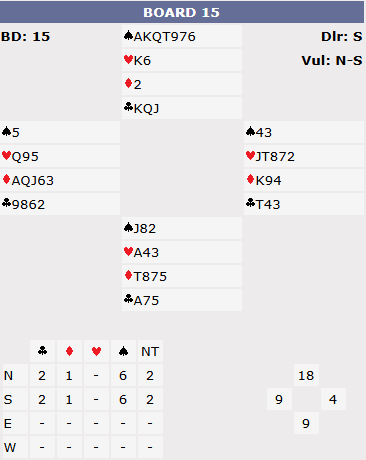
This hand from a recent pairs duplicate session was a good example. North South bid uncontested:
Pass 1♠ 2♠ 4♦ 4♥ 4NT 5♥ 6♠
Only a combined 27 points but slam is cold. Let’s explore the auction more.
South’s raise to 2♠ is normal, albeit he is maximum for the action with 9 points and 2 aces. The key bid in the auction was North’s 4♦ bid. This is a splinter showing shortage in diamonds (singleton or void) with, in this case, spades already agreed as trumps. It is also showing interest in going beyond game (otherwise North would simply bid 4♠ and not give extra information about her hand away to the defenders). Hearing this 4♦ bid is music to South’s ears! His hand has become enormous since none of his points are in diamonds at all – hence both his aces are in suits partner has some length in. What’s more his ♠J might be a useful filler for partner in the trump suit. His 4♥ bid is a cue bid showing a heart control and willingness to co-operate towards exploring slam. Note that even if he held the same hand with ♥K instead of ♥A he should still cue 4♥. Here North knows the cue bid must surely be ♥A which fits perfectly with her ♥K and hence she can pretty much underwrite at least 5♠ so uses key card blackwood. South’s 5♥ response shows 2 aces without the ♠Q. That is all North needs to hear to bid slam.
The pair only have a combined 27 points but the key is that all the points work together perfectly. Neither player has anything wasted in diamonds. Note that’s why it is usually wrong to splinter with a singleton honour as that would mislead partner about how valuable their honours in the suit might be. You might sometimes hear the expression “a 30 point pack” and this hand is a great example. The 10 points in diamonds have basically become irrelevant to North South (and it’s the splinter that gives South that information). The focus is purely on the other 30 points to see if the pair have enough to cover all their losers. Once North finds out South does in fact have 2 aces, she knows that’s enough.
Splinters are a very valuable tool in the bidding since they allow you to judge if the hands are fitting well. Had South held something like ♦KJxx, the 4♦ splinter is now a real turn-off because 4 of his points are likely to be useless. They can be used in many other positions too – see advanced section for more.
In this particular session only 3 pairs out of 9 bid this slam. Perhaps North, missing 3 aces, just bid 4♠ over 2♠. It would certainly be premature for North to jump straight to blackwood after 2♠ – after all partner might have something like ♠Jxx ♥Qxx ♦KQx ♣xxxx and now there are 3 aces missing and 4♠ is all the pair can make. So the key to the successful auction is for North to be able to show interest in slam below the level of game. Once South can cue bid hearts, NOW it is safe for North to go further. There are assorted ways North can show interest below game – the splinter here is one of them but new suits at the 3 level can be another. After a major suit raise they are usually some form of trial bid initially looking for game but they can also be used as something known as an “Advance cue bid”. See advanced section for more on this.
You would think there is nothing to the play in this hand wouldn’t you? There are 12 top tricks and a diamond loser. Indeed 8 of the 9 tables made 12 tricks. But at the 9th table North made all 13 tricks. The defence led a club and declarer ran all her tricks. Remarkably, both East and West chose to keep a diamond which meant neither kept 3 hearts and dummy’s ♥4 ended up as a winner. In matchpoint pairs, that extra trick was worth a lot. East was at fault for this – one defender clearly needs to keep a diamond winner but there can be no point in hanging onto ♦K when declarer is known to have 1 at most. She needs to keep at least as many hearts as dummy.
Key points to note
Splinters showing shortage are very powerful bids – they are very descriptive and allow partner to judge if a hand fits well.
Tend not to splinter with a singleton honour though – it misleads partner about how valuable their honours in the suit might be.
After 1M 2M, a new 3 level bid is usually played as a “trial bid” initially looking for game. But it can later be revealed to have been a cue bid (e.g. if you proceed anyway after partner signs off in 3M rejecting what, at that stage, he thinks is your “trial”)
If a splinter is one of the available bidding choices, it’s very often the best choice because it’s so descriptive.
More advanced
After a 1M 2M auction the opener will often hold a hand where they have interest in game but want to involve partner in deciding. That’s why new suit bids are normally played as “trial bids”. A trial bid is essentially an invite to game (so bid game if max, sign off if min) but asking partner to focus on a particular suit if he has a hand that is in between. There are different approaches available but the simplest is “long suit trials” where a new suit bid is essentially natural (although it might sometimes be only a 3 card suit). You are basically showing values there and that enables partner to judge if his 2M raise includes cards that fit with that. For example if you hold a shortage in the suit partner makes a long suit trial in, that’s usually bad news. An honour in such a suit is good news.
Another form of trial bid is “short suit trials” where you bid a shortage. The idea is the same of course – partner can again judge if his cards are fitting. These don’t tend to be used as much – perhaps because they give away too much information about declarer’s hand (leading declarer’s known shortage is often a good idea for the defence).
A third variation (closer to long suit trials) are “help suit trials” where you are basically looking for help in that suit. You will usually have an honour there (Kxx, Qxx, etc) but want partner to provide some honours as well (or shortage with perhaps an extra trump to ruff declarer’s in the suit with).
What form of trial bids you play is definitely something experienced pairs should discuss.
These bids are all very useful when you have a game invite hand. But if you have a much stronger hand that knows it’s already going to bid at least game after a 2M raise, you can also make an “advance cue”. You start by cue bidding a control in one of the side suits. Yes partner will INITIALLY assume that is a trial bid (of whatever form you are playing). So he will respond according to that. Hence if he jumps to game you now know he’s maximum or at least medium with a hand he thinks fits with your trial bid. That may be enough to now proceed towards slam. But if he signs off in 3M and you NOW continue anyway (either to 4M or, more likely, with another cue bid) you are now revealing that your previous 3 level bid was in fact a cue bid and you were always going to game anyway (why would you bother to make a game try, hear it rejected, and then bid game anyway?) This may now enable partner to re-evaluate his 2M raise and make a further cue bid or something.
On this particular hand North doesn’t have a 1st round control to cue bid over 2♠ so 4♦ is the more descriptive bid. But, had the ♣A and ♣K been swapped round, she might have started with 3♣ and then moved again when South jumps to 4♠ (as he would opposite a long or help suit 3♣ trial bid with a maximum and, in that scenario, an honour in clubs).
It’s worth noting on this hand that had North signed off in 4♠ after South’s 4♥ cue there is a good case for South to have another go with a 5♣ cue. He is the one who knows from the splinter that the hands fit extraordinarily well and has 2 aces (something a hand that has raised 1M to 2M won’t have that often) so showing his ♣A could be essential to partner.
Because they are so useful splinters can be used in other places too – e.g. as an immediate response to agree a suit (for example something like 1♠ P 4♣), in competition, etc. With one of my regular partners we actually also play things like 1♠ P 3♣ as splinters rather than the more common Bergen raises. They tend to show either about 8-11 points with that shortage or a very strong hand. It’s all something more experienced pairs can discuss.
In general, if a splinter is one of the available bidding choices, I nearly always choose it because it’s so descriptive and helpful to partner.
Julian Foster (many times NSW representative) ♣♦♥♠