I hope everyone had a good Christmas & New Year. I had a holiday last week but will now continue with the column which I will aim to publish each weekend.
This is a hand from the Sydney Bridge Club Festive Individual held on Sunday 28th Dec. Thanks to Mark Guthrie for providing the hand.
The event was extremely popular attracting 25 tables (and a waiting list). Individuals are a form of bridge event that are not played that often – primarily because they are hard to organise. You obviously want an exact multiple of 4 people (which means you may need 3 standby players), and you want to play with and against as many different people as possible – but to do so fairly evenly (otherwise some people will end up partnering the “good” players more often than the “bad” players). For some numbers of tables it’s also hard to get fair movements though. As a result they don’t tend to be that popular amongst directors!
From a player perspective they can also be extremely random so some people dislike them – it’s blind luck who you happen to play with and against on each board. On the other hand bridge is a partnership game and you learn something from every partner you play with (or should do). So, as long as you don’t take them too seriously, individuals can actually be really good fun (and often provide lots of good stories for dinner or the pub afterwards!)
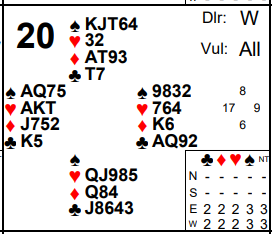
Board 20 above (from the afternoon session) often contained a decision about whether to double or not. At most tables West will open a strong 1NT (those playing a weak NT system may gain on this hand – see advanced section for why). Over 1NT North might consider wading in not vulnerable but when vulnerable it’s too much so he will likely pass. At that point East will use stayman and when partner bids 2♠ he will usually bid 4♠. This comes back to North who will be licking his lips (as well as being very relieved he didn’t wade in over 1NT!) But should he double 4♠? It’s certainly very tempting as he has ♦A and surely good chances of 3 trump tricks – and that’s just in his own hand (partner could contribute something as well).
BUT(!) the big danger of doubling is that it will tip declarer off that trumps are breaking very badly and he may be able to play the hand differently – possibly to even make the contract. Whereas, had you kept quiet, he would be unsuspecting and almost certainly go several off.
The winner of the event was Julie Guthrie. She was South and at her table East West landed up in 4♠ which North did not double. As a result declarer started (as surely we all would?) by attempting to draw trumps. When he innocently led a trump from dummy and South showed out he had a horrible surprise and eventually ended up 3 off! It perhaps wasn’t necessary to go 3 off but 4♠ 2 off was certainly a common result.
Contrast that to what happened at Mark Guthrie’s table. He was also South and this time, on the same auction, his partner doubled. After ♦A and another diamond declarer now had a tip off that trumps were breaking badly so he didn’t touch the suit. He could instead cross to ♥A, ruff a diamond, cross to ♥K, ruff another diamond then play 3 rounds of clubs discarding his final heart. At this point declarer had scored ♦K, ♥AK, 2 diamond ruffs in dummy and 2 clubs. North by now was down to just his 5 trumps so was forced to ruff (his 2nd trick). Now he had to lead away from ♠KJ10x which ran to declarer’s hand (his 8th trick). This left the last 3 cards as declarer with 3 trumps (♠AQ5, ♠A75, ♠Q75 depending on what spade North had exited with) and dummy with singleton ♠9. When declarer led a low spade towards the ♠9 North had no answer. He could win but then had to lead round to declarer’s remaining 2 trumps or he could let dummy’s ♠9 score but that would be declarer’s 9th trick with ♠A still to come. -790!
There are some important lessons here. Doubling often costs a trick because you tip off the declarer about the layout. That’s especially true on this hand (see advanced section for why). Even if declarer had gone 1 down he would have scored -200 which is likely to be the same (or even better) than the undoubled scores other North South’s were getting. Doubling is even more expensive if it actually enables declarer to make a contract that he otherwise wouldn’t have done!
Sometimes there is another reason for not doubling too – the opponents might have somewhere better to go. Here that’s unlikely as they are already at the 4♠ level but at lower levels it’s frequently a factor.
So doubling is by no means as tempting as it might at first appear(!) – especially if the opponents are vulnerable and will be going off in 100s undoubled. At the slam level this is even more the case. If you keep quiet and the opponents go off in a slam you will almost certainly score extremely well. For that reason doubling a slam has almost nothing to gain and many players use a double of slam to mean something else – see advanced section for more.
Key points to note
Be wary before doubling the opponents. You could tip them off that you have all the trumps and that might change the way they play the hand. It will frequently cost at least 1 trick. It can therefore often be better to sit quietly and wait for declarer to have an unpleasant surprise when he plays the hand!
A double which tips the declarer off about the layout to the point that he now makes the contract is one of the most expensive decisions you can make in bridge!
Doubling a slam that’s going 1 off is pointless (you’ll be getting a great score for 1 off undoubled anyway). A much better use of double of a slam is “Lightner” which basically asks partner to find an unusual lead (dummy’s 1st bid suit or try to find a suit partner is void in for a ruff on the opening lead). This gives the defence a chance of beating the contract that otherwise probably wouldn’t be found.
If you are doubled in a contract where you have plenty of points, competent opponents will have a reason. It’s almost certainly because key suits (usually trumps) are breaking very badly. Adjust your play accordingly!
More advanced
Those playing a weak no trump system will usually open the West hand 1♦ with the intention of rebidding 1NT (to show a strong NT). However, it’s now possible that North might wade in with an aggressive 1♠ overcall! So often overcalling with that sort of hand is right – but here it most definitely is not! Even if East West just pass 1♠ out they are likely to beat 1♠ by a number of tricks and go positive when they would otherwise have been going negative. If they decide to bid on instead, they have now both been tipped off that playing in spades is a very bad idea! So they are more likely to play 3NT which they can make. Either way they do much better than those opening a strong 1NT as West. These are just variations that different systems cause. On anther day the fact that West opens 1♦ might allow North to overcall 1♥ or 1♠ and find his side a fit that wouldn’t be found over 1NT because it’s too risky for North to overcall at the 2 level.
As declarer when you are doubled in a contract by competent opponents you should ask yourself why. Sometimes it can be because they just have a lot more points than you but that’s not the case on this hand. West can see that his side has a combined 26 points which is completely normal for game. That means the only reason North can be doubling is because he thinks he has trump tricks.
Doubling a slam to try for +100 instead of +50 is pointless since just taking a slam off will score really well (at either imps or matchpoints). In fact if the double enables declarer to make a slam that would otherwise have gone off then it’s about the most expensive mistake you can make in bridge! For that reason most experienced pairs choose to play double of a slam as something called “Lightner”. The idea is that double calls for an unusual lead (either dummy’s first bid suit, or frequently the doubler has an ace and an unexpected void which he’s hoping partner can find for an opening ruff on the lead). The logic is that the doubler thinks the slam will make on normal defence so is trying to get partner to find something else. It has far more to gain than lose in those circumstances. Yes there are times when this can backfire – sometimes the Lightner double of a suit contract tips declarer off that there may be a ruff and they may be able to shift to 6NT instead. As usual, no convention is perfect!
Julian Foster (many times NSW representative) ♣♦♥♠