City and Polish Club – Thursday Morning 31st July 2025.
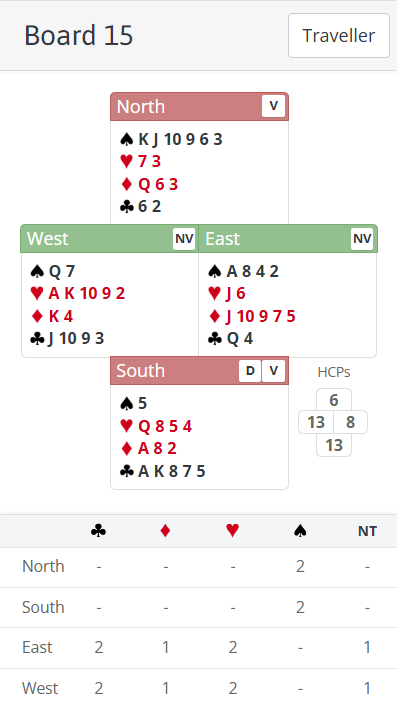
Board 15 last week was a classic competitive partscore hand. The points are roughly equal between the two sides and each can made a contract at the 2 level although, as we shall see, it’s a lot easier for East West than it is for North South!
The normal start to the auction will be 1♣ 1♥ 1♠. North’s 1♠ will often show at least 5 spades (because he could double 1♥ to show exactly 4). At this point East can make a very useful bid known as a “competitive double”. It’s not specifically takeout or penalties. It’s a bid that basically says he has some values but no clear action – he’s willing to compete but not quite sure how. It applies in a situation like this where 3 suits have already been bid. It says he has the 4th suit (diamonds here) but isn’t strong enough to bid them at the 2 level himself. He doesn’t have primary support for partner but has tolerance (almost always a doubleton). He probably doesn’t have stoppers in the opponents’ suits (or he would bid 1NT). So it’s really a type of “catch-all”.
After double from East, South should pass – and be happy to do so! He has nothing further to say, his 2nd suit has been overcalled on his left, and partner has bid his singleton. West will now bid 2♥ – he doesn’t have diamonds so the known 5-2 heart fit is the best option. Then it’s back to North. He might choose to have another go and if he does he should bid 2♠. But it’s very marginal – personally I would probably pass. His ♦Qxx doesn’t now look very good knowing there are diamonds sitting over him. Also he is vulnerable so there is a risk of going -200 for a horrible score. Assuming he had already shown 5 spades then he knows partner won’t have 3 (he would have raised) so the best he can hope for is partner holding 2 spades.
If East had chosen to pass over 1♠ then South will have to rebid 2♣. North will now have to decide whether to pass that or bid 2♠ himself (the latter is preferable – see advanced section for why).
What about the likely play and defence? 2♥ by West should make 8 tricks. North will most likely lead a club, his partner’s suit. South should win and switch to his singleton spade – he is hoping to set up a spade ruff in his hand or tricks in his partner’s. It’s also likely that partner has a broken spade holding where he needs South to lead through to it – see advanced section for why.
Declarer will win ♠A. He would like to take a trump finesse and also lead up to his ♦K but he only has one entry to dummy so he can’t do both. Trumps should be his priority so he should start with ♥J and that will enable him to draw them all. (Should South cover ♥J? Debatable! See advanced section for more). After drawing trumps declarer continues clubs to set up 2 further tricks there but he should be limited to 1 spade, 5 hearts and 2 clubs. That’s provided the defence avoid touching diamonds – South should exit clubs and North has safe spade exists. Both throw declarer back in his own hand and he will eventually have to lead away from his ♦K.
What about if North did play 2♠? On the face of it, the favourable spade position looks like declarer will just lose 1 spade, 2 hearts and ♦K. But it’s not as easy as that. In fact although Deep Finesse says 2♠ can be made, even making 8 tricks is quite hard if East leads ♥J and the defence play 3 rounds. If declarer ruffs the 3rd heart with, say, ♠9 East should NOT overruff. Instead he should discard a club. His ♠A8xx is now going to be quite a nuisance!
Most declarers in 2♠ went off. 1 off for a score of -100 wasn’t too bad because some East Wests made +110 in hearts but 2 off for -200 of course scored terribly. See advanced section for how it can be made and more on why it’s often right for a defender not to overruff in positions where he could.
Key points to note
Hands often play better in a weak hand’s long suit (it’s still worth something as trumps).
If partner doesn’t lead a suit your side has bid it’s usually because he has the unsupported ace or a broken honour holding he doesn’t want to risk leading away from. That might mean you need to lead the suit through for him.
A competitive double is a useful bid at the 1 or 2 level after 3 suits have been bid – it implies some values but no clear cut bid yourself – so usually tolerance for partner’s suit and the 4th suit.
Be wary of bidding on when vulnerable when you may have no fit. If you go -2oo you will get a really bad score!
It’s frequently better for a defender NOT to overruff even if they could – particularly if it’s with a card that would score anyway. By discarding instead, you may later score 2 trump tricks.
More advanced
If East passed over 1♠ I said South would have to rebid 2♣ and North should then bid 2♠ rather than pass. Two reasons for that. Firstly hands often play better in the weak hand’s long suit. North’s hand is worth several tricks when spades are trumps (partner’s high cards in other suits will still score tricks). But if clubs are trumps North’s hand might not be worth any tricks at all since even if partner could set up some spade winners he might never be able to reach them. Secondly it’s matchpoint pairs so spades score a lot more than clubs.
When defending against a suit contract and partner does not lead the suit he has bid it usually means he either has the Ace (without the King) or it means he doesn’t have a sequence of honours. That’s why South, on this hand, should be quick to switch to his spade against 2♥. He is missing ♠K,Q,J,10,9. Surely if North had a decent sequence of those honours he would have led the suit himself? So there’s a very good chance he has a holding he didn’t want to lead away from (as is the case here – North in fact did well not to lead from ♠KJ10 as it would have run around to declarer’s ♠Q).
Should South cover ♥J? Not clear! The purpose of covering is to promote a lower card into a trick – either in your hand or in partner’s. Here South knows North can have at most 2 hearts. It would be very embarrassing to cover and discover partner held singleton ♥K! On the other hand, if partner held ♥9x now you do need to cover (declarer doesn’t have another entry to dummy to later finesse against your ♥8).
How about the play in 2♠? I said East should not overruff if declarer ruffs the 3rd round of hearts with ♠9. There’s no rush to overruff with ♠A as it will score a trick anyway. If he discards a club instead, he will later score his ♠8. But it could be better than that! Suppose declarer initially ruffed with ♠9, then crossed to hand to play a trump to ♠10 and ♠A. He still has to reach dummy to continue drawing trumps and the only top spades he has left are now ♠KJ. So if he ruffs again with ♠J and uses ♠K to draw West’s ♠Q all of a sudden East is left with ♠84 sitting over declarer’s ♠63!
To make 2♠ declarer actually has to realise what is going to happen if he keeps ruffing high and counter it by deliberately ruffing low earlier. He can afford to lose 2 trump tricks but not 3. So East can score a cheap trump and exit ♦J but he cannot both take a cheap overruff and discard a club. Declarer can now win ♦A and lead a trump to the ♠9 and ♠A. The best the defence can do is cross to West’s ♦K and lead another heart. But now declarer can afford to ruff with the ♠10 and still has ♠KJ to draw two more rounds of trumps. That still gives East a trick with ♠8 but overall declarer holds his losers to 2 trumps, 2 hearts and ♦K. Not easy – and it would be quite understandable to start ruffing high in the hope trumps behaved better and could be drawn more easily.
It’s actually quite common for defenders to be better off not overruffing – especially with a top trump that would score anyway. Suppose you held ♠A10x sitting over declarer’s ♠KQJx. If he ruffs with ♠J and you overruff with ♠A that’s probably the only trick you get (when declarer next gets in his ♠KQ will draw your remaining ♠10x). On the other hand if you refuse to overruff and discard from another suit instead, now your ♠A10x are worth 2 trump tricks no matter what declarer does. It’s sometimes possible to promote some surprisingly lowly little trumps into tricks when declarer is ruffing high!
Julian Foster (many times NSW representative) ♣♦♥♠