City and Canada Bay – Thursday Morning 3rd July 2025.
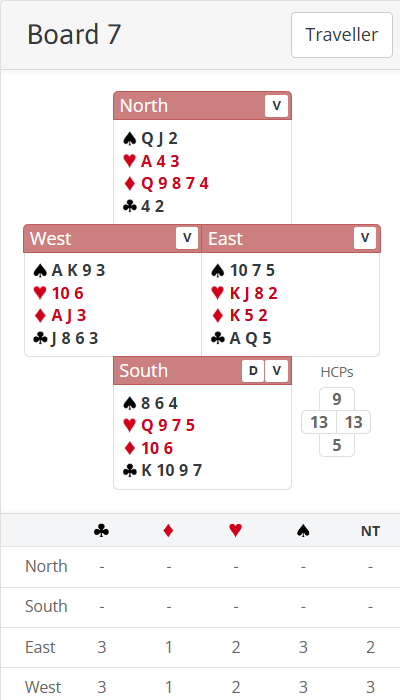
Board 7 last week normally ended up with East West playing in 3NT. But it was one of those difficult boards where it’s not clear which suit to play on to get your tricks. There are options in nearly all the suits.
The normal start to the auction will be Pass from South and 1♣ from West. Some North’s might choose to overcall 1♦. That’s marginal here with a poor quality suit and it takes up no space in the auction (see advanced section for more discussion on this).
East will presumably bid 1♥ although it looks like one or two Easts just bid 3NT directly. West will most likely rebid 1NT (some might bid 1♠ but it’s usually better to show the overall balanced nature of the hand with a fairly narrow point range and rely on some further enquiry methods to explore if you have a spade fit). East will clearly then raise 1NT to 3NT.
Against 3NT North is quite likely to lead a diamond which helps declarer as it runs around to his ♦J. But this is then one of those quite awkward hands where you have plenty of points but no obvious source of tricks. After the diamond lead you still only have 6 top tricks and need 3 more. You could play on spades to try for a 3rd spade trick, in hearts the ♥KJ10 means you will eventually be able to score another heart trick and clubs can of course also be worth 3 tricks.
However, none of these are enough for your contract on their own so you’ll have to do more than one. But the problem of course is time – you can’t try all of these things before the defence get their diamonds going. I would probably start with a club finesse because even if that loses I may now have 3 clubs. But the problem is South will win ♣K and return a diamond. Now the defence are ahead in the race to get North’s long diamonds established. Even if declarer now plays spades, North has entries in both those suits so the most declarer can get is 3 spades, 3 diamonds and 2 clubs. But note South has to be slightly careful. He needs to cling onto all his clubs because otherwise declarer will be able to score 3 clubs, 3 diamonds and 3 spades.
To make 3NT declarer actually has to knock out one of North’s entries first rather than South’s – say he plays on spades. That will succeed in setting up his 13th spade. North will get in and he can return a diamond but now if declarer takes the club finesse losing to South, this time South has no diamond to return. That gives declarer time to play on hearts as well. He will eventually score 3 spades, 1 heart, 3 diamonds and 2 clubs (3 if South discards one). But there’s no real way declarer can know which major suit to attack – South might just as easily have the spade entry or North might not hold ♥A.
3NT played by East cannot be made because South can lead ♦10 through West’s ♦AJx which limits declarer to 2 diamond tricks. There’s no way declarer can reach 9 tricks in time then.
One final quiz. How would you play the spade suit for 3 tricks? Assume you have ample entries to each hand.
Key points to note
Overcalls that take up no space should typically show a decent suit or a decent hand. Ones that take up a lot of space (e.g. 1S over 1C) it is worth doing when much weaker to cause problems.
Some no-trump hands have lots of possible suits to play on. Try to choose ones which create enough tricks for your contract (not always possible – as on this hand). Or knock out certain entries like aces.
Declarer usually wants to knock out entries in the defending hand which holds the potential long suit winners (so that hand can’t get back in later). But it’s still often a guess which defender has which entry – and hence which suit to play on first!
The best way to play a suit in isolation can often vary depending on which intermediate cards you have. The 10 or 9 can make a difference to the best play. There are many books covering card combinations for those really interested (but it’s important not to get too hung up on these – remember you are seldom playing a suit in complete isolation – you nearly always have other information about the bidding, lead or early defence that may swing the odds in a suit).
More advanced
When overcalling there are 3 general considerations:
- The quality of the suit
- The strength of the hand
- The amount of space it takes up in the auction
The suit quality is important – not only to reduce the risk of being doubled(!) but also to indicate a good lead for partner if your side ends up defending. The strength is obviously also relevant to being able to make your contract. But the amount of space a bid takes up in the auction often doesn’t get as much attention as it might. Overcalling 1♣ with 1♦ takes up no space at all (and in fact gives the other side an extra bid because they can now double as well as pass). Conversely, overcalling 1♣ with 1♠ takes up the entire 1 level and can cause a surprising number of problems for the opening side. Therefore it’s more worthwhile doing that on a weaker hand or a poorer suit.
When you are declarer where it’s not always clear which suit(s) to play on, it is usually right to knock out certain entries like aces first. If you have to take a finesse into the partner of the opening leader, you might want to do that later (hopefully after that hand has run out of the suit to return). That might be an argument on this hand NOT to take the club finesse. But it’s still then unclear whether you want to play on hearts or spades!
The question of which suit to play on is a common theme when the defence are trying to establish a long suit in no-trumps. It’s often necessary for declarer to attack the entries to the hand with that long suit. The trouble is it’s often a guess for him which defender has which entry! For example you might have two aces to knock out. If you first knock out the ace that’s with the long suit, that hand may not be able to get back in later to cash its winners. But if you knock the other ace out first and the other defender returns the suit, now it may get established while the hand with the winners still has an entry. Sadly it can often just be a blind guess which defender has which entry!
Lastly I asked how you should play the spade suit for 3 tricks? It does partly depend on the entry situation but, assuming enough entries to the hand with the 4th spade, the right play in the suit with this combination is to cash ♠AK. That’s because you hold the ♠10 and ♠9. So any time the suit breaks 3-3 it’s fine but it’s also fine whenever there is ♠Qx or ♠Jx in either defender’s hand (your ♠10 opposite ♠93 are then sufficient to knock the other honour out and establish the ♠9 as a winner). The only holding you lose to is when a defender has ♠QJxx. Note the presence of the ♠9 and ♠10 make a big difference. Without that you cannot pick up nearly as many combinations and will often just need the suit to be 3-3.
Bear in mind of course that, although there are plenty of books written about card combinations and the best way to play them – you should always be wary. These books are always written as if you are operating in isolation with no other information. But you never are! There will always have been an auction and an opening lead, and perhaps some earlier defence. These all give you clues to the likely layouts. It’s entirely possible that information will mean the technical odds play in a suit can no longer work and needs to be re-thought!
Julian Foster (many times NSW representative) ♣♦♥♠