
There are times when it’s quite dangerous to come into an auction. Today’s hand taken from the Newcastle congress held over the weekend of June 13-14 is an example.
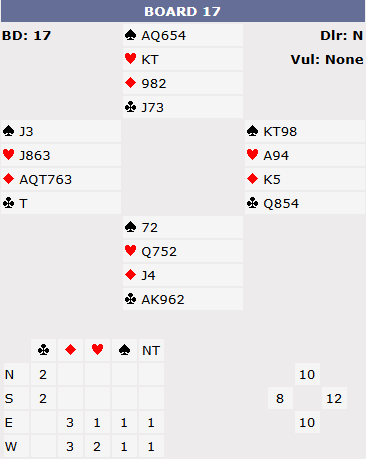
The bidding at the table began Pass 1NT (11-14) P 2♣. 2♣ was Stayman and West’s plan was to play in diamonds if partner didn’t have hearts (pass 2♦ or bid 3♦ over 2♠).
But at that point North came in with 2♠. This proceeded Pass Pass Double, all pass. Despite South having 10 points, the contract still ended up going 3 off for -500.
The 2♠ overcall by North was very dangerous for a number of reasons:
a) West was unlimited – he might have been using Stayman on the way to bidding game.
b) East’s hand was fairly well defined after the 1NT opening. That means West is the only player at the table who really knows whose hand it is.
c) South is limited to some extent – he wasn’t able to overcall 1NT, nor could he double it. OK he could still have had a balanced hand up to about 14 points but there are some hands he definitely can’t have.
d) It’s not a great hand – he is balanced, he only has 5 spades and their quality is poor.
This is sometimes referred to as coming into a “live” auction. East West are still bidding and it’s not yet known whether West is looking for partscore, game or maybe even exploring slam. The situation is very different if one of them has passed – now their hand is limited and it’s often possible to deduce that partner must have some values. That’s not the case here.
You might argue that this hand would surely overcall a 1 level opening with 1♠. Yes absolutely but that’s a very different situation. After a 1 level opening the opening bidder’s hand still isn’t well known (he could basically have anything between about 10 and 20 points and a vast array of possible shapes) so the overcall may make life harder for responder and allow your side to compete. A 1NT opening narrows down the hand types enormously which makes it much easier for partner to judge what to do if the opponents come in. Also a 1 level overcall is a much tougher proposition for the opponents to confidently double.
At the table West reopened with a double in case East was sitting with a penalty pass (his double of 2♠ would not have been penalties, it would have shown hearts – see advanced section for more on how to bid after the opponents bid over stayman). He still had the chance to bail out in 3♦ otherwise so the overcall just gave East West a possibility of taking a penalty instead of bidding their own contract.
The defence actually began relatively badly – East led a low club which declarer ran to his ♣J. At this point declarer tried ♥K which East won. He now switched to ♦K as partner had to have some diamond values (he has already shown up with nothing in clubs, at most ♥J and can’t have much in spades to be making a takeout double). This held the trick and West, tried to discourage to get a club ruff. But instead East continued a diamond and then ruffed a 3rd diamond with ♠8. Now the defence could continue club ruff, another diamond ruff and another club ruff (declarer had made an error by now – can you see what it was? See advanced section). East still had ♠K to come which was the defence’s 8th trick.
Key points to note
If one or both opponents have not limited their hands it’s much riskier to wade into the auction. Especially at the 2 level. Good opponents will penalise you heavily if the cards lie badly.
When one player opens 1NT their partner is in the most powerful position because only they know which side’s hand it is.
It’s worth regular partnerships discussing what bids mean if the opponents intervene over Stayman.
More advanced
Have you discussed what your bids mean if the opponents intervene over Stayman? It’s worth it – sometimes they actually give you more bids than you would have had yourselves! A fairly common method that I play is that double is basically takeout – so over 2♥ it shows 4 spades (bidding 2♠ would show 5 spades – assuming that’s allowed in your 1NT opening) and over 2♠ it shows 4 hearts (bidding 3♥ would show 5 hearts but also a maximum since you are a level higher). Over a 2♦ overcall you can choose to ignore the overcall and bid your major response, with pass showing a 2♦ response (which leaves double to mean something – could be diamonds?) If they double 2♣ you actually gain two bids – pass and redouble so you can define those as something if you want (perhaps one says you actually have clubs and are OK to play in 2♣ if partner wants to?)
What did declarer do wrong in the play? At the point West led a 4th diamond, he could have discarded his own 3rd club (he actually ruffed and was overruffed). East ruffs ahead of dummy anyway but now West doesn’t score his ♠J as another club ruff since declarer can overruff. This at least holds the loss to 300.
It’s worth returning to the comment made at (b) above – i.e. that after East’s 1NT opening West is the only player who knows whose hand it is. This is generally the case – the partner of a 1NT opener is basically in the most powerful position in the auction. Especially opposite a weak no-trump of 11-14. Why? Because West is basically going to pass 1NT with anywhere between 0 and 10 points. That’s a huge range – and only he knows where his hand sits within it. It’s what makes it risky for an opponent since those 10 points might be in their partner’s hand (in which case they might be being talked out of their contract) but they might not be (in which case wading in could be very expensive – as it was here). This is a reason why the weak 1NT is actually a very effective type of pre-empt!
Julian Foster (many times NSW representative) ♣♦♥♠







It’s a telling indictment of North’s bid that their hand can really only score the trump Ace and the fifth trump. The QS was under the KS, the KH was under the AH, and even the JC was under the QC. Most of the tricks made by NS come from the South hand that had actually promised nothing.