Recently I played in a session where the weak no-trump opening that we play (11-14 balanced) came up quite a lot. It was evident that many pairs, clearly not used to it, had no idea how to defend against it. So today we’ll look at that – along with some of the overall upsides and downsides of the weak no-trump.
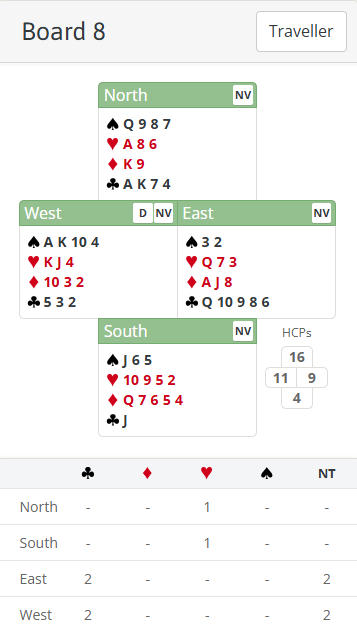
On the hand today West opened an aggressive 1NT (11-14) and North doubled. This is fine. Double should usually be played as penalties – generally at least 16 points (perhaps 15 with a good lead). One of the few downsides of the weak no trump is that it can occasionally get doubled and go for a large penalty (see advanced section for more on this). East passed which on this occasion was prepared to play there (it’s important to have a method of running from 1NTx with weak hands though – there are lots of possible options, see advanced section for more).
South not unreasonably didn’t fancy 1NTx and bid 2♦ with her extremely weak hand. At this point North made an error and bid 2NT. With only 16 points this was basically repeating what she’d already shown when doubling 1NT to start with. Her partner has shown a weak hand (usually less than 6 points) when she doesn’t leave the double in. So, even though 2♦ isn’t that appealing, it’s the least bad option and North should have passed. 2♦ is likely to go 2 off (losing ♠AK, a spade ruff, 2 hearts and 2 trumps). What’s more neither West nor East can really double it. -100 is not a disaster – especially as East West can score 120 in no-trumps themselves.
After 2NT, however, East doubled (she is looking at 9 points opposite 11-14 so her side has a majority, what’s more almost all the other side’s points are known to be in one hand which makes it much harder to play).
Even though East found the unfortunate start of ♣10 which allowed the singleton ♣J to score a trick, the end result was still 3 off and -500. Declarer tried a diamond to the ♦K and ♦A but East just continued clubs. With no entry to South’s diamonds, declarer only scored ♥A, ♦Q and 3 clubs.
One of the key things when defending a weak no-trump is that double should be a reasonable hand; don’t double on just any opening hand. There’s too much risk the contract can make – scoring at least 180. If you bid again after partner runs from the double, you should be showing an extremely good hand (20+ balanced or a very powerful hand with a long suit).
If you don’t have enough to double initially there are also lots of schemes for bidding over 1NT. It can be risky but if you pass you may risk missing too much, even potentially a game. Natural bids over 1NT are OK although it’s useful to have a bid to show both majors (most commonly 2♣). There are also lots of 2 suited methods available as well – interested pairs can read up on those. As usual exactly what you play isn’t so important – what matters far more is that you and your partner both know what you are playing!
Finally, it’s also important to discuss what happens after you do double 1NT and they run. It’s quite likely to now be your hand so you need to be able to either double them or reach your own contract. Are your doubles now penalty or takeout? These days takeout tends to be more common but either is playable, you and your partner just need to agree which.
Key points to note
Double of a weak NT should usually show 16+ or 15 with a good lead. Partner should usually pass with about 6+ points.
Don’t bid your hand twice. If you’ve doubled 1NT you have already shown a good hand. If partner pulls it that means they have a very weak hand and you should usually pass – unless you have even more (20+ or equivalent).
If you play a weak NT you should discuss how you run from it when you are doubled.
If you double their weak NT and they run, discuss whether your subsequent doubles are penalty or takeout.
Play and defence is much easier when the points are split between the hands. When almost all your side’s points are in one hand you tend to struggle as that hand will keep getting on lead and have to lead away from honours. This can happen if one hand doubles 1NT and the other has very little.
More advanced
The traditional downside of the weak no trump is it can be doubled and go for a large penalty. This is what’s usually talked about. While this is certainly possible in reality this very seldom happens – either you successfully find a better spot to run to, or they run themselves as the partner of the doubler is so weak.
The weak no trump is actually more like a preempt. It takes away the whole 1 level and makes it a lot riskier to bid over. It also quite narrowly defines the hand so only your partner knows which side’s hand it is. They might be sitting with 0 or 10 points and they will still pass 1NT. That’s a very wide range! If the opponents don’t bid and partner has 0, they may miss an easy game. If they do bid and partner has 10, they may get into big trouble! There’s no way to know. It’s a lot safer coming in with a 1 level overcall after a 1 minor opening bid, say.
The biggest downside of the weak no trump actually comes with the rebid. When the 1NT opening is 11-14, a 1NT rebid is usually 15-17. The problem comes in a competitive auction. Say it goes something like 1♣ 1♠ x 2♠. Playing Standard holding a weak no-trump you just pass here (you can’t hold a strong NT or you’d already have opened it). Playing a weak no trump you opened 1♣ planning to rebid 1NT. So you might hold 17 points in this auction. You’d like to bid something to say to partner you have those values. But that may now be quite uncomfortable if you haven’t found a fit. On the other hand, if you pass, you might miss a contract your way as partner doesn’t know you are that strong.
If your 1NT is doubled you do need a way to run. There are lots of schemes available – usually aimed at showing various combinations of 1 and 2 suited hands. What I play is XX shows a single suited hand (it asks partner to bid 2♣ whereupon you pass or bid your suit), a suit bid shows that suit and a higher (over which partner passes or bids the cheapest place they are prepared to play). I play pass over the double as neutral – it might simply be nowhere to go (a 4333 1 count!) or it might be values and prepared for partner to play in 1NTx.
Some pairs prefer pass to force a redouble from partner followed by various other bids meaning different things (often touching suits are bid directly and non-touching suits are bid via the redouble). Personally I don’t like that as it means you can never play 1NTx when it’s making. If partner passes the redouble the opponents are more likely to now run and it may not be clear whether your side should bid on or double them. Whereas opponents are more likely to stand 1NTx and just hope it goes off.
Julian Foster (many times NSW representative) ♣♦♥♠