You may have heard players use this expression. It’s referring to the fact that so often at bridge when you have a choice of passing or taking a risk and bidding – it’s the bidding choice that tends to pay off. Today’s hand taken from the Stroke Awareness fundraising session held at Sydney Bridge Club on Wed 9 September is an example.
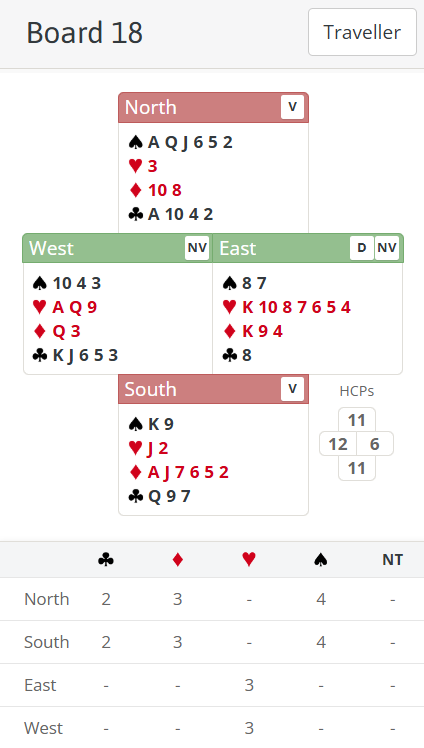
East will most likely open 3♥ – a fairly standard preempt. South can’t really bid over that. 4♦ would be a huge risk with a poor shape (no shortages) and a poor quality suit. Some people also play that to have a different meaning (see Advanced section).
West will surely then raise to 4♥. That has two ways to win – it increases the pre-empt and make things even harder for North South but 4♥ might easily be making anyway (on the hand just change partner’s ♠7 to the ♣7 – now you just lose 1 spade, 1 diamond and 1 club if you guess right).
Over 4♥ North now has the key decision. Pass or 4♠? From the scores on the board it looks like this was about 50:50. 4♠ certainly carries some risk – only West knows whether he is bidding 4♥ with a weak hand to increase the pre-empt or with a strong hand that has genuine expectations of making it. He is effectively in charge of the auction after his partner has pre-empted. If he does have the strong option then 4♠ could get doubled and go several off. On the other hand passing might mean North South get robbed blind! This of course is why pre-empts work – opponents are forced to guess at a high level and will sometimes guess wrong.
Today, as so often is the case, the more aggressive 4♠ bid pays off as that contract makes. It’s worth noting that North and South both have 11 points but it’s far more attractive to bid on the North hand for many reasons:
- The long suit is good quality (so less likely to find a strong trump holding against you which may be able to double).
- The shape is better – a shortage in hearts (so only 1 loser) and a 2nd suit that could be set up.
- The points are in the long suits.
- Two aces and no jacks (in the traditional point count aces tend to be undervalued at 4 points and jacks overvalued at 1 point).
- The contract you’re bidding is game so you get a bonus when you are right.
Contrast that with the South hand which has a poor quality long suit, no shortage, no 2nd suit, several points in short suits, only 1 ace and 2 jacks. It’s also a minor suit so not game unless partner can raise to 5 which looks highly unlikely to be making given the number of losers in the South hand.
Let’s now look at the play. About half the field defended 4♥. This should lose 2 spades and the 2 minor suit aces. South may have a tricky lead though. It’s easy enough if North has bid spades at some point. Now the ♠K lead is attractive. Declarer does have to be slightly careful if the defence start with 3 rounds of spades. He needs to ruff the 3rd round with the ♥K to ensure South can’t score ♥J. However, see Advanced section for more on both the defence and declarer play here.
If North hasn’t bid spades, South has a much tougher opening lead choice as no suit looks attractive. I’d probably have tried ♣7. After ♣7 J A 8, North needs to immediately cash the two spades or declarer can discard one of them on ♣K. Not necessarily clear to do!
For the other half of the field that did bid to 4♠, East commonly led ♣8. This is perfectly reasonable. A singleton lead is attractive to try and get ruffs – especially from a weak hand that has pre-empted (more chance of partner having the ♣A or ♠A to be able to get in and give you a ruff). Today it didn’t help though. Trick 1 probably goes ♣8 9 J A. After that declarer just draws trumps and then knocks out ♣K. He scores 6 spades, ♦A and 3 clubs. It’s a little harder on a heart lead but declarer can basically play clubs through West himself to achieve the same. A few pairs went off, however. Maybe after drawing trumps they tried ♣A and then a low club? How would you play clubs (or diamonds) after two rounds of hearts? See advanced section for more discussion.
Key points to note
When partner preempts you are in control of the auction – you might raise on weak or strong hands and only you know which!
Preempts work! They force you to decide at a high level what to do. You have to take some risks to bid.
When faced with a choice of passing or bidding, the more aggressive bidding option pays off more often than you might think! But there’s no doubt it can backfire sometimes.
Good quality suits, points in the long suits, more shape and aces are all attractive features that make it more appealing to bid.
A singleton lead by a hand that has preempted is often a good option to try to score a ruff.
More advanced
I said some people play a 4♦ overcall as something else. That’s a good hand with 5 spades and 5 diamonds. It’s known as “non-leaping Michaels” (a reference to a convention known as leaping Michaels played over weak two bids where over 2M, a leap to 4 of a minor shows a strong hand with 5 of the other major and at least 5 of that minor). The argument is that over a 3 level pre-empt that’s a more useful hand type for 4m to show than a single suited overcall (which might be able to start with double or bid 5 of the minor instead).
When defending 4♥ if South does lead ♠K what should North do? He should overtake it. He knows he has ♠AQJ, South doesn’t. If the lead was a singleton ♠K he will immediately be able to cash 3 spades. Yes his hand can be reached with ♣A even if South is left on lead with ♠K but why put pressure on your partner to find the club switch if it was a singleton ♠K? I also said declarer has to be careful to ruff a 3rd round of spades with ♥K. That’s true but there may be a better play available. Don’t ruff at all! Discard your losing ♣8 instead. Imagine how annoying it would be to ruff with ♥K and then find North began with ♥Jxx! Mind you if North is trying to give his partner a trump promotion he can also do better. After cashing 2 spades he could cash ♣A (before declarer can discard his loser) and THEN play a 3rd spade. However, with the good quality hearts in dummy the chances of partner getting a trump promotion are not at all good – so North may be better to just sit back and hope declarer has a club guess which he gets wrong.
In 4♠ if the defence do begin with 2 rounds of hearts how should declarer then play clubs? It’s tricky. West will almost certainly play ♥AQ so declarer now knows East only has ♥K in his own suit. Therefore, he’s likely to have some other cards and they could be in clubs. So declarer might try playing diamonds to try and find out where those honours are first.
On the hand he can draw trumps and lead ♦10. If that runs to ♦Q, he can then finesse ♦J on the next round. Or if East covers ♦10, declarer can duck and play ♦A on the next round. But that play is basically seeing through the back of the cards! Perhaps a more realistic line is to draw 2 rounds of trumps ending with ♠K and then try ♣Q. He can then use ♦A later to take a 2nd club finesse.
The “par” score on this hand is actually 300 to North South – i.e. East West bidding over 4♠ and playing 5♥x going 2 off. No-one did that and it would still have scored well for North South today (beaten only by 6 pairs who made 4♠ for 620). 4♥ 1 off for NS +50 was average.
Julian Foster (many times NSW representative) ♣♦♥♠