City and Polish Club – Thursday Morning 14th August 2025.
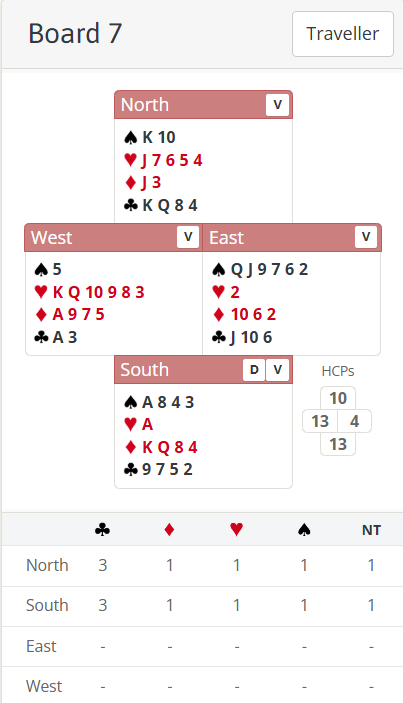
Board 7 last week saw a mixture of results – often with East West going off. But it was when they defended that it was the most interesting.
South will normally open 1♣ (it will be a matter for partnership agreement as to the minimum length that shows) and West will overcall 1♥ which takes away North’s response. If South’s opening showed at least 4 clubs then North might consider raising (either to 2♣ or by bidding 2♥ to make a “cue raise” showing a hand worth 3♣ or better – this hand is a bit in between those two bids!).
But for most people these days a 1♣ opening doesn’t guarantee 4 so North can’t really raise. Yet with 10 points he definitely needs to do something. But what?
The answer is 1NT. This shows about 7-10 balanced with a stopper in the overcaller’s suit. Note that that’s quite different to a 1NT response had there not been an overcall – in that situation 1NT doesn’t have to be balanced and can be a lot weaker (this is sometimes confusing to newer players as NT are usually bid with balanced hands – but a 1NT response without an intervening bid is an exception. It just shows a hand that can’t bid a new suit at the 1 level, isn’t strong enough to bid at the 2 level (i.e. < 10 points), but does have something. So it could be a hand with 5 points, a 7 card minor and a void). The difference after an overcall is you can pass with a weak hand. So bidding something then signals a positive intent – i.e. is constructive.
After 1NT neither East nor South should bid so it’s back to West. Several bid 2♥ and played there – usually going 2 off for -200 and a bad score. 2♥ isn’t unreasonable on the hand in my view – you have decent quality hearts so you have 6 certain tricks. It’s pretty unlucky that today partner doesn’t contribute anything!
However, rather than bidding 2♥ West might prefer to pass out 1NT with the hope of beating it. Another reason for passing is that both sides vulnerable is actually the worst vulnerability to compete at matchpoints (in fact even worse than unfavourable – see advanced section for more).
So if defending 1NT what should East lead? Several seem to have chosen ♠Q but ♥2 will work much better on this hand. The main reason for this is East’s lack of other entries. Even if he can set his spades up for winners can he then get to them? Unlikely. Therefore he is better off trying to set up partner’s suit instead because his hand is likely to have more entries to later be able to cash his suit. This is a very common theme in defence. But there is also another reason to lead a heart – see advanced section.
After a heart lead declarer will probably play a club to his ♣K and then perhaps knock out ♦A. West can then set up his hearts by giving ♥J a trick and still has the other minor suit ace as an entry. That will be 6 tricks (4 hearts and the two aces). Meanwhile declarer can score 7 (2 spades, 2 hearts, 2 diamonds and 1 club).
Even though West might be disappointed at 1NT making, holding it to -90 could still be a good score. Not only because playing 2♥ himself will go -100 or -200 but because a spade lead gives the chance for declarer to make more than 7 tricks.
For example after ♠Q, declarer can win ♠K and knock out ♦A. West can’t continue spades even if he wanted to so he’ll no doubt play a heart. But the timing is different. Now declarer can lead a club to ♣K and duck the next round to West’s bare ♣A. This sets up 3 clubs to go with 2 spades, 2 hearts and 2 diamonds (i.e. potentially as many as 9). Of course that requires declarer to guess to play a low club to knock out West’s ♣A early on. He might well not do that. In fact see advanced section for something else the defence might do to deflect him!
No trumps is basically a race between the defence and declarer to set up tricks in their long suits. On this hand a heart lead puts the defence ahead in that race but a spade lead doesn’t. The race is basically the number of stoppers to be knocked out. On this hand there are two stoppers to be knocked out in either spades or hearts. But the difference is entries. When declarer knocks out the first minor suit ace West can continue hearts but can’t continue spades (and even if he could, East couldn’t get in later to cash them). That’s why it’s important for the defence to kick off with the suit in the hand with the most entries.
Key points to note
1NT by responder after (opening), (1 level overcall} is constructive showing about 7-10 balanced with a stopper. (Very different to opening, pass, 1NT which can be weaker and unbalanced – it’s a catch all).
When defending no-trumps consider which defender’s hand has more entries – prefer to lead that hand’s long suit.
Be wary about competing too much at game all in pairs (it’s actually the worst vulnerability to compete) – you might end up -200 for a very bad score but even if you don’t do that you might have been able to collect +200 defending!
Consider playing a false card if it can’t hurt your side – it might give declarer a losing option he didn’t have before!
More advanced
If you do the maths about the scoring when competing at the various vulnerabilities, it emerges that no-one vulnerable is the best time to compete and everyone vulnerable (“game all”) is the worst. Many players automatically assume vul v non-vul is the worst but it’s actually not. Why? Because, even though you run the risk of -200 whenever you declare when vulnerable, at game all if you defend and they go off you collect 100’s so there’s a chance of +200. But at unfavourable vul if you defend you can only collect 50’s. So it’s more appealing to try and bid on yourself.
The main reason for East to lead a heart is entries but another is simply because it’s his partner’s suit. By leading his suit you are more likely to win the post mortem if there is one! But it also shows you are listening to your partner – something which will definitely help your partnership in the long run when he listens to you!
I said the defence might try a deflection when declarer leads a club to ♣K. The spotlight is on East – what about following with ♣10 or ♣J? This is a false card but it might cause declarer to think. After an opening ♥ lead he’s only got 1 more entry to South (♠A). If he thinks it’s a singleton club, he could cross to that and run ♣9 from dummy which will pick up the now singleton ♣A. But that’s risky as it releases his last spade stopper and creating spade winners for the defence if they can get in. What if East had ducked ♣A or had ♣J10 doubleton?
Or he might cross to ♠A and lead a small one which will also work as they are actually 3-2. But what if he thinks ♣10 might be from a holding of ♣J10? Now he might decide to save his entry to South and come out with ♣Q from hand hoping to squash East’s ♣J. No luck today – he has just created a new loser that didn’t exist before! The false card has no real way to lose on the hand and could gain by giving declarer a losing option. Always a good thing to do. There are many books on false cards for those interested and there are in fact some positions where a defender SHOULD play a false card as it’s the only thing that gives declarer a chance to go wrong.
Julian Foster (many times NSW representative) ♣♦♥♠