Today’s column is primarily just an amusing story but it does have some interesting points in both bidding and defence. The hand occurred in the Barrier Reef Congress teams held recently in Townsville.
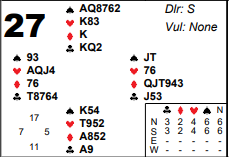
North South can make 6♠ because ♥A is onside. You discard North’s other heart loser on ♦A.
If South passes as dealer North will end up as declarer after starting with 1♠. They might reach slam too. South will show an invitational hand with 3 trumps. North’s hand is very strong now and he might look for slam. When he finds partner with 3 key cards he may bid it – especially as his King holdings are protected from being led through at trick 1.
At our table things were different. I opened the South hand 1NT (we play 11-14). North started with a transfer to spades so South became declarer. North actually bid 2♥-2♠ and then 4♦ which is a splinter saying that spades are trumps (so he must have at least 6 good spades to do this since South completing the transfer doesn’t show any more than 2 spades). 4♦ also showed some slam interest (see advanced section for why).
It’s not usually a good idea to splinter with singleton honours since it misleads partner about what cards in the suit are valuable but here North is a bit stuck for a bid and he wants to at least show some slam interest opposite 11-14.
After hearing 4♦ South’s hand looks very suitable with ♠Kxx (when he might have had ♠xx), ♦A opposite shortage, ♣A and a possible club ruffing value too. On the other hand he is still completely minimum for his 1NT and has nothing in hearts he can cue bid. He is also concerned about a heart lead. So I, perhaps wimpishly, signed off in 4♠.
Now switch to West. What would you lead? Andrew Spooner found the ♥Q!! From his point of view I had not bid 4♥ over 4♦ which I might well have done had I held ♥K – so there was a good chance the ♥K was sitting over him. What’s more my hand is balanced since I opened 1NT so it’s unlikely the ♥A will run away.
Observe the effect this has. Declarer of course now thinks the ♥A is offside since “no one” would lead ♥Q from ♥AQ at trick 1 would they?! So, relieved not to be in 6♥, I took the only chance I thought I had which was to duck hoping that East has ♥A or ♥Ax.
After ♥Q held the trick, Andrew now smoothly continued with ♥J!! His hope, of course, was that his partner held ♥10 in which case I would surely duck again hoping for ♥Ax with East. Now he could produce ♥A on the 3rd round having swindled me out of any heart tricks! Sadly for him I did hold ♥10 so it cost me nothing to cover with ♥K. When I recovered from the surprise of ♥K winning(!) I could draw trumps and later discard ♥8 on my ♦A to make 12 tricks after all!
I bet no-one else who made 12 tricks playing this hand lost a trick to ♥Q but NOT a trick to ♥A!
He could also have held me to 10 tricks by continuing ♥A at trick 2 and giving his partner a heart ruff. But it wasn’t obvious to him that his partner had a doubleton.
His defence, had it worked, might have even had a chance to beat 4♠. It doesn’t work here but can you see a position where it might have? See advanced section for the answer
Key points to note
Underleading aces is wrong a huge proportion of the time. But occasionally it can be highly successful.
There are a huge number of ways of bidding hands after a 1NT opening – it’s worth more advanced pairs discussing these sequences in depth to agree the differences between the various routes you can take.
Splinters are a great bidding tool as they help partner evaluate whether the two hands are fitting well. For that reason it’s usually wrong to splinter with singleton honours.
More advanced
Underleading aces is of course generally a very bad idea – it will cost far more often than it gains. But there were good reasons to try it here – i.e. you think the King is definitely sitting over your Ace and there isn’t likely to be enough shortage around for the other losers in the suit to be discarded.
Another reason underleading an ace is dangerous is because partner will very seldom play you to have done it. Therefore even if you do find a brilliant underlead through dummy’s King, partner might not put his Queen up at trick 1 because he will assume declarer has the Ace. A case of “the operation was successful but the patient died”!
Why did 4♦ show slam interest in the bidding sequence we had? Because we have an agreement that a hand with a single suited major that does NOT have slam interest bids 4♣ or 4♦ immediately over 1NT (to show hearts or spades respectively). So, had partner’s hand been weaker, he could have just bid 4♦ over 1NT – not this time meaning a splinter, just meaning a hand that wants the contract to be 4♠. Therefore, by inference, if we show a single suited major hand by another route over 1NT then we ARE showing at least some slam interest.
There was certainly a case for me to have bid 4♥ over 4♦ (not specifically a cue bid but just showing a hand very suitable for spades opposite the splinter). Partner might well have bid Blackwood over that and put me in 6♠. Would Andrew have still tried ♥Q at trick 1 against 6♠? We’ll never know but I suspect he would – particularly if he asks about the auction and finds out 4♥ is not specifically a cue bid.
So how might there have been a chance to beat 4♠? Suppose his brilliant plays in hearts had worked and he was able to cash ♥QJA in that order. Now suppose I had only held ♠Kx and his partner had started with ♠J10x (perfectly possibly since my 2♠ didn’t show any more than 2 spades). A 4th round of hearts from him would now have promoted a trump trick. What a spectacular result it would have been to have beaten 4♠ when declarer was cold for 6♠ all along!!
Julian Foster (many times NSW representative) ♣♦♥♠