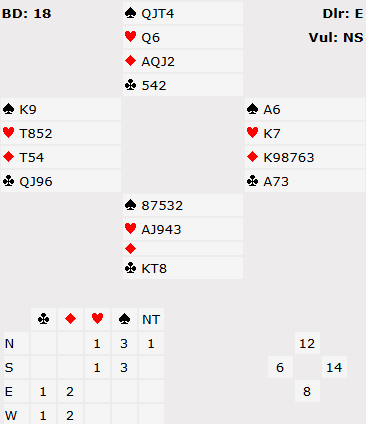
This hand comes from the Fixed Income Solutions One Day swiss pairs held as part of the Summer Festival of Bridge in Canberra on Fri Jan 16th. It was a 6 round butler imp swiss pairs (a form of scoring I personally hate – see more on that below!)
My partner and I had had a good day and landed up on table 1 for the last around against a young New Zealand pair. At which point everything came to a grinding halt for us! This board was a typical example of how aggressive bidding pays off so often.
East opened 1NT (11-14). This is quite reasonable despite holding a 6 card minor. There are honours in every suit, the 6 card suit is not particularly robust so opening 1♦ and rebidding 2♦ isn’t that appealing. Finally it takes the 1 level away from the opponents which may make it harder for them to come in.
On this occasion, however, that didn’t matter. South, despite being vulnerable against not and holding only 8 high card points, liked her shape and waded in with 2♣ over 1NT showing both majors. East passed and North, looking fondly at his honours in the majors, invited with 3♠. South then accepted the invite! This is hyper aggressive bidding from North South but, with butler scoring, that’s good tactics. It’s imps so there is a big premium for bidding and making vulnerable game. In fact at butler it’s worth pushing even harder (provided you make it!) – see advanced section for more.
East has a very unpleasant lead against 4♠. She chose, not unreasonably, a diamond from her long suit. Today that worked out very poorly – it ran to declarer’s ♦AQ allowing him to discard 2 clubs from dummy. He then played carefully by starting with a heart finesse (entries to the North hand were fairly sparse) and then played a trump. That went to East’s ♠A who now tried ♣A and another. But it was no good. Declarer could ruff and with trumps 2-2, he could ruff the hearts in North to set up the 5th one – losing just 2 trumps and ♣A. +620 was an enormous score because most of the field hadn’t bid game, let alone made it. Were North South lucky? To some extent yes – but they made their own luck by bidding aggressively and putting the pressure on. Especially on East who was on lead. Opening leads are the hardest thing in bridge because you have the least amount of information to go on – only the auction. For every decision you make after that there are 13 cards visible in dummy and more that have been played to tricks. Some perfectly reasonable opening leads can still turn out very badly. More contracts are probably let through by unfortunate opening leads than by mis-defences later on simply because of the lack of information available.
It can be seen from the hand record that 4♠ can be beaten. Can you see how? See advanced section for the solution.
Lastly, I said I hate butler imp scoring. Why? Because it so often depends on the luck of the cards. If there is a game to be bid, no matter how cold it is, there will be some pairs that miss it. So the datum (the average score of everyone on the board – usually after excluding the very extreme scores at each end) is usually somewhere below the value of game. If you bid it, you therefore gain imps and if you have it bid against you, you lose imps. But you have no control over whether you have the cards or not. There can be matches where you sit with no points and the opponents bid their cold games. You typically lose 4 or 5 imps per board through no fault of your own. Likewise if you happen to have the values and bid your games you gain similarly. But that’s not down to bridge skill, it’s just luck whether you happen to have the cards or not (more like rubber bridge). It’s not quite so bad when the tournament is arranged into 2 fields – so all the North Souths and East Wests remain in that direction and are competing with each other. Now in a match where the values are really biased to one side it’s the same for everyone you are competing with. But when there’s a single field (a far more common arrangement) it can amount to blind luck which way you happen to be sitting.
Key points to note
Opening 1NT with a 5 card major or 6 card minor is often a good idea if the texture of the hand suggests it (e.g. honours in most suits, a weakish long suit).
Shape beats points every day of the week! When you have both majors it’s seldom wrong to get into the bidding and show them.
At butler imps, bidding and making game can be worth even more than it is at regular teams. So aggressive bidding often pays off. But it’s a form of scoring that tends to reward having the cards.
Opening leads are the hardest thing in bridge because you have the least information to go on.
More advanced
It is well known that at teams there is a big premium for bidding a vulnerable game and in fact the mathematics works out that it’s worth being in game even if it only has a 37.5% chance of making. This is because the gain for bidding it v not bidding it (+600 v +170 = 10 imps) is more than the loss for bidding it when it goes off (-100 v +150 = -6 imps) – those figures are assuming 3NT but it’s the same for 4 major. The equation at matchpoints is different because each board is worth the same and you score points based on how many pairs you beat, not by how much you beat them by.
Butler imps is broadly the same strategy as teams – but there is another factor that makes the difference between making your contract and going off even higher than it is at regular teams.
In regular teams, if you make a vulnerable game that your opponents go off in you score +600 and +100 for a 12 imp gain.
Playing butler imps, however, the difference can be more. Suppose, for example there’s a game contract that depends on a guess in a key suit. Half the field get it right and make game for +600 and half go off for -100. That leads to a datum of +250. If you are one of the ones who score +600 you gain +350 for 8 imps, if you go -100 you lose -350 for -8 imps – so this time a difference of 16 imps.
How could 4♠ have been beaten? It is down to the opening lead. East has to lead a club – either a low one, or ♣A and another. This is not remotely obvious. Underleading aces or leading them into thin air is wrong far more often than it’s right but it works here. Why? Because declarer wins ♣K in the South hand and can’t immediately reach the North hand to discard the other club on ♦A. Whatever he does, the defence can win and cash their 2nd club before declarer can take his discard. They then have ♠AK to come. Easy when you can see all 4 hands. But very different at the table! It’s one of the many reasons why aggressive bidding tends to work – even if you reach a no-play contract, defence and opening leads are seldom perfect so you will still make a fair proportion of them.
Julian Foster (many times NSW representative) ♣♦♥♠