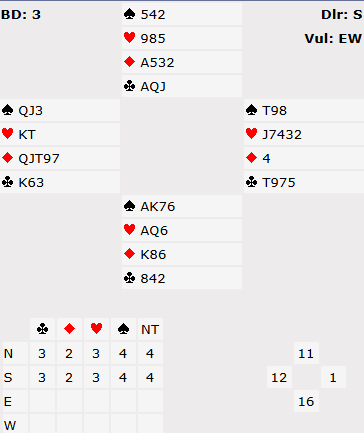
This hand is taken from the SBC Harmony Park Swiss Pairs congress played on 14 February 2026 (match 4).
Every pair except one played 3NT by South – most commonly after a simple auction 1NT (15-17) 3NT. Every West led ♦Q which seems completely reasonable – there is no better lead in bridge than top of a solid sequence (it combines attack with a very low risk of giving a trick away).
There can be a case for a major suit lead on auctions like this but on this hand that’s less appealing – see advanced section for more discussion.
After ♦Q lead the problem becomes a declarer play one. How should South attempt to make 9 tricks? Although Deep Finesse says 10 tricks can be made, about 2/3 of the field here actually ended up going off. So let’s consider how best to go about the hand.
As usual the starting point is to count our tricks. On top we have 2 spades, 1 heart, 2 diamonds and 1 club. That’s only 6 so we need 3 more from somewhere. There are several possibilities. If spades split 3-3 we can score a 3rd spade trick. The heart finesse would give us a 2nd heart trick. The club finesse would give us 2 more club tricks. So what should we do?
It looks like clubs is the best suit to start with because if the finesse works that will give us 2 of the 3 extra tricks we need. What’s more if it works, it gives us time to try for one of our other chances in hearts or spades (before the defence get in and knock out our 2nd and last diamond stop). A final reason to play on clubs is that we are finessing into the “safe” hand – i.e. the hand that we hope won’t have any more diamonds to play. Hearts is the worst suit to play on because it’s all or nothing – and, more importantly, because we are finessing into the “danger” hand – i.e. the one setting up diamond winners. We basically want to be able to test for spades 3-3 first and leave hearts as our last resort.
That gives a clue to what we should do immediately. Which is DUCK the ♦Q completely. West will surely play another one and this time we win in hand with ♦K. (On this particular hand diamonds were 5-1 so we could have won immediately but had they been 4-2, we didn’t want East to have any diamonds left if he did later win ♣K). Now we take the club finesse and it works. Things are looking up!
I suspect at this point some declarers took the heart finesse. With the club finesse working they were up to 8 tricks (2 spades, 1 heart, 2 diamonds and 3 clubs). So they may have reasoned that a finesse is a 50% chance whereas a suit breaking 3-3 is only a 36% chance – hence it’s better to take the finesse. In isolation that’s true – but the point of this hand is that we want to try both chances. Once the heart finesse lost West would set his diamonds up and can’t be prevented from reaching them in spades. So it’s too late.
There is no rush to play hearts. Instead we should try spades first. So the next job is to duck a spade. If East wins, he cannot play another diamond but could play a heart through. If West wins, he will surely continue with diamonds. But the key point is either of these options give us time to try both our major suit chances. If East plays a heart through we try the finesse and it loses. Now West sets his diamonds up but we then fall back on spades 3-3. If West had won the spade and set up his diamonds we first try for spades 3-3. When that succeeds we have 9 tricks with 3 spades, 1 heart, 2 diamonds and 3 clubs. But had spades not been 3-3, our last resort would have been the heart finesse aiming to make 2 spades, 2 hearts, 2 diamonds and 3 clubs. (But there is one other thing to consider with that line – can you see what it is? See advanced section for the answer).
You might also notice that Deep Finesse can make 10 tricks. Can you see how? Also see advanced section.
Key points to note
Always count your top tricks and assess where you might go for extra ones. Usually play on the suit that will get you to (or closest to) your contract if it succeeds.
Also consider which defender you would prefer to be on lead (East on this hand as you hope he’s run out of diamonds). Prefer to take earlier finesses into that hand.
Even when holding 2 stoppers in a suit, it’s very often right to duck the 1st round and win the 2nd. That increases the chances of a defender being out of the suit when you lose a trick to them.
If there are multiple possibilities try to arrange the play so you can try all the chances rather than be placed in a position of having to guess before you know what’s going on in another suit.
As a defender after 1NT-3NT a major suit lead is often appealing as dummy hasn’t looked for a major fit. But also consider entries – there’s not much point trying to set up a long suit in a weak hand as that hand probably can’t get in to cash it. Try to set up a long suit in a hand with entries.
More advanced
After the opponents bid 1NT – 3NT there is often a case to lead a major. Why? Because responder almost certainly doesn’t have a major – if he did, he would have surely either transferred or used stayman? Yes declarer could of course still have 1 or both majors but if he is also short in at least one major and you pick the right one, he could be in trouble.
On this hand, however, I said that’s not so appealing. Why not? Three main reasons:
- We have a very good alternative lead with the virtually solid 5 card diamond suit.
- We don’t have much in the majors ourself so we would basically be guessing which one to try.
- We have most of the defence’s values (we have 12 points and, assuming the opponents will have the usual 25-27 for game, that leaves at most 3 for partner). So, even if we can hit partner’s major, it’s likely declarer can just hold up his stopper and partner will never be able to get in to cash his winners. Hence it’s better to try and set up our long suit as it’s our hand that has the entries. Had our hand been weaker, NOW we might try a major as it’s then partner’s hand that is likely to have the entries.
After the play of ducking ♦Q, winning ♦K, club finesse winning, ducking a spade – let’s assume West overtakes his partner’s ♠8 in order to set his diamonds up (quite reasonable considering he is looking at another possible entry in ♥K). I said we next test for spades 3-3. That works here but supppose it hadn’t. Then our last chance would have been the heart finesse. That’s the additional thing to consider that I mentioned above. We have to be able to get to dummy to take that heart finesse! Which means we need to have left a club entry there. After spades don’t work we cross to that club and finally have to resort to the heart finesse. Although…..
So how do we make 10 tricks? It’s a bit double dummy but play much as described above to start with. At the point we duck a spade if East wins and plays a heart through we win ♥A. Now we cash our black suit tricks and then DUCK a heart to West’s now singleton ♥K. That way we win 3 spades, 2 hearts, 2 diamonds and 3 clubs. Do we have any reason to do that? Not really – it just happens to work! What about if West wins the spade and knocks out our remaining diamond stopper though? Now West seems to have the ♥K entry to his winning diamonds. Well yes – except what we do is cash our spades, take the club finesse a 2nd time and cash ♣A. West must make a discard on the 13th spade and that has to be a diamond (otherwise he would have to bare his ♥K). So his last 3 cards are ♥K10 and ♦9. Declarer’s last 3 are his 3 hearts and dummy’s are 2 hearts and the 4th diamond (which you have of course preserved and not discarded on the 13th spade?!) So exit with the diamond discarding a heart from hand and at trick 12 West will have to lead back round to the ♥AQ! This is what’s sometimes referred to as a “strip squeeze”. West is stripped of winners before being thrown in. (Note this is not necessarily a certainty because, unless East has discarded a club at some point, from declarer’s point of view West might have the 13th club to cash – i.e. he might have started with a 3154 shape including ♣K10xx and should definitely then play ♣K under the ♣A on the 3rd round so declarer doesn’t know where ♣10 is.)
Julian Foster (many times NSW representative) ♣♦♥♠