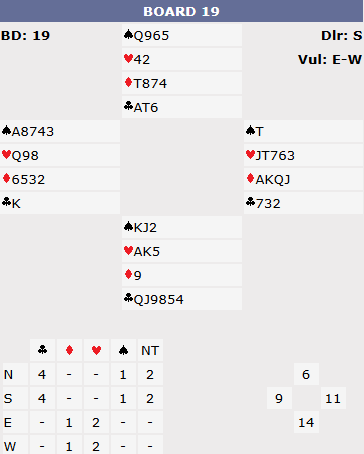
This hand is taken from a recent duplicate pairs session and shows how the vulnerability can make such a huge difference at that scoring format.
South opened 1♣ and West overcalled 1♠. Although some might frown at overcalling with only 9 points (3 of which are a singleton king in the opponents’ suit and might well be useless) these days it’s becoming more normal and such aggressive bidding often pays off. It’s particularly worthwhile when you are overcalling clubs with spades because it takes up so much of the opponent’s bidding space.
At the table North chose to bid 1NT. This is also aggressive – after there has been an overcall things are not quite the same because you can pass (after a pass it’s worth responding on 5 points to keep the auction alive in case partner is very strong – but that’s not necessary after an overcall as partner will have another chance anyway). So 1NT in this situation normally shows about 7-10 points with a spade stopper. East then bid 2♥. Also a bit dubious with only a singleton spade (and do you really want partner to lead a heart from ♥Kx if he ends up on lead against a club contract?) but on the other hand he does have quite a few values and his side might easily miss a contract if he doesn’t bid. South passed 2♥, as did West and North re-opened with a double (competitive) over which South bid 3♣. Now West competed to 3♥ which came back to South who passed it out. (We’ll come back to that).
If West doesn’t overcall the auction could take a very different turn. North may well respond 1♠ himself and East will either overcall 2♥ or make a takeout double. South might have a bid to show 3 card spade support and West will probably then pass (hopeful that North South are going to end up in a spade contract!) But North, knowing spades is only a 4-3 fit, will likely return to clubs.
The majority of tables did play a club contract by South. This should make 10 tricks, losing 1 diamond, 1 spade and 1 spade ruff. But the defence need to take their spade ruff straight away before declarer draws trumps. When they didn’t do this clubs made 11. Sometimes that was because of a heart lead, other times perhaps a diamond lead but East tried to cash a 2nd one instead of switching to his singleton spade. See advanced section for why he should switch.
When East played hearts there are a couple of ways to beat 3♥. One is to immediately lead 3 rounds of trumps (or start with a club and then switch to 3 rounds of trumps). That stops any club ruffs in dummy so declarer will only score 1 spade, 3 hearts and 4 diamonds. Another is to lead the ♦9. Then win the 1st round of hearts, cross to partner’s ♣A and receive a diamond ruff. The latter is what happened at our table.
The scores were significant on the hand. 3♣ scored 130 or 150. 3♥ one off was 100 which therefore scored very badly. Which brings us to the key point of the article. At pairs South should have doubled 3♥. That would have scored North south +200 and a virtual top! But why? Once North implies some club support (at our table via the re-opening double of 2♥) he should reason that 3♣ is quite likely to be making. That will score at least +110 so scoring +100 for beating 3♥ by 1 trick won’t be good. He either needs to double it or hope it goes 2 off. You might think the double is risky and could easily score -730 for 3♥x making. Yes absolutely it could. But this is one of the main differences between pairs and teams. At teams it would be mad to double because -730 would indeed be a disaster and the difference between +100 and +130 is negligible. -730 would be a bottom at pairs too but there’s a lot more to consider there. It’s all about the possible gain and the possible loss. See advanced section for more details.
Key points to note
Overcalling spades over clubs can take up a lot of space in the auction so is worth doing quite aggressively.
After a 1 level opening and overcall a bid of 1NT usually shows about 7-10 with a stopper. This is a bit stronger than a response in an uncontested auction would be because after the overcall you don’t have to bid – partner will get another chance if they have a strong hand.
Pairs and imps are very different games. At pairs if you think you are making your partscore you may need to double the opponents if they push on because the score for beating them undoubled won’t be any good. This is especially true when they are vulnerable because the difference in score between +100 and +200 is often enormous (almost all other partscores fall between the two).
A partscore doubled into game is a disaster at teams when it makes. But at pairs it may actually cost very little when you consider what you would have scored anyway had you not doubled.
More advanced
After a diamond lead against a club contract, it might be tempting for East to try and cash a 2nd one. But there’s a very good reason not to. What is the rush? Where will a diamond loser in declarer’s hand go? The only possible thing it could be discarded on is ♠Q but surely partner has at least one spade honour given they overcalled? So partner will get in well before there is any risk of a discard – at which point there is time to cash another diamond then. On the other hand, it’s quite possible that West has ♠A and East can get at least one spade ruff. A key aspect in defence is often working out which of declarer’s losers might run away and which can’t.
So why is it worth doubling 3♥ at pairs but not at teams? It’s best illustrated by looking at the actual matchpoints the different actions did, or would, score. At the table I passed out 3♥ and we scored +100. That scored 4 matchpoints out of 24. Had I doubled we would have scored +200 and 22 out of 24. The difference is huge! And that’s because all the club contracts scoring +130 or +150 (of which there were 8 in this session) fall right between +100 and +200. +200 on a partscore board is almost always a huge score because it beats almost all normal partscores. So there is a lot to gain when 3♥ goes off.
Note this is why pushing onto 3♥ was risky for East West because they were vulnerable. Had they been not vulnerable it would have been much more appealing. Now even 1 off doubled is only -100 which is still less than the value of 3♣ making 10. North South would have to either bid onto 4♣ or double and take East West 2 off to get a good score.
Now let’s consider the other scenario where 3♥ makes. Doubling it for -730 would indeed have scored 0 out of 24 as you’d expect. But not doubling it and scoring -140 would have scored 2 out of 24. That’s the key point here. At PAIRS the double makes very little difference – you were already getting a dreadful score if 3♥ was making (-170, -730 and even -2,000 would all have scored the same 0!) The double has cost a mere 2 matchpoints. So on this hand doubling 3♥ loses 2 matchpoints when it’s wrong and gains 18 matchpoints when it’s right. That’s quite an appealing equation! Especially as South can see a way to beat 3♥ from his own hand. Lead the diamond, win a trump and aim to get partner on lead in one of the black suits (turns out to be clubs when dummy becomes visible) to get the diamond ruff. Partner has voluntarily bid 1NT and made a competitive double so she surely must have an entry in at least one of those suits. Therefore there is a very good chance of beating 3♥x for +200.
The whole thing is completely different when playing IMPS. Because now the SIZE of the score matters. At pairs all that matters is how many pairs you beat but not by how much you beat them. At imps, suppose the other table scored +130 North South. Now going -140 loses 7 imps (-310), but going -730 loses 13 (-860). That’s a much bigger difference and it’s exactly why doubling partscores hoping for 1 off at imps is extremely dangerous. What’s more the difference between +100 and +130/+150 is almost negligible at imps whereas, as we saw above, it’s enormous at pairs.
So in summary, it was losing bridge at pairs to pass out 3♥. South either needs to double it (the best action here since there are excellent chances of +200) or bid onto 4♣ and hope to make that (which would have at least scored an average on the hand instead of a near bottom +100). Double is sometimes known as a “matchpoint double” because it’s one you would never dream of doing at imps but is completely logical at pairs – purely because of the way the scoring works.
Julian Foster (many times NSW representative) ♣♦♥♠