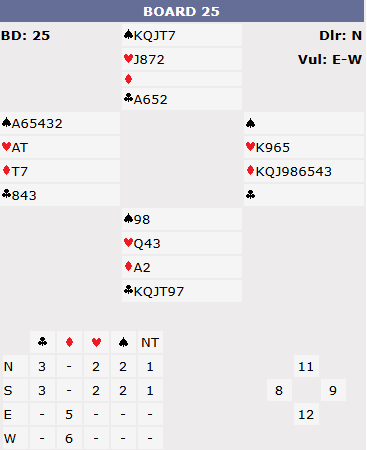
On this hand from a recent duplicate East had an extraordinary 9400 shape. But at one table there was another most unusual scenario where declarer could have made literally any number of tricks and it made no difference to the matchpoints! Let’s have a look.
The “normal” auction started with 1♠ from North and most Easts immediately bid 5♦. Almost every South doubled this. Doesn’t seem unreasonable does it? The opponents are vulnerable, you have 12 points including the Ace of trumps, and partner has opened the bidding. But….
After ♠9 lead, East soon wrapped up 12 tricks by discarding one heart on ♠A, then ruffing the other heart loser in dummy. That was a score of +950. One East West pair ended up in 6♦ also doubled and they scored +1540. The defence could have beaten this though – can you see how? See advanced section. Overall this board is yet another example of shape beating points – on this occasion one of the most extreme shapes you will ever see. I have been playing bridge for just over 40 years and this is only the 2nd 9400 shape I can ever remember (see advanced section for a story about what happened on the other).
There is of course no textbook that covers how to bid such hands. It can be a case of bluff and double bluff – you could jump high immediately, or you could take it more slowly. The latter has the advantage that you might be able to find out if partner has one or two of the key cards you want, or you might entice the opponents to later double you as you haven’t revealed your extreme shape so quickly and perhaps it might look to the opponent as if you were “pushed” higher. But of course you also run the risk that everyone passes!
The overwhelming thing on a hand like this should be to bid, keep bidding, and declare the hand at almost any cost. The hand is worth a fortune played in diamonds, it may be worth absolutely nothing defending against a black suit. That’s always the case with really freak hands.
Speaking of being worth nothing against a black suit – see what happened at the last table. Extraordinarily the East player didn’t bid on the hand at all! North South then had an uncontested auction 1♠ – 2♣ – 2♥ – 3♦ – 5♣ – 6♣. This of course is a completely ridiculous contract and deserved a terrible score! See advanced section for South’s logic in raising 5♣ to 6♣.
Against 6♣, West tried ♦10 (perfectly reasonable as that was the 4th suit in the auction North South had had). Declarer ruffed this in dummy (and realised he should have passed 5♣!) Resigned to going several off he tried a low spade towards his own hand and was even more depressed when East showed out as it now looked like he was going even further off. West thought so too – and after winning ♠A, returned a 2nd spade to give East a ruff! When everyone had recovered from the shock of East ALSO discarding on ♠10(!) this meant that, unbelievably, 6♣ was now making! Declarer could draw 3 rounds of trumps ending in North and cash 3 more spades to discard all his hearts. +920 to North South!
But on closer inspection this actually didn’t matter in the slightest! It was a matchpoint pairs session. As mentioned above one East West scored +1540, most scored +950 and there was one +620 (that South didn’t double). That meant that South could have scored literally 0 tricks, gone 12 off undoubled (for -600) and STILL got a top board! I don’t think I have ever seen that before. But definitely a good example of how at pairs the size of the difference in score doesn’t matter, merely how many pairs you beat.
Key points to note
On really freak hands – BID! A lot! They will be worth far more when declaring and might be worth nothing when defending.
Be wary of doubling when good players, vulnerable, jump to a really high contract. They will usually be close to the contract (they know going off doubled vulnerable gets expensive very quickly).
At matchpoint scoring every trick usually counts (more than at imps). But occasionally the board has already been won or lost in the bidding and number of tricks you make may not actually matter that much.
More advanced
6♦ by East is beatable if South leads 2 rounds of trumps. That stops the heart ruff in dummy and, provided one defender clings onto at least 3 hearts when declarer runs his seemingly never ending(!) trumps, the defence will score a heart trick as well as the ♦A. Played by West, North can’t lead a trump so 6♦ is cold.
The other 9400 shape I remember occurred at the Summer Festival of Bridge in Canberra many years ago. The 9400 hand included a solid club suit and ♠Kxxx or something like that. Partner held ♠AQxx and a red ace. But the auction was something like 1♣ – 1♠ – 5NT – 7♠. 5NT was asking partner to bid a grand slam holding 2 of the top 3 trump honours. The tragedy was that spades split 4-1 on the hand! So 7♠ could not be made while 7♣ was cold (discard the 4th spade on dummy’s red ace). It gave rise to a lot of discussion in the bar afterwards about what the responses to 5NT should be – the conclusion being partner should always jump to 7♣ holding 2 of the top 3 trump honours, NOT 7 of the suit they were being asked about. That allows for partner holding a solid suit elsewhere.
Finally, just a word on North South’s auction to 6♣. It was also influenced by the matchpoint pairs scoring. South’s 3♦ was fourth suit game forcing as he wasn’t sure he wanted to play 3NT with just ♦Ax (partner might have had 64 or 55 in the majors, or maybe some club support and no diamond stopper). North’s jump to 5♣ was intended to show a minimum hand (3♦ was game forcing so she could have bid 4♣ with a stronger hand). After hearing that, South was now concerned he should have been in 3NT all along. From his point of view he did have a diamond stopper and it now looked like the pair would immediately have had 7 tricks in the minors and that was with partner holding just 4 points (♣A) when she clearly had plenty more than that for her opening bid. So there was a good chance that 3NT would be making and that would almost certainly outscore 5♣. Hence he decided he might as well raise to 6♣ anyway since he thought 5♣ would not be scoring any matchpoints. In hindsight, that logic isn’t especially sound. Had North had ♣A and 2 quick tricks in the majors (what is needed to make 3NT) she would have recognised those controls would be valuable to partner in a club contract and would most likely have bid 4♣ not 5♣ (remember partner was basically unlimited at the time he bid 3♦). Of course at the time neither North nor South had a clue that the hand was such a freak and what either of them bid was actually completely irrelevant!
Julian Foster (many times NSW representative) ♣♦♥♠