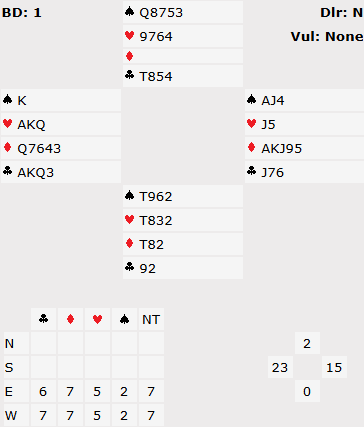
Occasionally a board comes along that everyone should bid to a grand slam. Today’s hand is like that. But sometimes people over complicate matters!
4NT Blackwood is of course the most famous slam going convention. In its simplest original form it was just asking for aces. These days for a possible suit contract slam almost everyone plays Key Card Blackwood where the K of trumps is also included as 1 of 5 key cards. Typical responses are 5♣=0 or 3, 5♦ = 1 or 4, 5♥ = 2 without Q of trumps, 5♠ = 2 with Q of trumps. Many pairs these days reverse 5♣ and 5♦.
Generally Blackwood should be used on hands in two circumstances:
- where all you care about are the number of key cards partner has; and
- primarily just as a check that you are not missing too many key cards – after you’ve already judged that the two hands will have enough for 12 tricks otherwise.
Our auction on this hand was a simple use of Blackwood. There are very few hands where you can just use Blackwood directly over the opening bid but this is one of them. We bid 1♦ – 4NT – 5♣ (0 or 3) – 7NT. We started with 1♦ (which shows at least 4 diamonds) because we play a weak NT opening. The West hand really only cares about ♠A and ♦AK so Blackwood is perfect to find out about these. The 5♣ response has to show 3 key cards here because there are only 17 points missing. The 3 missing key cards amount to 11 of those. So if partner had 0 key cards that means she’s opened 1♦ on 6 points! Once partner has those 3 cards, West can count 13 tricks (2 spades, 3 hearts, 5 diamonds and 3 clubs).
Playing a strong NT opening the right auction is even simpler: 1NT – 7NT! Whenever partner shows a specific point range with a NT bid you can evaluate the combined total you have. You have 23 and partner is showing 15-17. That’s a combined 38-40 – you’d be pretty unlucky not to be able to make 13 tricks with two balanced hands and that many points! The general guidelines are with two balanced hands you want 33 for 6NT and 37 for 7NT. In suit contracts it is often fewer because you have extra ways of making tricks by ruffing losers with the short trumps and setting up long suits.
As usual even with a hand like this there were several tables where grand slam wasn’t bid. Several stopped in 6, a couple of tables stopped in game and 1 pair must have had an accident and played in 4♣ (perhaps intended as an ace ask?)
One pair that only reached 6 started with 1NT and West asked for aces – receiving the answer of 2. He then wasn’t sure if partner had ♦K, perhaps didn’t have a way of asking for kings(?), and only bid 6. Can you see the flaw in his argument here? See advanced section.
There is of course nothing to the play on this hand as there are 14 top tricks (2 spades, 3 hearts, 5 diamonds and 4 clubs). If only every hand were this easy!
Useful though Blackwood is, many people overuse it on hands where it isn’t so suitable. It’s also important to know what you do after Blackwood (in particular after the 5♣ or 5♦ responses you often want to ask if partner holds the Q of trumps, or perhaps about side suit kings). See advanced section for more discussion on these areas.
Key points to note
Blackwood is a great convention but use it when you just need to know how many key cards partner has.
Whenever partner shows a specific range with a NT bid, add your points to that to identify what the partnership has.
Don’t overcomplicate things. The more bids you make, the more chance for a misunderstanding. If you have a simple option, use it!
4♣ as an ace ask is a bad idea. It’s far more useful as a cue bid, a splinter, or just as a means of agreeing clubs.
Serious partnerships should discuss continuations after Blackwood is used. Most importantly how you ask about the Q of trumps and side suit kings.
More advanced
The argument that West couldn’t tell if East had ♦K falls down pretty quickly if you check the points. ♦K is 3 points. We saw the partnership has 38-40 between them. So the most we can possibly be missing is a Q. Therefore partner must have ♦K!
So when isn’t Blackwood suitable? Two types of hand typically:
1. Those with a void. Partner holding the ace in that suit might be completely useless to you whereas holding the ace is another suit might be totally critical.
2. Those missing any control in a side suit. If you have, say, xx in a side suit and you find out you are missing a key card, if it’s in that suit then you might be off the cashing AK in that suit.
The theme is the same for both of these. You need to know WHERE partner has key cards, not HOW MANY he has. Blackwood is perfect for how many, but not for where they are. Those sort of hands are far better progressed with cue bidding. With a void if partner doesn’t cue that suit it’s good news as he probably doesn’t have a wasted ace there. With xx in a suit if partner does cue there now you know you aren’t off AK of that suit and NOW Blackwood may be suitable. This is one reason why using 4♣ Gerber as an ace ask is such a bad idea. It’s far more useful as a cue bid, a splinter, or just as a means of agreeing clubs.
There is a special form of Blackwood known as “Exclusion” that is good for hands with voids. Basically it asks partner for how many key cards they have but excluding that suit. The challenge is you need some pretty clear agreements about what bids are Exclusion keycard. It’s usually an unusual jump to a 5 level – for example, 1♠ – 2NT – 5♦. If 2NT is a game forcing spade raise then 5♦ has no sensible other meaning. This is an area for more advanced partnerships to discuss. You don’t want an expensive accident when you bid your void meaning it as Exclusion and partner passes it!!
What about continuations after Blackwood? It’s common after 5♣ or 5♦ responses to play the next step (excluding 5 of the trump suit which is a sign-off – but see final paragraph below) as asking about the Q of trumps. Responses to that vary – I play the trump suit at the lowest level denies the Q, and other bids show the Q and that K. Others play the next step denies the Q. You generally also want a bid asking about side suit kings (perhaps the next but one step – or possibly 5NT). Once again I have seen responses vary – some players bid specific kings (e.g. 6♣ shows the ♣K), others show how many Ks they have (e.g. 6♣ = 0, 6♦=1, etc).
A 5NT continuation can be used in various ways. Some players use it as the king ask, some use it to confirm that all key cards are held and as an invite to grand slam if partner has anything extra, another common use these days is “pick a slam” – which can be handy if there are possibilities of playing in more than one suit, or in no-trumps. The key point is there’s not universal agreement about what all these bids mean and it’s important for serious partnerships to discuss and agree them. Getting things wrong in the slam zone can prove expensive!
Finally, returning to the point that 5 of the trump suit is a sign-off. That requires a bit more clarification. If partner responds, say, 5♣ (0 or 3) it is usually pretty obvious from the previous auction whether he has 0 or 3 key cards but there are occasions where it may not be. So partner might be signing off just in case you do have 0. Therefore if you actually do have the 3 not the 0, you should move again. Partner would not generally have been using Blackwood in the first place with 0 or 1 key cards himself so with your 3 you are highly unlikely to be missing 2.
Julian Foster (many times NSW representative) ♣♦♥♠