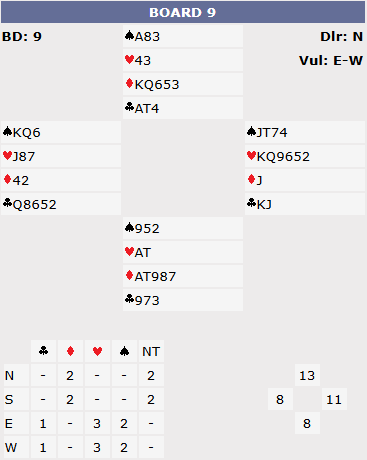
This recent hand from a pairs session showed again the vagaries of matchpoint scoring.
At most tables the auction began 1♦ 1♥. South competed to 3♦ and East West usually bid onto 3♥. That contract just had a trick in each suit to lose for a score of 140 to East West.
At a couple of tables North South pushed onto 4♦ and this went 2 off for -100 which scored a joint top for those pairs. As usual, the vulnerability is really important. Had North South been vulnerable this would have been disastrous as they’d have scored -200 which is worse than the heart partscore East West can normally make.
At my own table we started differently with North opening a weak NT (11-14). East overcalled 2♥ (it’s possible he might have chosen to show both majors but 2♥ is likely to be better most of the time as there is a big discrepency between the two suits and he wouldn’t want West bidding 2♠ with 32 in the majors since he’d land up in a 4-3 spade fit instead of a 6-2 heart fit). Looking at the favourable vulnerability, South decided to compete to 3♦ which he did by bidding 2NT first. This is a convention called “Lebensohl” (see advanced section for more details) which distinguishes between forcing hands and weaker hands that just want to compete to the 3 level. He was taking a slight risk as North might have only had 2 diamonds but the aim was really to push East West to 3♥ (they may not know how big North South’s diamond fit is) and you don’t usually want to sell out to 2 of a major at pairs. The auction proceeded 2NT P 3♣ P 3♦ and now West, with 3 card heart support did compete to 3♥. North, however, with 5 card diamond support for partner’s suit and also an eye on the vulnerability raised to 4♦ which became the final contract.
Against 4♦ the defence will normally lead hearts which declarer will win and draw trumps. He might then exit in a black suit and the defence will cash their heart trick before exiting a black suit again. The net result should be 8 tricks, losing 2 spades, 1 heart and 2 clubs, for a score of +100 to East West. To get a good matchpoint score East West need to double this (to score +300) but it’s almost impossible for either of them to do so – neither of their hands look like they will make many tricks at all! In practice, however, there are chances for South to escape for 1 off. Can you see what might happen? See advanced section for more details. Hint – look for an endplay situation where a defender might be forced to give declarer a ruff and discard.
Key points to note
After a 1NT opening and an overcall, it’s useful to be able to distinguish between forcing hands and hands that just want to compete. “Lebensohl” (via a 2NT relay bid) allows you to do that.
The vulnerability is critical at matchpoints. Going 2 off undoubled when not-vul for -100 can be a very good score if the opponents are making their partscore contract. But going 2 off vul (-200) or doubled not vul (-300) will likely be disastrous.
It’s not usually right to sell out to 2 of a major at pairs – try to compete and force the opponents to decide whether to double you, or push them to 3 of their major.
Sometimes even though it looks like you have losers in suits, the defence’s own holdings may be blocked so they cannot always cash their tricks. They might end up running out of a suit and being forced to give you an extra trick with a ruff and discard.
More advanced
Lebensohl is a handy convention to distinguish between hands of different strengths. It is commonly employed when responding to takeout doubles of weak twos. But another scenario where it’s useful is after a 1NT opening and an overcall. There are some hands where South has a long minor suit and wants to compete to that knowing partner has a 1NT opening (whether weak or strong depending on the pair’s methods). There are other hands where South is strong with a minor and wants to show it en-route to either 3NT or possibly even slam in that minor. Clearly you can’t bid 3m with both hand types. Therefore 2NT is used as an artificial bid which forces partner to bid 3♣. Now with the weaker hand you either pass 3♣ or bid your own suit. Stronger hands just bid 3m directly and don’t go via 2NT. Although that’s the most common thing that comes up, there are other more advanced things that can be played too. Suppose the overcall is 2♥. You can distinguish between these 4 sequences: 1NT (2♥) 3♥, 1NT (2♥) 2NT (P) 3♣ (P) 3♥, 1NT (2♥) 3NT, and 1NT (2♥) 2NT (P) 3♣ (P) 3NT. Usually cueing their major is like stayman (so effectively showing the other major). Going via 2NT and not going via 2NT usually identifies whether you have a heart stopper or not (pairs need to agree which way round they play this though!)
As usual, if you play a convention, you also need to consider what you are losing. If you use 2NT as artificial you can’t also play it as invitational in no-trumps. So with those hands you either need to push to 3NT or perhaps double.
So what might happen in 4♦ to allow declarer to make 9 tricks? There’s a risk the defence will be endplayed because of the blockage they have in clubs. Suppose declarer wins ♥A, draws trumps and ducks a spade. The defence will win and surely cash their heart trick. It will look dangerous for either of them to lead clubs so they will probably exit spades again. This time declarer wins and exits his own 3rd spade. Once again the defence are in but now it’s too late. If they lead a club (anything else will be a ruff and discard) declarer simply wins and plays a 2nd club. Now what? If East wins the trick, he has no more clubs and is then endplayed forced to play a club for a ruff/discard. Even if East has unblocked the ♣K under the ♣A it’s still no good because West now can’t overtake ♣J with ♣Q as that would set up declarer’s ♣10. It’s quite hard for the defence to avoid this endplay. One way is to lead clubs immediately (which is highly unlikely as they have bid hearts). Now they are able to score all their tricks because East still has a safe exit after winning the 2nd round of clubs. Later West will get in in spades and can cash ♣Q too. Another way might be not to cash their heart trick but switch to clubs at that point. Depending on what declarer does, East might be able to win the 2nd round of clubs and then underlead his heart to West’s ♥J enabling him to cash ♣Q and then safely exit spades.
Julian Foster (many times NSW representative) ♣♦♥♠