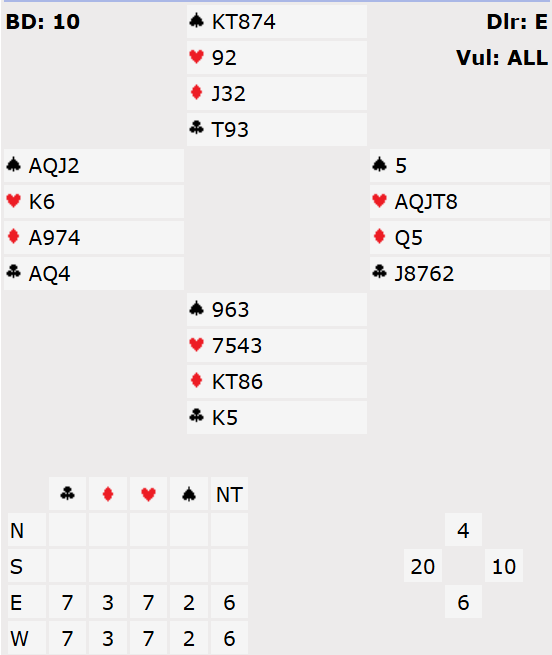
Playing matchpoint pairs East West climbed all the way to 6♣ on today’s hand and it became a nasty play problem!
But first the auction. East opened an aggressive 1♥ with the 55 10 count and good hearts. At this point West is already thinking about slam. The auction began with a quiet 1♥ – 1♠ – 2♣. West continued with 2♦, 4th suit (artificial game forcing). East bid 3♣ showing at least 5-5. 3NT would be very pessimistic now with 20 points opposite an opening bid so West bid 4♣ to set that suit as trumps and show slam interest.
For those that use 4♣ as Gerber ace ask this is a good example of why that’s a bad idea. So much more often you want 4♣ either to agree clubs, or as a cue bid with another suit already agreed. After 4♣ East was of course feeling a bit uncomfortable having opened with such a weak hand so she tried to slow partner down with 5♣ (instead of cue bidding 4♥). But all that succeeded in doing was causing West to “only” bid 6♣ and not look for a grand slam! He was never going to pass 5♣, however. See advanced section for why.
What would you lead as South? See advanced section for some thoughts. At our table he chose ♦6 which gave declarer a nasty problem at trick 1. How would you play it? Of course when you can see all 4 hands it’s easy to run the diamond lead to hand and make all 13 tricks when the clubs are a very lucky ♣Kx onside. But it looks like you will have a club loser a lot of the time so you want to avoid losing any tricks in diamonds or spades.
So, not unreasonably, declarer won ♦A immediately. She then had to decide how to play spades. She could take a normal finesse and aim to discard the ♦Q on the 2nd spade. Or she could take a “ruffing finesse” by playing ♠A, ♠Q and throwing ♦Q unless North covered. It’s largely a guess and, at our table, declarer unfortunately guessed wrong by crossing to ♥Q and trying a spade to the Queen which of course failed. With the clubs being favourable she ended up 1 off.
This, however, is a bad choice of lines. Can you see why? (Hint – it’s nothing to do with misguessing the spade and diamond positions). See advanced section for more.
Key points to note
Using 4♣ as a Gerber ace ask is not a good use of the bid. It’s far better used to agree clubs as trumps or as a cue bid with another suit already agreed.
At matchpoints playing 5 minor scores so much less than majors or no-trumps. You should only play it as a last resort – aim to either play 6 minor or 3NT/4NT if at all possible.
Tend to lead aggressively against suit slams. You often need to set a trick up quickly. Against 6NT tend to lead more passively.
At pairs, even if you’ve been unlucky and guessed wrong, or the opponents have picked the right lead, still try to limit the damage. Retrieving 20% on boards instead of zero makes a big difference in the long run.
More advanced
At the time West bid 4♣ he had basically committed to playing in slam. Why? Because playing 5♣ at matchpoint pairs would guarantee to be a bad score since no-trumps will definitely score more. He chose 6♣ instead of 6NT in case East’s hearts weren’t as good as they actually are and a heart ruff in dummy might have been needed.
South did well to put the pressure on with the diamond lead. Against suit slams it is often right to lead aggressively. You often need to set a 2nd trick up quickly before declarer can get his own tricks going. It worked here not because it set a diamond trick up but because it gave declarer a nasty guess. No matter how good a player someone is, giving them a nasty guess early in a hand will cause them to go wrong every so often. Against 6NT leading is bit different. Declarer has fewer options (he can’t ruff out side suits to set them up) so you tend to want to be more passive on lead.
So why was declarer’s line poor on this hand? It’s nothing to do with the position of ♦K or ♠K. Those were guesses and declarer unluckily chose wrong. The point is that taking the natural spade finesse exposed her to quite likely going 2 off (♦K, ♠K and usually a trump). It was only thanks to the lucky club position that she escaped with 1 off. Taking the ruffing spade finesse would guarantee at worst 1 off (if South had ♠K he’d win that but declarer has already discarded the ♦Q). As it happens on this hand the ruffing spade finesse wins so declarer can ruff ♠K, cross back to ♥K to discard ♦Q on ♠J. She could risk ruffing back to hand to finesse clubs but that’s very dangerous since she is then already down to 3 trumps. It’s likely better to just play ♣A, ♣Q at that point.
Playing matchpoints going off in 6♣ will definitely be a bad score. But the hands are so strong that it’s likely other pairs will also be in slam and some may well have faced the same problem. So going 1 off might still score up to 20% whereas going 2 off will almost certainly score 0%. That 20% could make a big difference in a close event! It’s impossible not to have some bad boards when you play pairs but limiting the damage when you do definitely adds up in the long run.
Julian Foster (many times NSW representative) ♣♦♥♠