Responding to a takeout double is very different to responding to an opening bid. On this hand, quite a few pairs missed a good slam and the initial response was a big part of the problem. Let’s have a closer look.
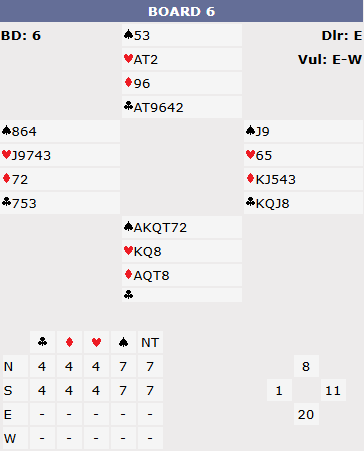
Most Easts opened 1♦ which, these days, is pretty normal despite only having a 2254 11 count with no aces.
The South hand is enormous and far too good for a simple overcall so it has to start with a double. (See advanced section for some more discussion on this). West passes and it’s over to North.
At quite a few tables North responded 2♣. Over that most South’s bid either 3♠ (raised to 4) or 4♠ and that ended the auction. So what went wrong? The initial problem is North’s response. Give North exactly the same shape hand but without either of the aces. What would you do after 1♦ x P to you? You’d have to bid 2♣ wouldn’t you? You can’t possibly pass because then East would be playing in 1♦x and, assuming partner has a normal takeout double of that, it means the opponents have a pretty good diamond fit and will make easily! The only time you could ever contemplate passing the double is if you had a good hand with lots of diamonds yourself.
That’s the key point to understand about what’s different when responding to a takeout double compared to when responding to an opening bid. You can pass an opening bid to show nothing! You can’t pass a takeout double! So you might have to make a bid holding no points at all. Partner then needs to allow for that.
The problem is if you would bid 2♣ on a 2326 shape hand with 0 points, you can’t possibly ALSO bid 2♣ on the same shape hand with 2 aces. How is partner ever going to be able to know what to do? This hand is a good example. Look at it from South’s perspective. If partner has nothing then 4♠ could easily be the limit of what you can make – in fact on a really bad day you might not even make that! So bidding 4♠ over 2♣ is not unreasonable. But opposite partner’s actual hand, 7♠ can be made and you’d certainly want to be in 6♠.
Although on this hand South’s question is whether to bid slam or not, the more common scenario is at game level. Suppose you make a takeout double initially with 17 points. If partner bids the same way with 0 points and with 10 points you are just blindly guessing what to do. Pass and find he has 10 points and you have just missed bidding an easy game; bid on and find yourself overboard when he has 0 points!
So what’s the solution? North should jump over the takeout double to tell partner he actually does have some values (so 3♣ in this case). The usual sort of ranges played are a minimum response to a takeout double shows about 0-7 points and a jump shows about 8-11. With an even stronger hand than that North can start by cue bidding the opponents’ suit (2♦ here). That gives the takeout doubler a much better idea whether to explore for game or not. Depending on the strength of his own hand, he may now be able to safely invite or bid game knowing he is not sitting opposite 0 points. This table gives a broad idea of what doubler would do:
| Strength of initial takeout double | Opposite min response (0-7) | Opposite jump response (8-11) |
| Minimum (11-13) | Pass | Pass |
| Medium (14-17) | Pass | Invite |
| Strong (18+) | Invite | Bid game |
Over 3♣ South can bid 3♠ (which will be game forcing now because when he bids a new suit it means he had a hand too strong to overcall initially and partner has shown 8-11). North probably raises to 4♠ (he can’t bid 3NT with no diamond stopper and partner will have a 6 card suit a lot of the time he doubles first). Having now found out about some spade support, knowing his partner has some values, and with all the diamond cards sitting over the opening bid (and a likely diamond lead coming) South should definitely want to play at least 6♠. The only question is whether he could look for 7♠? See advanced section for more.
What about the play? The lead is likely to be a diamond which is helpful. Declarer can attempt to ruff a diamond in dummy (West can ruff ahead of dummy but that’s the only trick the defence gets as declarer’s 4th diamond is discarded on ♣A). Alternatively declarer can draw trumps, cross to ♥A, discard a diamond on ♣A and then take a 2nd diamond finesse. That makes 13 tricks today because trumps split 3-2. But even if they split 4-1, the ♠J is likely to be the only loser.
Key points to note
Responding to a takeout double is fundamentally different to responding to an opening bid because you can’t pass with nothing.
Minimum responses to a takeout double show about 0-7 and jumps about 8-11. This helps partner decide what to do when he has a better than minimum hand for his initial double.
Doubling first and then bidding a suit shows a hand too good to overall that suit originally (these days that tends to be a good 17+ points or more).
More advanced
What sort of strength hand makes a direct overcall and what sort of hand doubles first and then bids a suit is something worth agreeing with your regular partner. Originally it used to be the case that you doubled first with about 16+. Today, however, that has gone up and it’s considered fairly normal to still overall at the 1 level on hands all the way to 16/17 points and only start with a double on REALLY strong hands. Why?
- Because auctions are more competitive so the odds of a heavy 1 level overcall being passed out and your side missing game are low.
- Because showing your suit immediately has huge advantages in a competitive auction (primarily because partner can raise and you find your fit early if you have one). Doubling first may mean the auction gets to an uncomfortable level by the time it comes back to you (e.g. if the opponents start pre-empting). So you want a hand that really is strong enough to bid all by itself at quite a high level on the next round.
Of course having a 1 level overcall be so wide ranging can cause problems for partner (similar to the point made about responding to a takeout double earlier). But there tends to be ways to resolve these better – it’s very rare for your overcall to be passed out so you will nearly always get another chance to bid. This time, partner may be able to come to life in a way he couldn’t over your overcall because he didn’t have a fit for your first suit.
On this hand how might South continue after his partner raises 3♠ to 4♠? He could bid blackwood although that’s not overly useful with a void – suppose partner shows 1 ace, if it’s ♥A that’s fantastic, if it’s ♣A that might be completely useless! Today it works OK because partner shows 2 aces. He still doesn’t know about partner’s diamond holding but his own diamonds look extremely well placed over the opening bid so he might take a reasonable gamble and bid 7♠. It might also depend what sort of competition he is playing in. Playing pairs if he thinks a lot of the field will bid 6♠ then it might be worth trying for 7♠. Conversely if he thinks quite a few will miss 6♠ then he should settle for that – there would be nothing more annoying than bidding 7♠, going off on an unlucky trump break (say) and then finding you’d have scored a virtual top for just bidding 6♠ anyway! In general most fields are extremely bad at bidding slams so you tend to score well just for bidding 6 and should only really bid 7 if you can literally count 13 tricks!
Julian Foster (many times NSW representative) ♣♦♥♠