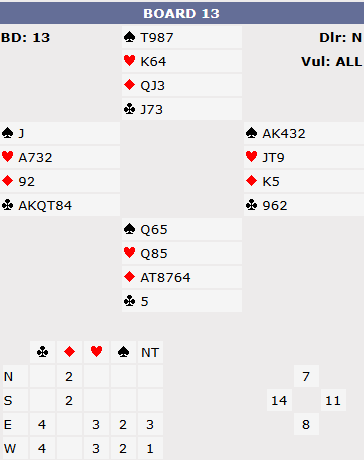
On some hands it’s essential to play no-trumps from one direction. Today’s hand (taken from the Newcastle Congress played the weekend of June 13-14) is an example. 3NT played by West is hopeless because North can lead ♦Q and the defence will take the first 6 diamond tricks. However, played by East it’s cold as East’s ♦K provides a stopper and there are 9 tricks ready to cash in the other suits. ♦Kx is what is sometimes called a “positional” stopper because it’s only a sure stopper if that hand is declarer. The ace on the other hand is always a stopper regardless of what hand it’s in.
So it’s often important for the hand with a positional stopper in the opponent’s suit to bid no-trumps first. Of course it’s also important to be able to identify whether your side does have a stopper in the first place!
The bidding at our table was Pass 1NT (11-14) 2♦ 3♦ X 3♠ P 3NT end (yes it’s dubious whether South should have overcalled 2♦!) Here the weak 1NT opening had, perhaps fortunately, already right sided the final contract. A standard auction if East opens might be 1♠ – 2♣ – 2NT – 3NT (no point West bidding hearts since East didn’t rebid 2♥).
There was little to the play – South led ♦A and another. Declarer now had 10 tricks (2 spades, 1 heart, 1 diamond and 6 clubs). In fact when he ran all the clubs both defenders discarded too many spades so he ended up making 12 tricks. But just reaching 3NT by East was a good score anyway – the overtricks didn’t really matter.
However, there was more to the East West auction than you might think. Specifically 3♦ denied a diamond stopper, and East’s final pass of 3NT showed one. How? Why? By agreement about the meaning of various bidding sequences after the opponents overcall 1NT.
The most common convention used after the opponents intervene over 1NT is known as Lebensohl. It is a very useful convention that can distinguish between different strengths of hand. Another scenario where Lebehsohl is frequently played is when partner makes a takeout double of a weak two (say 2♠) – see Advanced section for more on that.
Suppose the bidding begins 1NT 2♠ to you. You might have a weak long suit and want to compete to 3 of that suit but nothing more. Or you might have a decent hand (invite or game force) with that suit. You can’t bid 3 of your suit with both those hands or partner will have no idea what to do. So you can use 2NT as an artificial bid. Partner must bid 3♣ over it and then you either pass or bid your suit. That option shows the former hand type – i.e. you just wanted to compete and partner should pass your bid regardless of whether he is min or max. Now that frees up an immediate bid of a suit at the 3 level to show the other hand type – i.e. strong with that suit (so that sequence is forcing).
The obvious question is what do you do with a hand that might have wanted to bid a natural 2NT? That’s the loss (every convention has a loss – it’s just a question of whether you think the bid you can no longer use as natural is more valuable as meaning something else). So if you can’t bid 2NT invitational you have to take a view and either go conservative and pass or go aggressive, bid game and hope! In practice that isn’t much of a loss relative to all the extra hands you can show by having 2NT as artificial.
By far the most common use of Lebensohl is for this – i.e. distinguishing strength. But there are some other bidding sequences available too. For example after 1NT 2♦ you can bid any of the following sequences:
| Bidding sequence after 1NT 2♦ |
| 2♥ / 2♠ |
| 2NT – 3♣ – Pass |
| 2NT – 3♣ – 3♦ |
| 3♦ |
| 2NT – 3♣ – 3♥/3♠ |
| 3♣ / 3♥ / 3♠ |
| 2NT – 3♣ – 3NT |
| 3NT |
What do you think they all mean? Especially the ones that cue the opponents suit or end up in no-trump. See advanced section for more.
Key points to note
Stoppers in the opponents’ suit are critical for no-trump play. So you need to be able to show or ask for them.
Lebensohl is a very useful convention to distinguish between hands of different strength. It most commonly arises in two situations (experienced pairs can add more):
- Responding to partner’s takeout double of a weak two
- After the opponents overcall partner’s 1NT opening
After a 1NT opening is overcalled, Lebensohl opens up other more advanced sequences that can be used to show or deny stoppers as well as explore major suit fits.
More advanced
Although we have been talking about Lebensohl after the opponents overcall our 1NT, it’s probably most commonly used when partner makes a takeout double of a weak two (say 2♠). It’s exactly the same principle – you want to give partner an indication of your strength. After (2♠) X (Pass) you are basically forced to respond but if you bid 3♥ (say) on both 0 points and 11 points then partner has no idea what to do. So the idea is you reserve a bid of 3♥ directly to show values (8-11) and with a weaker hand you start by bidding 2NT (artificial asking partner to bid 3♣ and then you will either pass or bid your own suit – but showing about 0-7 points). This makes it far easier for partner to know what to do if they are sitting with 15-17 points for their takeout double.
Returning to when they overcall over 1NT – besides distinguishing strength the use of 2NT as an artificial relay to 3♣ opens up a number of sequences. This is a common scheme of meanings after a natural 2♦ overcall:
| Bidding sequence after 1NT 2♦ | What it means |
| 2♥ / 2♠ | Natural, weak to play in 2♥ / 2♠ |
| 2NT – 3♣ – Pass | Natural, weak to play in 3♣ |
| 2NT – 3♣ – 3♦ | Stayman with a stopper (Game Force) |
| 3♦ | Stayman without a stopper (Game Force) |
| 2NT – 3♣ – 3♥/3♠ | Natural, invitational |
| 3♣ / 3♥ / 3♠ | Natural (Game Force) |
| 2NT – 3♣ – 3NT | Game force, no major, with a stopper. |
| 3NT | Game force, no major, without a stopper. |
The immediate bids of hearts and spades are weak and strong respectively. Here, because you have 3 options (2 major directly, 2NT-3♣ then 3 major, or 3 major directly) you can show weak, invitational, and strong hands. That’s not always available though. It works here because the overcall was 2♦. Had they overcalled 2♠ you would only have 3♥ and 2NT-3♣-3♥ available to show hearts. When that happens you have to give up on the invite and just use one sequence to show a hand that just wants to compete to 3♥ and the other as forcing. Most commonly the route via 2NT is played as the weaker option.
But you can also bid 3NT or cue bid their suit. In both cases you can do so immediately or via 2NT-3♣. So that gives 4 possible sequences. All these are game forcing so there’s no need to distinguish strength.
Instead, a common usage is to make the cue bid basically like Stayman but this time play one sequence showing a stopper in their suit and the other denying a stopper. Likewise when you bid to 3NT you can show or deny a stopper (and that would typically deny unbid majors because you didn’t use the Stayman cue-bid option). It doesn’t really matter which way round you play these – as long as you both agree! In the scheme above I’ve used going via 2NT as showing a stopper and bidding directly as denying a stopper (“direct denies” is a way to remember that).
So what does that mean for the sequence we had on the hand today? West’s 3♦ was Stayman (looking for a heart fit) but it denied a diamond stopper. East’s 3♠ showed at least 4 spades so West, having failed to find a heart fit, now bid 3NT. But East’s subsequent pass of 3NT then confirmed a diamond stopper (because West had already denied one). If East also didn’t have a diamond stopper then he’d know 3NT wasn’t viable and would probably have tried 4♠ to show a 5th spade (which West would probably leave if he had a doubleton but on this hand would likely have converted to 5♣). Conversely had the bidding after 2♦ gone 2NT-3♣-3♦-3♠-3NT now East will pass knowing West does have a diamond stopper (and 4 hearts).
Once again 3♦ works as Stayman here because the overcall was only 2♦ and either major might be a plausible contract. What about if the overcall was 2♠? It’s a similar principle. Now a direct 3♠ bid shows 4 hearts but denies a spade stopper; whereas 2NT-3♣-3♠ also shows 4 hearts but shows a spade stopper. Still like Stayman but now only looking for the other major. Bidding 3NT directly tends to deny 4 hearts and also denies a stopper; bidding 2NT-3♣-3NT also denies 4 hearts but has a stopper. These sequences don’t come up that often in practice but it’s worth experienced pairs knowing them when they do arise.
Finally, there are other bidding schemes available here besides Lebensohl. One method is transfers (so each bid from 2NT through 3♠ becomes a transfer after an overcall). Interested pairs can no doubt research these further.
Julian Foster (many times NSW representative) ♣♦♥♠