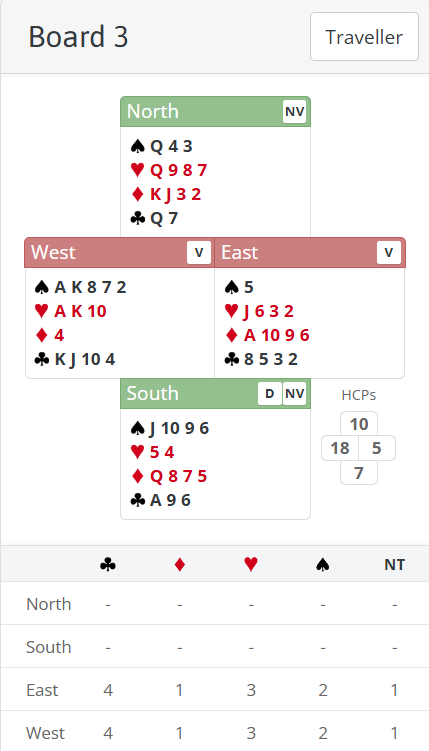
This week’s hand is once again taken from a recent SBC duplicate on Thursday 7th May. The hands were played at two separate venues at the same time. Quite a lot of East West pairs played the hand in 1♠ but, even though it made, that wasn’t the best option for them.
The auction will usually start P 1♠ P. The key decision is East’s about whether to respond. Traditional teaching says you need 6 points to respond but these days it’s becoming quite common to respond on less.
There are a few reasons for that:
- It’s becoming more common to open some very big hands at the 1 level because it makes the auction a lot easier (opening 2♣ or some other strong bid at the 2 level takes up a lot of bidding space so is increasingly being reserved for really big hands that are basically a game force). If partner can have as many as 21 points for a 1 level opening you need to respond on 5, and maybe even 4, to avoid the risk of missing game.
- Keeping the auction open makes it harder for the opponents as they don’t know the strength of your hand. If you pass, you advertise that your hand is really weak. Not only does this make it easier for them to decide whether to re-open, if they end up declaring later it also makes it easier for them in the play (you are known to have at most 5 points so once you have shown up with one honour card, they will know all the other significant cards must be in the other hand).
- There’s a chance of finding a much better fit in a 2nd suit.
The 3rd point is probably the most important here. East definitely doesn’t like spades. Anything partner might rebid would be better from his perspective! Also, it’s not as if his 5 points are bad – they include an Ace which is typically undervalued at 4 points.
So I’d definitely respond 1NT on East’s hand. It’s important to understand that, unlike most no-trump bids, this does not necessarily show a balanced hand. A 1NT response is basically made on any hand that has no biddable suit at the 1 level, isn’t strong enough to bid at the 2 level, but can respond. Suppose East had a hand with 6 points and a 1372 shape. He can’t bid 2♦ over 1♠ immediately as that would show at least 10 points so he has to respond 1NT. This also has implications for opener’s rebid – see advanced section for more.
Now what about West? I’d rebid 3♣ (the hand is too strong for 2♣) and East will be happy with that. Rebids after a 1NT response can be quite hard in terms of what strength each bid shows, what’s forcing, etc. There are bidding methods that can increase accuracy – there’s a convention called “Gazilli” where a 2♣ rebid is artificial and shows 16+ points, some pairs play a raise to 2NT as an artificial game force, or there are also transfer methods. Interested pairs can read up on these elsewhere (I have discussed the transfer methods in past columns).
Of course responding light won’t work all the time. If West rebids 2♠ or even 3♠, East will inwardly curse that he bid at all! But on balance there are more ways to improve things by bidding than there are to make things worse.
What about the play? In spades, North doesn’t have a particularly pleasant lead but most tried a diamond. This was fine on the hand. Declarer will win ♦A and most routes will lead to 8 tricks. He will eventually lose 2 trumps, 2 clubs and a heart. That is a score of +110.
But in clubs things can go better. Declarer can ruff his spades in the East hand. He is likely to lose just 2 clubs and a heart. So, even though clubs are a minor suit, that’s a score of +130. Declarer should be careful, however. He needs to immediately take spade ruffs. If he wins ♦A and plays a trump to the ♣J first North could win, return another trump for South to play ♣A and a 3rd round. Now declarer can only ruff one spade and will end up losing the 4th round of spades before establishing his 5th spade as a winner. Correct play is to cash ♠AK, ruff a spade, cross to ♥A and play a 4th spade. Yes North can ruff this with ♣Q in front of dummy but that’s ok – that’s a trump trick declarer was going to lose later anyway.
See advanced section for a further thought about North’s lead against a club contract.
Key points to note
It’s frequently worth stretching to respond to an opening bid with fewer than 6 points. This won’t always work but it has several ways to gain.
A 1NT response to a 1 level opening bid does not necessarily show a balanced hand (an exception to most no-trump bids).
If you have a 2nd suit, it’s almost always right to show it after a 1NT response from partner.
Leading trumps is often right when the opponents have had an auction showing clear preference for a 2nd suit.
More advanced
To take further the point about East preferring another suit, when he holds hearts that might even make game good. Give partner as little as ♠Axxxx ♥AKxxx ♦x ♣xx. That’s only a very minimum opening but opposite the East hand it will give good play for 4♥ – just losing 2 clubs and perhaps a trump. Even if partner is 5422 shape, hearts will play much better than spades. But you won’t find a heart contract if you pass 1♠!
That’s also a reason why, if he holds a 2nd suit, opener should almost always bid it after a 1NT response. But there’s another reason too. Besides increasing the chance of responder liking that suit, it also may enable him to show a long suit of his own that he couldn’t initially. Above I referred to East holding a hand with 6 points and a 1372 shape on which he would have to respond 1NT to 1♠.
But now over opener’s 2♣ rebid (say), he can bid 2♦ to show this sort of hand (or 3♦ over 3♣). Even with a 1327 shape he could bid 3♣ over a 2♦ rebid. Now he has shown his hand quite well. These bids cannot be forcing because responder is already limited to under 10 points from his 1NT bid. Unless he has a really big hand, 0pener should usually pass them as it will likely play much better in the weak hand’s long suit than it will in 1NT. But it’s only by the opening showing a 2nd suit that there’s a chance for responder to show that long suit in the first place.
What about a lead from North after the auction 1♠ 1NT 2♣ pass?
With nothing looking very appealing, strange though it might seem, I’d be tempted to try ♣7! East has shown a clear preference for clubs when he passes 2♣ so it’s likely declarer will want to ruff his spade losers and a trump lead might reduce his ability to do that. It’s frequently the case that a trump lead is right after an auction showing preference for a 2nd suit. Another time is often when the opponents are sacrificing and you want to remove as many trumps as possible since declarer won’t have as many high cards so will likely only score extra tricks from ruffing.
After ♣7 lead when South wins ♣A and returns a low one what would you do as declarer? You’d surely finesse wouldn’t you – playing South for ♣AQx? After all no-one is crazy enough to lead from Qx in trumps are they?! Getting 2 rounds of trumps played doesn’t particularly help the defence here, they need to get 3 rounds played to ensure a spade trick. But it would have been important had declarer only had ♠Axxxx since he would have now wanted to try and ruff 3 spades to set up his 5th one. An occasional odd lead like this also gains you a reputation for being sneaky – which might pay dividends at a later point against this declarer!
I was once given a tip that when the auction tells you to lead a trump you should do so almost regardless of your holding. Not long after I heard that, I tried it out. I led a low trump from Qx against a clear sacrifice from opponents. On the face of it that seemed crazy but it turned out to be essential. They had a 10 card fit but partner had singleton K. Therefore when I got in I could draw a 2nd round of trumps to reduce declarer’s cross ruffing ability. It was the only way for our side to take a 500 penalty instead of 300!
Julian Foster (many times NSW representative) ♣♦♥♠