The auction on today’s hand from an online pairs session might look quite strange but we’ll get to what happened and what the implications might be.
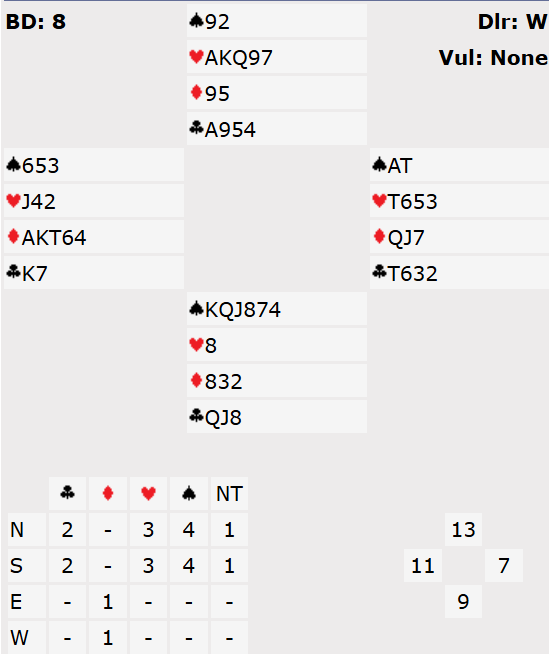
The auction went 1NT (11-14) Pass Pass 2♦. After that North South bid uncontested 2♥ 2♠ 3♦ 4♠.
Nothing was alerted. So what happened? South thought his 2♦ bid was showing a single suited major but North thought it was natural.
North’s 2♥ was normal (although personally I would have overcalled 2♥ over 1NT initially). South obviously then repeated his spades as he had nothing else to bid and North, still none the wiser, gave “preference” to 3♦. What do you think of South’s 4♠ bid at that point?
Both defenders thought South was showing at least 5 spades and 6 diamonds (he started with 2♦ and then bid spades twice – all apparently natural since nothing was alerted and no corrections were offered at the end of the auction). It soon emerged of course that he didn’t have that at all(!) but there actually wasn’t much to the play. 4♠ makes 10 tricks losing ♠A and 2 diamonds (South’s remaining losers being discards on dummy’s hearts). Even though the defenders have been misled by the auction can anything be done?
This is where we get into the murky world of unauthorised information and damage!
Unauthorised information is always a delicate matter. Basically when playing bridge a partnership is only entitled to communicate with each other by the bids made and the cards played. But of course there are lots of other ways in practice that information also gets conveyed, often completely accidental. The time it takes partner to do something, facial expressions(!), comments, alerts, explanations given to the opponents, etc. Any information acquired by these extraneous things is “unauthorised information” – i.e. information you are not entitled to know. If can of course be very difficult to identify this and then deliberately ignore it.
When partner takes a long time to do something that usually indicates they have a tricky decision and a choice of plays. That of itself is not a problem – bridge is not an easy game! Everyone is entitled to think and it’s often very important to do so! The point is your PARTNER is not entitled to use any information you may convey by hesitating. That aspect is not relevant to this hand, it’s the 2nd aspect about alerts that’s relevant here.
Anything said (or not said) by your partner in the way of alerts or explanations to the opponents is information purely for them (they are entitled to know your system agreement and bidding methods).
Returning to the auction, North has done nothing wrong at all – she thought her partner had diamonds and spades and bid accordingly (although holding such a good hand with a club stopper and partner bidding twice, there might be a case for her to jump to 3NT over the 2♠ bid). Once South jumped to 4♠ there wasn’t anything else North could do. But what about South? This is where it gets tricky. He is in possession of unauthorised information. You might ask what that information is? It’s the fact that his partner did not alert his 2♦. He knows from that that she think’s it is natural. But he is not allowed to know that! Imagine a screen between you and your partner (which is exactly what does happen at the top levels of many bridge events). Now you wouldn’t see whether partner did or didn’t alert – and that’s how it should be. South therefore must pretend he hasn’t seen partner not alerting 2♦ and continue to bid as he would have done in the belief he had already shown spades with his 2♦ bid. So, after he has repeated his spades over 2♥, partner has still bid another suit. She must really hate spades! What’s more she can’t have a strong hand since she didn’t bid over 1NT the first time. So it’s arguable that he should pass 3♦ – which he definitely prefers to hearts. It’s therefore possible that South’s 4♠ bid might have been influenced by the fact he knows partner actually thought 2♦ was natural.
That of course is quite subjective and South might well dispute it. As you can imagine things can get quite ugly with these situations and it’s where the director should be called. Sometimes it’s appropriate for an adjusted score to be awarded, sometimes it isn’t.
You might think it doesn’t make any difference. Sometimes it doesn’t. But sometimes the other side may have been damaged because they didn’t have the right information. I said above that both defenders on this hand thought South had 5 spades and 6 diamonds. That could have influenced their lead or defence. Another possibility is the score should be adjusted to what would reasonably have happened with South playing in 3♦ (probably going about 3 off!)
Which brings us to the question of whether South should have said something before the opening lead? That also depends – on two things:
Firstly it matters whether you are the declaring side or the defending side. As dummy or declarer you ARE obliged to correct a misexplanation or a failure to alert before the lead is made. As the defending side you must NOT do that. See advanced section for why.
Secondly, was there was a failure to alert or a misexplanation in the first place? That depends what the partnership agreement is. If they do play 2♦ as showing a major then South should have told the defenders that his 2♦ bid should have been alerted (at which point they would no doubt enquire more and find out what had happened). But if South had just made a mistake and 2♦ is in fact natural then he doesn’t need to say anything. (This was the case here). Of course that can also get messy as it’s sometimes hard to establish whether the pair actually have an agreement anyway (another reason why pairs are required to have convention cards at tournaments)! But the difference between a misbid (just forgetting your own system) and a misexplanation (telling the opponents the wrong thing) is very important.
Lastly if there has been a misexplanation that still doesn’t automatically entitle the opponents to an adjusted score. See Advanced section for more.
Key points to note
In bridge you are allowed to communicate with your partner by the bids you make and the cards you play, not by any other means (e.g. how long you take, facial expressions(!), etc).
Alerts are for the benefit of the opponents. If your partner does, or does not, alert your bid that’s also information you are not entitled to know.
At the end of an auction if your partner has not alerted a bid of yours that you think they should have done, or has misexplained a bid of yours to the opponents then:
- if you are the declaring side you should tell the opponents;
- if you are the defending side you should NOT say anything (it might give your partner further unauthorised information!)
There’s a difference between a misexplanation and a misbid.
Call the director in these situations. They can get delicate!
More advanced
It’s important to understand the difference between when you are the declaring side or the defending side. Why are the two different? Because only one of the declaring side will be playing the hand so giving extra information to their partner after the auction doesn’t matter. For the defending side both players are still going to be involved. So:
⁃ As declarer or dummy you ARE obliged to correct a failure to alert or a misexplanation of a bid by your partner. And you should do so at the end of the auction before the opening lead is made.
⁃ But as a defender you must NOT do that. The reason is you will be giving your partner unauthorised information as well (he may be blissfully unaware anything unusual has happened). You must instead wait for the end of the hand. Yes the declarer may have been misled by the auction and that might cause him to misjudge which defender might have what cards – but that has to be dealt with at the end of the play.
That brings us to the last point – damage. If there has been a failure to alert or a misexplanation that doesn’t automatically entitle the opponents to an adjusted score or a good result (despite what some players seem to think!). It’s a question of whether they have been damaged – i.e. would they have bid differently or played/defended differently had they had the right information? AND would that have actually made a difference? Only if the answer to both those is yes might an adjusted score be in order.
On the hand here, the defenders haven’t really been damaged in the play – it’s evident soon enough that South doesn’t have the 56 shape they initially thought he did from the auction, and there isn’t any alternative defence they could have come up with even if they did know what had happened. The damage is the fact that South could perhaps have made use of the unauthorised information by bidding on over 3♦. In the event no further action was taken – because this took place in a small friendly Thursday evening online club game. In a more serious tournament, it might have been taken further – to establish what North South’s agreement was and whether North had failed to alert 2♦ or whether South had simply misbid.
Julian Foster (many times NSW representative) ♣♦♥♠