Today’s hand is taken from the SBC Fixed Income Solutions Christmas in Winter teams congress held on Sunday 2 August 2026.
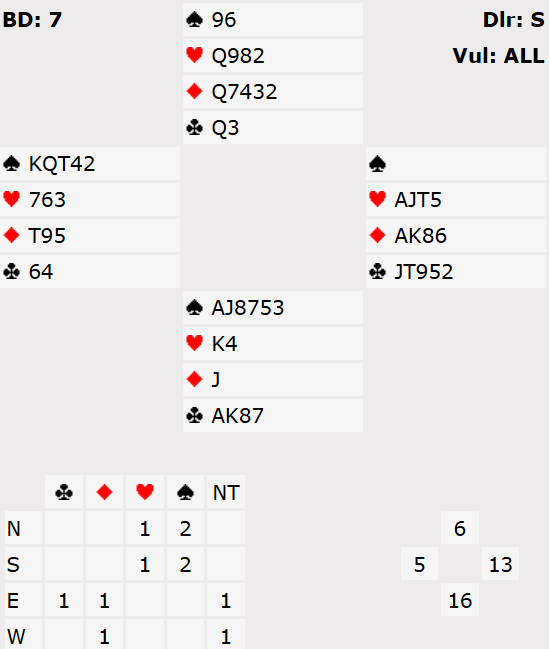
Board 7 from the 1st match was a potentially unpleasant experience for North South with several incurring significant penalties when they got doubled in spades: https://nsw.bridgeaustralia.org/showtraveller.asp?id=679319&board=7&pair=
The normal start to the auction will be 1♠ P 1NT. Now what?
As East I would now have doubled. This is basically takeout of spades – North hasn’t bid any suit with 1NT so it’s very similar to doubling over an opening 1♠. South will most likely rebid either 2♣ or 2♠. If he chooses 2♣ (which is what I would do – see advanced section for why) West will pass but now North will innocently give preference back to 2♠. This time West might double as he has a nasty spade holding lying over South! If South rebids 2♠ then the question is what is double by West? It’s not automatic that it’s penalties – this is definitely something that experienced pairs should discuss. See advanced section for more.
Regardless of how they got there, quite a few pairs did end up in 2♠x. One or two unlucky pairs got even higher (the South hand is quite powerful with its 64 shape so it’s certainly not unreasonable to bid more agressively – although it works very badly today with the horrible layout on this particular hand!)
Let’s now switch to South’s perspective. Suppose initially you are in 2♠ (not doubled). West is likely to lead a red suit (knowing he’s likely to be sitting with at least 3 trump tricks). How would you go about playing it? You’d probably try to ruff a club in the North hand and then play 2 rounds of trumps hoping for a 3-2 split. If everything behaves nicely that way you’d make 9 tricks losing 2 spades, 1 heart and 1 diamond. On this hand if you tried that line, you’d have an unpleasant surprise on the 2nd round of spades!
How might things change if you are doubled? Well, now you would know that all the spades were sitting over you so trying to draw trumps is futile. So can you do something different? Yes. You can in fact make 2♠ doubled – no doubt to West’s dismay! In general what you want to do is set up your side suit tricks and cash them before anyone can ruff. Plus you want to try and score some small trumps in your own hand (perhaps with diamond ruffs). If you don’t play trumps yourself but exit in the red suits, the defence may have to exit themselves in a red suit and allow you to score more small trumps. That way, even though he may well end up with more trumps than you, West may end up having to trump his partner’s red suit winners and lead back to your ♠AJ. See advanced section for a plausible sequence of play.
This leads us to an important point. When West doubles 2♠ he tips declarer off that spades are breaking very badly. This is often worth a trick because declarer now knows to play the hand differently. The most expensive doubles of all are the ones that actually cause declarer to play a hand in such a way that he NOW makes the contract. Whereas had you kept quiet he would never have known to play the hand that way. Generally therefore, especially when playing imps, you want to be very wary about doubling partscores unless you are pretty confident they are going at least 2 off. For example doubling 2 major making is -470 or -670. Greed can end up being very costly at bridge!
Key points to note
After the auction 1A pass 1NT it’s usual to play double as takeout of A.
A 1NT response to a 1 level opening bid does not promise a balanced hand – it’s just any hand that can’t raise, has enough to respond but not enough to bid at the 2 level. So that could easily include a 6 point hand with a 7 card suit, say.
If the opponents have bid a suit, you pass, partner makes a takeout double and then they repeat their suit it’s important to know whether your double is penalty (having passed over their suit the previous round) or still takeout. One for experienced partnerships to discuss.
When you are doubled, it usually tips you off that trumps are breaking badly. This may well change your line of play. If you can scramble some small ruffs in your own hand, the defender with all the trumps may end up getting endplayed later or be forced to ruff his partner’s winners.
For the same reason as a defender allow for that. Be wary of doubling partscores at teams unless you’re pretty confident it’s going at least 2 off. It’s particularly expensive if 2 major doubled makes as that’s now game!
More advanced
Why would I prefer to rebid 2♣ on the South hand despite holding 6 spades? Two main reasons. Firstly it’s showing more of your hand – partner could easily have clubs. Playing teams it’s less important to play in a higher scoring major, it’s more important to find your fit and get to a makeable contract if you can. Secondly partner does not have to be balanced for his 1NT response. This is a commonly misunderstood auction but a 1NT response just shows any hand that can’t raise spades, has enough to respond, but not enough to bid a new suit at the 2 level. That means partner might be sitting there with a long red suit. Rebidding 2♣ gives him the chance to bid that suit at the 2 level, rebidding 2♠ doesn’t. In particular if partner has 6 hearts, you will be happy to pass 2♥. If he bids 2♦ you can still bid 2♠ now.
After the auction 1♠ P 1NT X 2♠ there is definitely a case for double to be penalty (you passed over 1♠ originally and now you are doubling 2♠) but there’s also a case for it to still be takeout (probably with only 3 hearts or you’d just bid hearts which partner will have for their takeout double nearly all the time). Such a double is known as “responsive”. It’s obviously important to know what your partnership plays it as. If you do play it as responsive then with a penalty double West just has to pass again and hope East can re-open a 2nd time.
So how might the play go in 2♠x? The defence may well start with a diamond to the ♦K, now East can’t safely play another diamond so he is likely to switch to ♣J. Here you can win ♣Q in dummy, take a diamond ruff in hand (not something you’d generally do if you were trying to draw trumps – but here it’s just ensuring you score some small trumps). Now you might play ♥K to set up a trick there. East does best to duck this but if he errs and wins ♥A, now you can later play a heart to ♥Q and score another red suit ruff in hand. If 3 rounds of clubs stand up, you are now looking OK – 3 clubs, 1 heart, a couple of ruffs in hand with small trumps, ♠A and ♠J would end up with 8 tricks. On this hand only 2 clubs stand up but that ♠9 in dummy is still extremely useful! West can ruff the 3rd round of clubs with ♠10 but that’s basically ruffing one of your losers with a trump trick he was going to make anyway. If he tries ♠K now, you can win ♠A and lead your 4th club. Once again you are threatening to score the ♠9 in dummy unless he trumps in with yet another top trump (and each time he trumps in, his trumps are getting shorter so your long trumps will now be able to draw his remaining small ones – your ♠87 are now becoming very powerful!) Effectively the defence end up scoring 3 trump tricks and 1 trick in each red suit. That could be a very handy +670! Only one pair did that at the table but it is a demonstration of how it becomes possible if the double has tipped you off about the bad trump break.
Julian Foster (many times NSW representative) ♣♦♥♠