
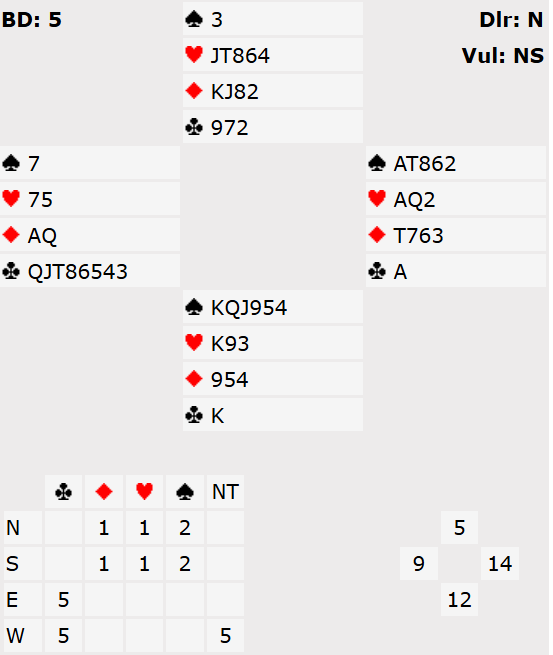
Many bridge tournaments are won and lost because of simple carelessness. It’s almost impossible to maintain 100% concentration all of the time but a simple little slip can often prove costly. Today’s hand is an example.
First, however, the auction. North passes, East opens 1♠ and South, all ready to open 1♠ himself, will have to quickly adjust and pass – hoping no doubt that the opponents are about to get into a mess!
The first key decision is what West decides to do. This will depend partly on their system. If they are playing a 2 level response over a 1 level opening is game forcing then West can’t really start with 2♣ and will have to start with 1NT. As I have mentioned in previous columns, a 1NT response to a 1 level opening is a bit of an exception to the norm because it does NOT show a balanced shape. It’s really just a “catch all” for a hand that has a response but can’t bid a suit at the 2 level. This is an extreme example of that principle.
If East West are playing methods where a 2 level response is not game forcing then West has to decide whether to bid 1NT or 2♣ (which normally shows 10+ points). Personally I would stretch to bid 2♣ on the hand – you do have 8 of them! Played in clubs your hand is worth at least 7 tricks (6 clubs and ♦A) but in any other denomination your hand could be worth just one trick (♦A). A tip I was once given is that 8 card suits are trumps! There’s a lot to be said for that.
At our table, however, the West player decided to start with 1NT. Fortunately for her, East rebid 2♦ (another downside of 1NT here is that East might pass it and you could be in a ludicrous contract). Then, after much thought, she jumped to 5♣ which became the final contract. See advanced section for more discussion on this.
But let’s now shift to the play. Against 5♣ North chose to lead his singleton spade which declarer won with ♠A. She cashed ♣A and was no doubt delighted to see South follow with his ♣K. There are now 11 tricks (8 clubs and 3 aces). However, declarer decided to now take a diamond finesse which lost. North returned ♥J and she finessed ♥Q which also lost to ♥K. At this point South played ♠K and, after much thought, declarer ruffed high, drew the remaining trumps and claimed 11 tricks.
Seems normal? Maybe. What might South have done differently? See advanced section for the answer.
Finally, returning to the auction – suppose West did decide to bid 2♣ initially. East will now rebid 2♦. Now what? Maybe 4♣? You basically don’t want to play this hand in anything except clubs – it’s purely a question of what level. But 3♣ feels a bit wet – you’d do that with a minimum 10 points and 6 clubs. Here, although you have fewer points, you have 8 clubs which is more powerful but also makes it even more imperative to play the hand in clubs. Over 4♣ East should raise to 5♣. That might seem odd with only 1 trump but a singleton honour makes playing in no-trumps extraordinarily unattractive. Besides, he also has 2 aces which are always good cards but especially so when you know partner is relatively short in all the side suits since he surely has a minimum of 8 clubs.
Key points to note
A 1NT response to a 1 level opening bid does not show a balanced hand. It’s just a placeholder bid for any hand that can’t raise, can’t bid a new suit at the 1 level, and isn’t strong enough to bid a new suit at the 2 level.
8 card suits should be trumps! That’s one of the sounder rules at bridge.
Always keep in mind what information is known by the various players. Sometimes you know something that no-one else does – maybe you can use that to your advantage?
Opponents are not perfect. When defending if you give declarer a chance to make a mistake, every so often he will oblige – even if the contract is 100% cold!
More advanced
West’s actions on the hand were very inconsistent. Can you really have a hand that can only respond 1NT initially (risking partner passing which could have been ridiculous) and then, after a minimum rebid of 2♦, NOW decides to bid 5♣? Surely any hand that was prepared to go to 5♣ initially should have started with 2♣? Otherwise bid 1NT to start with and then only bid 4♣.
After the play discussed above, what should South do when in with ♥K? At that point the defence already have 2 tricks so only need one more to defeat the contract. South has seen all 13 spades so he knows both partner and declarer have none left. It’s clear to play a spade since that might genuinely be promoting a trump trick for partner. But which one?
The natural instinct is to play ♠K. But it’s always critical at bridge to appreciate what knowledge each player has about the hand – and it’s not the same! Here, South knows the full distribution of the spade suit at trick 1. But no-one else at the table knows that and the auction hasn’t revealed it either. What’s more North has led ♠3 which, from declarer’s point of view, could be a low card led from a regular honour holding. So a much better play by South is an innocent low spade!
If that happens, how many declarers wouldn’t even think about it and just instinctively ruff low? If they do, they have just managed to go off in a cold game when North overruffs. Lazy? Yes. Careless? Yes. Should declarer fall for it? No, of course not! After the 1st round of trumps, there are only 2 left and he has the top 3 remaining clubs in his own hand so it costs him nothing to ruff high regardless. As soon as ♣K dropped, he had 11 cold tricks (8 clubs and 3 aces). In fact playing teams it was risky to even take the diamond or heart finesses since either suit could split really badly and he might potentially go off with an unforeseen ruff.
Another reason for declarer to ruff high is he should ask himself why did North lead dummy’s 1st bid suit? That’s usually a pretty poor lead. Surely it can only be because it’s a singleton? It’s easy to analyse that here. But in the heat of the moment at the table it’s not so easy.
The point here is a low spade return from South gives declarer an added opportunity to slip concentration and make a mistake. The ♠K return, on the other hand, might wake declarer up to what is going on. South has nothing to lose by trying – give declarer some rope and see if he hangs himself!
Julian Foster (many times NSW representative) ♣♦♥♠






Nice hand, Julian, and solid principle too. I’ve slowly forced myself to move from “ruff low unless you know you need to ruff high” to “ruff high unless you know you can’t afford it.” On this hand, declare should actually return to hand after AC not with QD, not even with AD, but ruffing a spade high.